
Jazz is an American art form built on improvisation, a swung rhythm, expressive blue notes, and rich, extended harmony. Born among African American musicians in early-1900s New Orleans, jazz fused West African rhythm, the blues, ragtime, and brass-band tradition into a music where the players invent their parts in real time, so no two performances of the same tune sound quite alike.
This guide explains what jazz actually is, where it came from, how to recognise it by ear, the acoustic combo that gives it its timbre, its major eras from Dixieland to fusion, how it differs from blues and soul, and the artists worth knowing first. Curious whether a recording is jazz? Run it through the free AI music genre detector. It listens for the swing, the improvised solos, and the extended chords that set jazz apart, then tells you how strongly the clip points that way.
What Is Jazz?
Jazz is defined by a process as much as by a sound: musicians take a tune's melody and chord changes and then improvise new melodic lines over them, often trading solos in turn. Where pop fixes every note in advance, a jazz performance is partly composed on the spot.
Three traits make jazz instantly recognisable. First, the swing feel: eighth notes are played unevenly, long-then-short, giving the rhythm its loping, propulsive lilt. Second, blue notes: flattened thirds, fifths, and sevenths bent for expressive, vocal-like inflection inherited from the blues. Third, harmonic depth: jazz favours seventh, ninth, eleventh, and thirteenth chords and frequent key shifts, giving even simple tunes a sophisticated colour. Add the back-and-forth of a small acoustic group, and you have jazz.
History & Origins
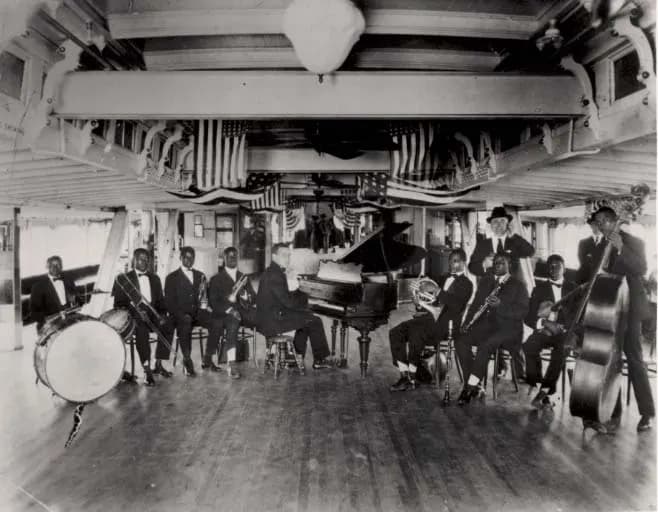
Jazz took shape in New Orleans in the early 1900s. As a busy port city, New Orleans let African, Caribbean, and European musical traditions intermingle freely; African American musicians blended West African polyrhythms, the call-and-response of spirituals, the blues, and the syncopation of ragtime with the city's brass-band instruments. Early New Orleans jazz centred on collective improvisation, where several horns wove independent lines around the melody at once. Louis Armstrong, whose virtuoso trumpet and gravelly vocals turned the soloist into the music's star, carried this New Orleans sound to Chicago and the world in the 1920s.
In the 1930s and 40s, jazz became America's pop music in the swing era: large, arranged big bands led by figures such as Duke Ellington and Count Basie filled dance halls with hits like "One O'Clock Jump." Ellington, a composer as well as a bandleader, treated his orchestra as a single instrument and wrote a large body of work for it.
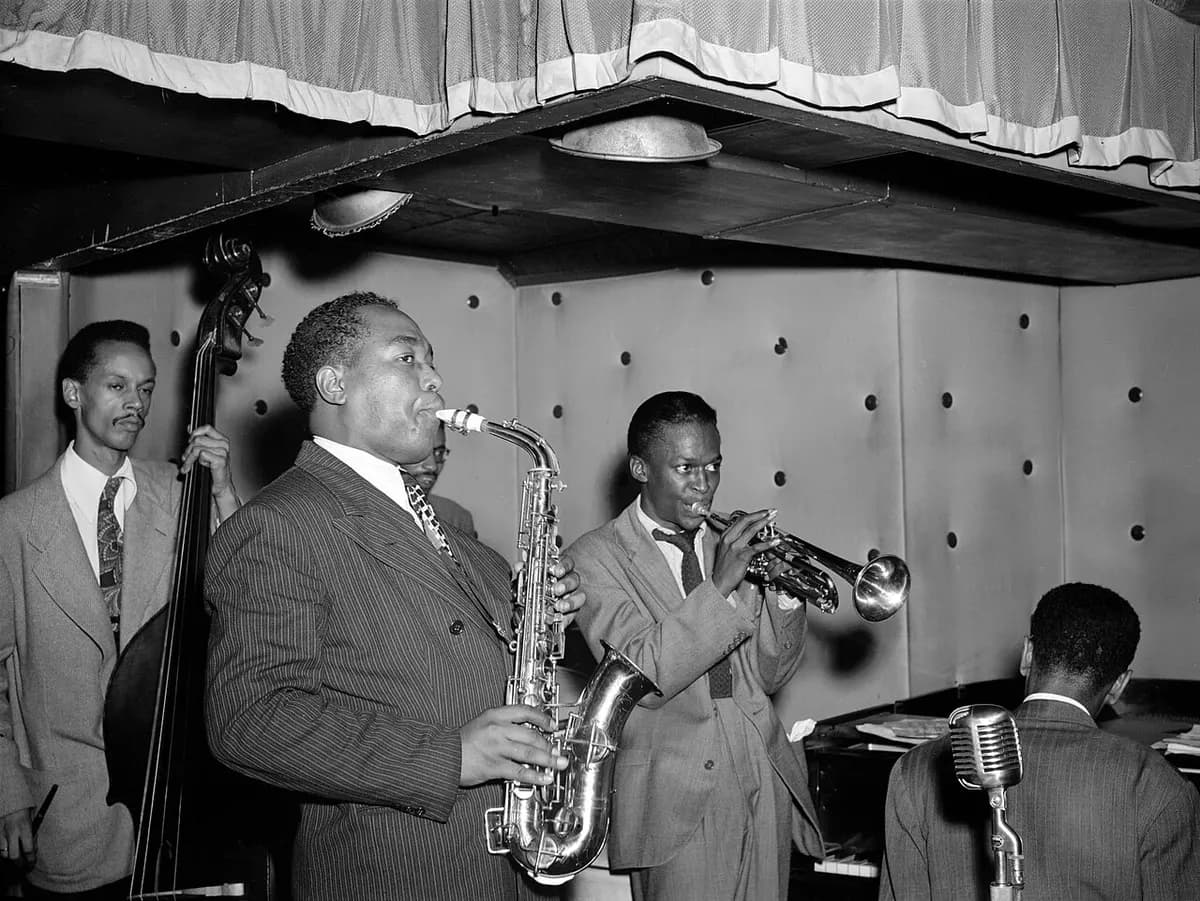
By the mid-1940s a younger generation reacted against swing's commercialism with bebop: fast tempos, complex melodies, and harmonically dense improvisation meant for close listening. Charlie Parker (alto saxophone) and Dizzy Gillespie (trumpet) reshaped what improvisation could be. From there jazz splintered fast: the relaxed cool jazz of the early 1950s, the modal jazz of Miles Davis's Kind of Blue (1959), and the spiritual intensity and eventual free jazz of John Coltrane and Ornette Coleman. In 1969–70 Davis switched to electric instruments, launching jazz fusion.
Key Characteristics & Sound
You can usually identify jazz by these traits:
- Improvisation: soloists invent melodies in real time over the tune's chord changes, the defining feature of the genre.
- Swung rhythm: uneven, long-short eighth notes that create the propulsive "swing" feel, anchored by a walking bass and ride-cymbal pulse.
- Blue notes: flattened, bent thirds, fifths, and sevenths borrowed from the blues for vocal-like expression.
- Extended harmony: seventh, ninth, eleventh, and thirteenth chords, substitutions, and frequent modulation.
- Syncopation & interplay: accents off the beat and constant conversation between players.
- Acoustic combo timbre: saxophone, trumpet, piano, upright bass, and brushed or ride-driven drums.
If you hear a small acoustic group swinging behind a soloist who is clearly making the melody up as they go, over chords richer than simple major and minor triads, you're almost certainly hearing jazz. The feel and tempo shift sharply from one era to the next:
| Era / Substyle | Peak Years | Feel | Typical Tempo |
|---|---|---|---|
| Dixieland (New Orleans) | 1900s–1920s | Collective, joyful, marching brass | Medium–fast |
| Swing / Big Band | 1930s–1940s | Danceable, arranged, smooth | Medium–fast |
| Bebop | 1940s–1950s | Intricate, virtuosic, headlong | Very fast |
| Cool Jazz | 1950s | Relaxed, restrained, lyrical | Medium–slow |
| Modal Jazz | Late 1950s–1960s | Spacious, scale-based, open | Medium |
| Free Jazz | 1960s | Abstract, atonal, untethered | Variable |
| Fusion | 1970s onward | Electric, funky, rock-driven | Medium–fast |
Instruments & The Jazz Combo
Jazz is overwhelmingly acoustic, and its core ensemble, the "combo", gives the genre its unmistakable timbre:
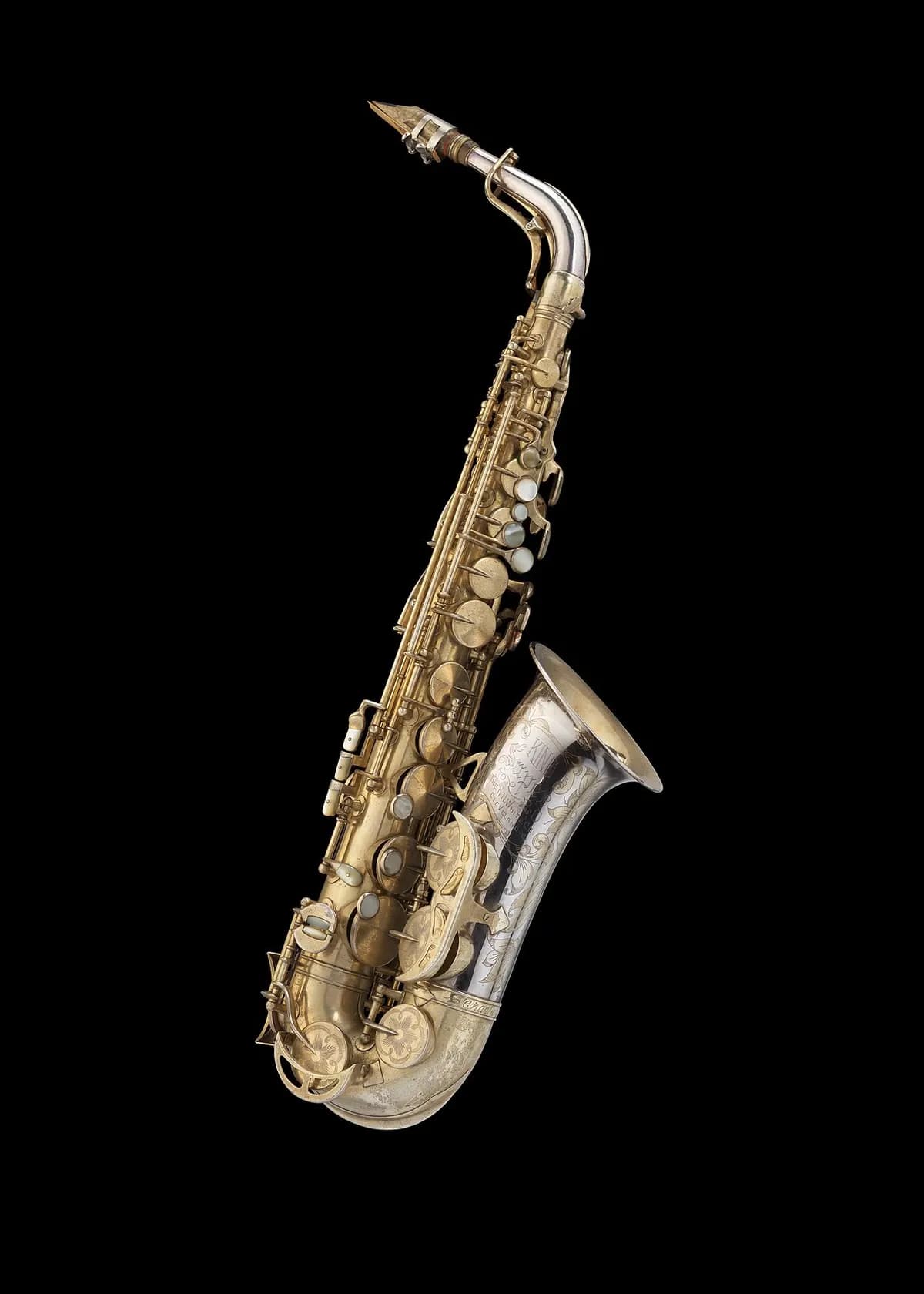
- Saxophone: the voice of modern jazz, from Charlie Parker's alto to John Coltrane's tenor. Agile and vocal, it suits fast bebop lines.
- Trumpet: the lead horn since Louis Armstrong, bright and declamatory, often muted for a softer, conversational tone (Miles Davis's signature).
- Piano: supplies chords ("comping") and harmony, and steps out as a solo voice; the harmonic anchor of the band.
- Upright (double) bass: the walking bassline that outlines the chords and drives the swing, usually plucked (pizzicato).
- Drums: the engine of swing, built on a ride-cymbal pulse, brushed snare, and off-beat accents.
Larger ensembles add full sections of brass and reeds (the big band), and guitar, vibraphone, or organ appear often. From the 1970s, fusion brought in electric guitars, electric piano, and synthesisers, but the acoustic sax-trumpet-piano-bass-drums quintet is still the sound most people picture when they think "jazz."
Subgenres of Jazz
Jazz has reinvented itself every decade. The essential styles:
- Dixieland (New Orleans / Trad Jazz): the original 1900s–1920s sound, built on collective improvisation and brass-band instrumentation.
- Swing: the 1930s–40s big-band era of arranged, danceable jazz led by Ellington and Basie.
- Bebop: fast, harmonically complex small-group jazz for listening, pioneered by Parker and Gillespie.
- Cool Jazz: the relaxed, understated 1950s counter to bebop's intensity, associated with Miles Davis's Birth of the Cool and the West Coast.
- Modal Jazz: improvisation over scales/modes instead of fast-moving chords, defined by Davis's Kind of Blue (1959).
- Free Jazz: abstract, often atonal music that discards fixed chords and tempo, led by Ornette Coleman and late Coltrane.
- Fusion: jazz improvisation fused with rock and funk and electric instruments, launched by Davis's Bitches Brew (1970).
Many of these neighbour other genres: jazz's roots run straight into the blues, fusion borrows the backbeat of funk, and soul-jazz sits close to soul.
Jazz vs Blues vs Soul
Jazz, blues, and soul share African American roots and a feel for the blue note, but they part ways on harmony, rhythm, and purpose:
| Trait | Jazz | Blues | Soul |
|---|---|---|---|
| Origin | New Orleans, early 1900s | Deep South, ~1900s | US, late 1950s–60s |
| Core focus | Improvisation & harmony | Emotional vocal expression | Vocal groove & feeling |
| Harmony | Extended, complex chords | Simple 12-bar I–IV–V | Gospel-rooted chords |
| Rhythm | Swung, syncopated | Shuffle / straight backbeat | Tight backbeat groove |
| Typical form | Head + open solos | 12-bar repeating verse | Verse–chorus song |
Notable Artists & Recordings
A handful of artists map the whole history of jazz:
- Louis Armstrong: the trumpet virtuoso who made the improvised solo central to jazz; "West End Blues," the Hot Five and Hot Seven sides.
- Duke Ellington: composer and bandleader of the swing era; "Take the 'A' Train," "Mood Indigo."
- Charlie Parker: co-founder of bebop on alto sax; "Ko-Ko," "Ornithology."
- Miles Davis: a central figure in cool, modal, and fusion jazz; Kind of Blue, Bitches Brew.
- John Coltrane: tenor saxophonist known for "sheets of sound" and spiritual jazz; Giant Steps, A Love Supreme.
- Thelonious Monk, Dizzy Gillespie, Bill Evans, Ella Fitzgerald: key names in composition, bebop, piano, and vocal jazz.
Start with Kind of Blue for modal calm, Parker's "Ko-Ko" for bebop fire, and Armstrong's "West End Blues" to hear where the soloing began.
Jazz Around the World & Today
From New Orleans, jazz became a global language. Europe embraced it early (gypsy jazz emerged in 1930s France around Django Reinhardt), and the genre seeded distinct scenes from Scandinavia (the ECM sound) to South Africa, Brazil (bossa nova's jazz-samba fusion), and Japan.
Jazz keeps changing. The London scene and players like Kamasi Washington, Robert Glasper, and Esperanza Spalding fuse jazz with hip-hop, electronic, and neo-soul, while jazz harmony and improvisation run through much of modern R&B and beat-driven music.
How AI Detects Jazz
An AI genre detector identifies jazz by listening for a very different fingerprint from electronic or pop music. Instead of a rigid four-on-the-floor grid, it picks up the uneven swing ratio of the rhythm and the ride-cymbal pulse; it flags the harmonic complexity of extended and altered chords; and it recognises the acoustic combo timbre of saxophone, trumpet, upright bass, and brushed drums. Long improvised solo lines that never quite repeat are themselves a strong jazz signal.
Watch it happen in seconds: open the Genre AI music genre detector, let it sample a few bars of any recording, and it will report whether the clip lands as jazz and often which era. To follow how the model reasons its way from audio to a label, read how AI music genre detection works.
In our own listening tests, Genre AI's model commits to Jazz most readily when a swung rhythm rides a walking upright bass, an improvised solo unfolds on saxophone or trumpet, and the harmony leans on extended, complex chords instead of plain triads. Plug the band in and let a backbeat take charge, and the weighting tilts toward Fusion or funk; pare the harmony down to a 12-bar shape, and Blues climbs the order. Those shifting pulls are why a jazz read arrives as a set of confidence scores, each one marking how close the clip sits to a neighbouring style.