
Classical music is the written tradition of Western art music: works composed, notated, and performed over more than a thousand years, from medieval chant to today's film scores and concert halls. The word has two meanings that are easy to confuse. In everyday speech, "classical" is shorthand for the whole tradition of Western art music. Among musicologists it names one era, the Classical period of roughly 1750–1820, the age of Haydn, Mozart, and the young Beethoven. This guide uses the broad sense unless it says otherwise.
Below we untangle those two meanings, walk through the six historical eras, explain the orchestra and the forms (sonata, symphony, concerto, opera), compare classical with jazz and ambient, and name the composers worth knowing. Not sure whether a piece counts as classical? The free AI music genre detector listens for blended acoustic timbres, wide dynamic swings, and the absence of a drum machine, then reports how classical the clip reads.
What Is Classical Music?
Classical music is art music rooted in Western traditions, set apart above all by a system of staff notation that lets a composer fix pitch, rhythm, dynamics, and instrumentation precisely on the page. Where folk and most popular music pass down by ear and improvisation, classical music is largely a written tradition: a score by Bach or Mozart can be performed faithfully centuries after it was composed, by musicians who never met its author.
Writing the music down is what allows its complexity: many independent voices, movements and works lasting thirty or forty minutes, and harmonic plans worked out bar by bar. Listeners value it for craft and form as much as for groove. Be careful with the label, though. "Classical" with a capital C means the 1750–1820 era specifically (think clean, balanced Mozart), while "classical music" in lower-case casually covers the entire span from medieval plainchant to twenty-first-century composers. Both senses are correct; context tells you which is meant.
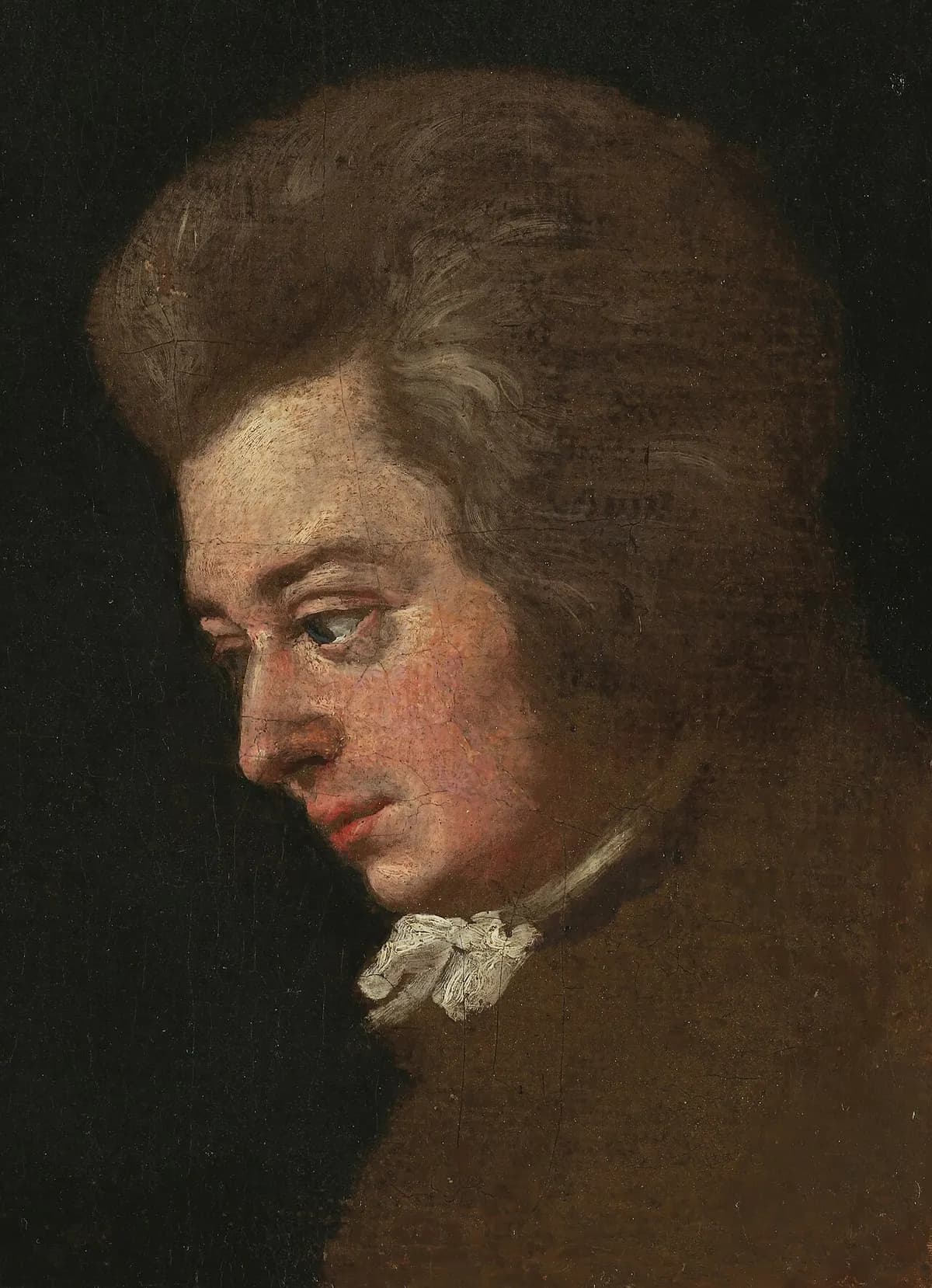
History: The Six Eras
Historians divide Western art music into broad periods. The dates are a rough guide, since styles overlapped and changed at different speeds in different countries.
- Medieval (c. 500–1400): sacred plainchant (Gregorian chant), sung in unison, gives way to early polyphony as composers begin layering independent melodic lines. Musical notation develops in this period; around 1030 the monk Guido of Arezzo described the staff lines and pitch syllables that modern notation grew from.
- Renaissance (c. 1400–1600): interweaving vocal polyphony fills the motets and masses of composers like Josquin des Prez and Palestrina, alongside secular madrigals. Harmony grows smoother and more consonant.
- Baroque (c. 1600–1750): ornamented, dramatic, and contrapuntal. Opera appears in Italy around 1600 (Monteverdi's L'Orfeo followed in 1607), the orchestra takes shape, and J.S. Bach writes the fugues still used to teach counterpoint. Vivaldi wrote hundreds of concertos and Handel made the English oratorio popular.
- Classical (c. 1750–1820): a turn toward clear textures, balanced phrases, and singable melody. Haydn, Mozart, and the early Beethoven settle the shape of the symphony, the string quartet, and sonata form.
- Romantic (c. 1820–1900): bigger orchestras, bolder harmony, personal expression, and the touring solo virtuoso. Beethoven's late works lead into Chopin, Brahms, Wagner, and Tchaikovsky.
- 20th-century & Modern (c. 1900–present): no single style dominates. Debussy's impressionism, Stravinsky's irregular rhythms, Schoenberg's atonality, later minimalism (Reich, Glass), and film scoring all run side by side.
The term "classical music" only appeared in the early 19th century, when writers began to hold up the music from Bach to Beethoven as a golden age. The label then spread from that canon to the whole tradition.
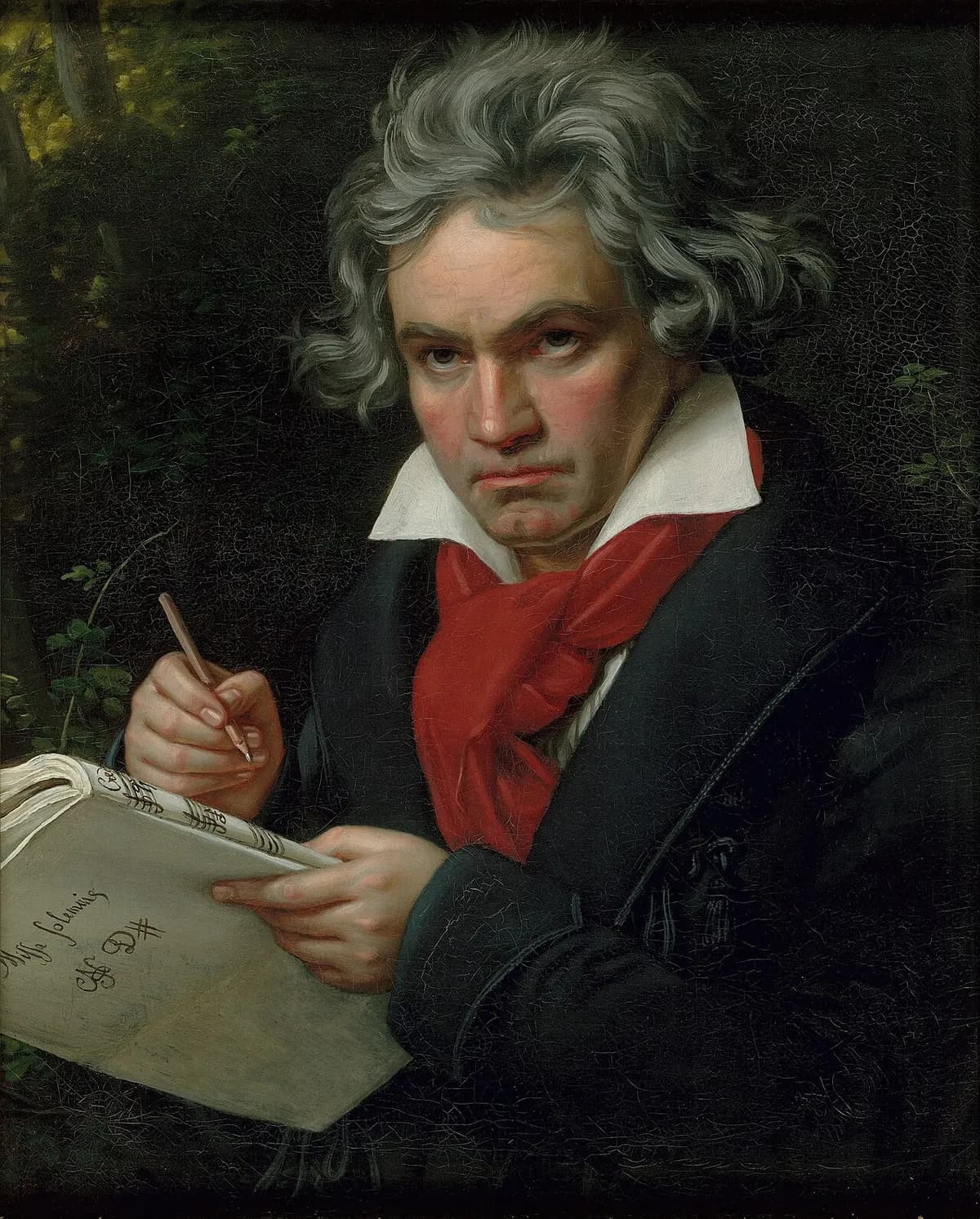
Key Characteristics & Sound
Across its eras, classical music shares a recognisable set of traits:
- Notation: composed and written out in detail, so the same score can be performed for centuries.
- Acoustic timbre: played instruments (strings, woodwinds, brass, percussion, piano, voice), not synths or drum machines.
- Dynamic range: huge swings from a barely audible whisper (pianissimo) to a full-orchestra roar (fortissimo), often within a single phrase.
- Form: long structures such as sonata form, theme and variations, rondo, and fugue, where pop uses verse and chorus.
- No fixed beat grid: tempo flexes with rubato and ritardando, and there is rarely a steady looping pulse to nod to.
- Harmonic depth: functional harmony, modulation between keys, and counterpoint (multiple independent melodies at once).
If you hear acoustic instruments swelling and receding in volume, melodies that keep developing over several minutes instead of looping, and no electronic beat anywhere, you are almost certainly hearing classical music. The character changes a great deal by era:
| Era | Approx. years | Defining traits |
|---|---|---|
| Medieval | 500–1400 | Plainchant, early polyphony, sacred |
| Renaissance | 1400–1600 | Smooth vocal polyphony, motets, madrigals |
| Baroque | 1600–1750 | Ornate counterpoint, fugue, birth of opera |
| Classical | 1750–1820 | Clarity, balance, sonata form, symphony |
| Romantic | 1820–1900 | Emotion, large orchestras, virtuosity |
| 20th-c. / Modern | 1900–present | Atonality, rhythm, minimalism, film score |
The Orchestra & Its Instrument Families
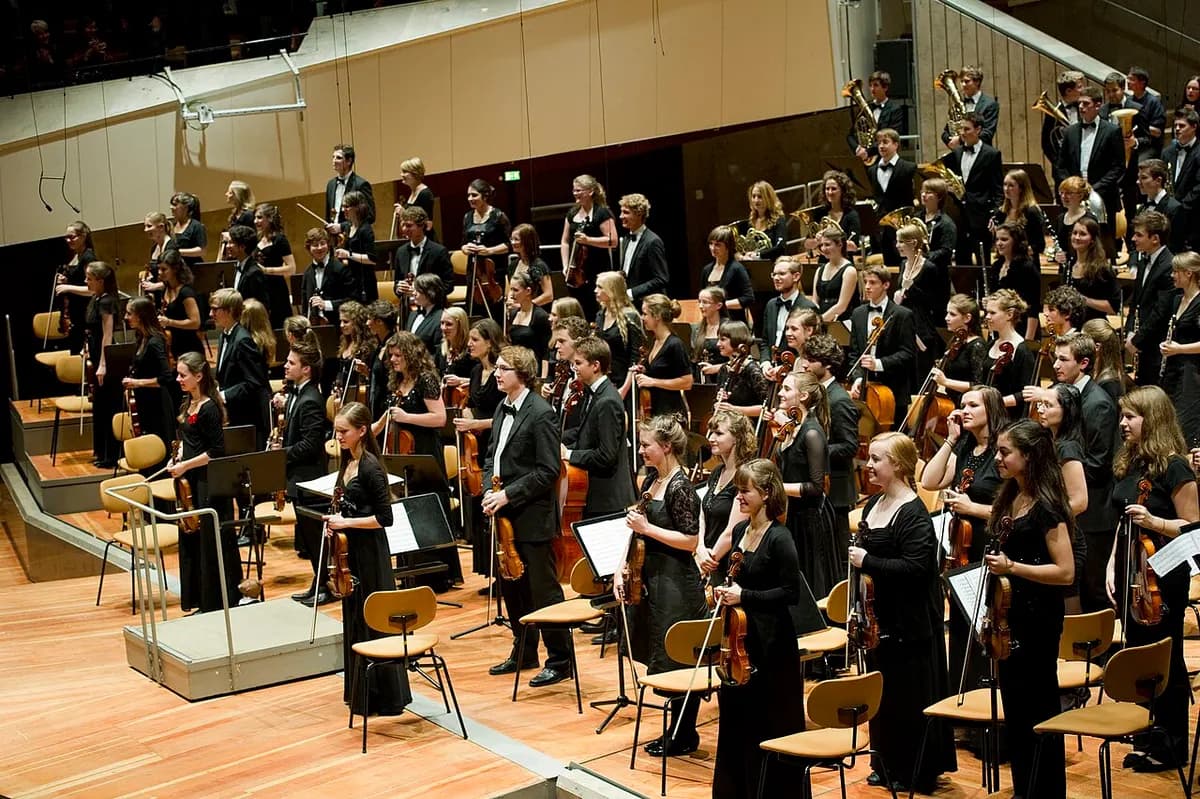
The symphony orchestra is classical music's main large ensemble. It is organised into four families, and a full score lists them in a fixed order from top to bottom:
- Strings: violins (first and second), violas, cellos, and double basses. This is the largest section and carries most of the melody and harmony. The harp is usually grouped here too.
- Woodwinds: flutes and piccolo, oboes and cor anglais, clarinets, and bassoons, used for agile solo lines and colour.
- Brass: French horns, trumpets, trombones, and tuba, which supply weight, volume, and fanfares.
- Percussion: timpani (tuned kettledrums) plus snare, bass drum, cymbals, triangle, xylophone and more, used for accents and colour.
Two instruments sit slightly apart. The piano is central to chamber music and the solo concerto but is not a standard orchestral seat; the human voice anchors opera, oratorio, and choral works. Beyond the orchestra, smaller chamber groupings, the string quartet above all, let a handful of players converse as equals. None of these instruments needs electricity; the sound comes from vibrating strings, reeds, lips, skins, and air columns.
Forms & Genres Within Classical
Classical repertoire is usually sorted by form (how a piece is built) and by ensemble, not by subgenre. The essentials:
- Symphony: a large, usually four-movement work for full orchestra, the central orchestral form of the Classical and Romantic eras (Beethoven's Fifth and Ninth).
- Sonata: a multi-movement work for a solo instrument or small group; "sonata form" is also the internal blueprint (exposition–development–recapitulation) used across the repertoire.
- Concerto: a soloist set against the orchestra, alternating display and dialogue (Vivaldi's "Four Seasons," Tchaikovsky's piano concertos).
- Opera: sung drama with orchestra, staging, and voice (Mozart's "Don Giovanni," Wagner's "Ring").
- Chamber music: music for a small ensemble with one player per part; the string quartet is the best-known format.
- Choral & sacred: masses, requiems, oratorios, and cantatas (Bach's "Mass in B Minor," Handel's "Messiah").
- Solo & character pieces: nocturnes, études, preludes and the like, especially for piano (Chopin's nocturnes).
- Contemporary & minimalist: twentieth- and twenty-first-century concert music, from Stravinsky to Steve Reich and Philip Glass.
These forms cut across the eras. Haydn's Symphony No. 104 (1795) lasts under half an hour; Mahler's Second (1894) runs about 80 minutes and adds a choir, two vocal soloists, and offstage brass.
Classical vs Jazz vs Ambient
Classical is sometimes lumped with other "non-pop" instrumental music, but it differs sharply from jazz and from ambient electronic music in how it is made and what it values:
| Trait | Classical | Jazz | Ambient |
|---|---|---|---|
| Created by | Composed & notated | Improvised over changes | Programmed/produced |
| Core sound | Acoustic orchestra & voice | Acoustic combo, swing feel | Synths, drones, texture |
| Rhythm | Flexible, no beat grid | Swing & syncopation | Slow, often beatless |
| Structure | Long architectural forms | Head + solos | Evolving, loop-based |
| Dynamics | Very wide (ppp–fff) | Moderate to wide | Subtle, sustained |
Notable Composers & Works
A short list of composers that maps the whole tradition:
- Johann Sebastian Bach (Baroque): "Mass in B Minor," "The Well-Tempered Clavier," the "Brandenburg Concertos"; the composer most associated with counterpoint and fugue.
- Antonio Vivaldi & George Frideric Handel (Baroque): "The Four Seasons" (published 1725) and "Messiah" (first performed in Dublin in 1742).
- Wolfgang Amadeus Mozart (Classical): "Eine kleine Nachtmusik," "Symphony No. 40," "Don Giovanni"; more than 600 works before his death at 35.
- Ludwig van Beethoven (Classical → Romantic): Symphonies No. 5 and No. 9 ("Ode to Joy"); his career spans the move from one era to the next.
- Frédéric Chopin (Romantic): nocturnes, études, and preludes; almost everything he wrote involves solo piano.
- Brahms, Wagner & Tchaikovsky (Romantic): Brahms's four symphonies, Wagner's operas, Tchaikovsky's ballets and symphonies.
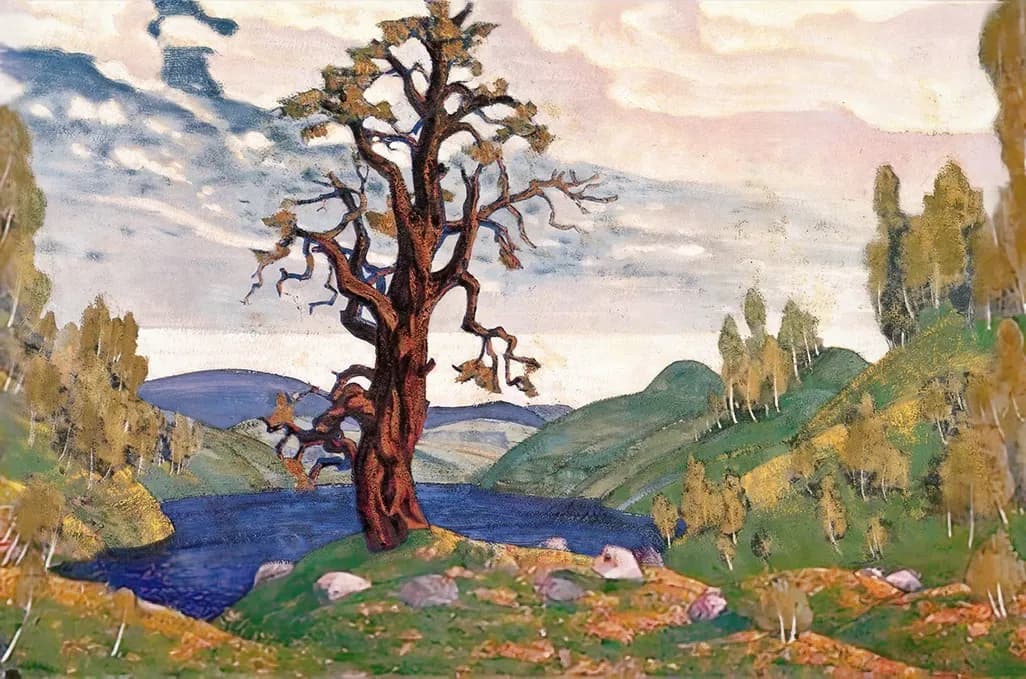
- Igor Stravinsky (Modern): "The Rite of Spring," whose 1913 Paris premiere caused an uproar in the hall and whose rhythms influenced composers for decades.
Start with the Air from Bach's Orchestral Suite No. 3 (known as "Air on the G String" after an 1871 violin arrangement by August Wilhelmj), Mozart's "Symphony No. 40," Beethoven's Fifth, and Stravinsky's "Rite of Spring" to hear how far the tradition moved in under two centuries.
Classical Music Today
Classical music is still being written. Much of the orchestral music people hear today comes from film and game scores: John Williams, Hans Zimmer, and Hildur Guðnadóttir (who won the 2020 Oscar for Joker) write for orchestral instruments that Beethoven would recognise. A neoclassical strand led by Ludovico Einaudi, Max Richter, and Ólafur Arnalds mixes solo piano and strings with ambient production and is a fixture of study and focus playlists.
Streaming has also changed how older repertoire reaches people. "Calm," "focus," and "sleep" playlists lean on Bach, Debussy, and Satie and reach listeners who may never buy a concert ticket. Orchestras, opera houses, and living composers carry on alongside all of it. Because so much classical music now plays in the background, it is easy to forget how much detail a single score holds.
How AI Detects Classical Music
Detecting classical music is easier than detecting electronic genres in one way and harder in another. Easier, because the signal is clearly acoustic: an AI model hears the blended timbres of bowed strings, woodwinds, and brass, with no synthesiser, no drum machine, and no four-on-the-floor kick anywhere in the spectrum. Harder, because classical has no steady beat grid for a tempo detector to latch onto, so the model leans instead on timbre, an unusually wide dynamic range (very quiet passages swelling to very loud ones), and the absence of a looping rhythmic pulse.
A good detector also treats long, developing phrases that change instead of looping as a strong classical cue, balancing the prominence of acoustic instrument families against any electronic ones. Try it on something of your own: open the Genre AI music genre detector, let it hear a short stretch of any orchestral or piano piece, and within seconds it will report how firmly the clip reads as classical. To see how the underlying model converts sound into a genre, read how AI music genre detection works.
In our own listening tests, Genre AI's model is surest of Classical when blended acoustic timbres (bowed strings, woodwinds, brass, or solo piano) carry a wide dynamic range with no drum-machine pulse or steady beat grid to lock onto. It is most decisive on full-orchestra and solo-piano passages; on sparse, beatless piano writing the certainty eases, and Ambient or neoclassical can surface as close contenders. In those borderline moments the scores spread across the nearby labels, showing which way the clip leans instead of forcing a single call.