A big band is a large jazz ensemble of usually 15 to 20 musicians, organised into sections of saxophones, trumpets and trombones over a rhythm section of piano, guitar, bass and drums, playing written arrangements with space for improvised solos. The standard modern line-up has 17 players: five saxes, four trumpets, four trombones and four rhythm. Big band is a format. It carried the dance music of the 1930s, and later bebop, Afro-Cuban jazz, long concert works and the composer-led jazz orchestras of today.
That is the key difference from swing. Swing is the style and the era (roughly 1935–1946) when big bands were America's popular music; our swing guide covers that dance-hall story. This page follows the big band itself: how the sections work, how arrangers write for them, and what the format turned into after the swing era ended. To hear how a 17-piece orchestra reads to a machine, try our free AI music genre detector.
What Is a Big Band?
A big band is defined by its sections. Instead of each horn playing its own improvised line, as in Dixieland, the instruments are grouped into choirs that play harmonised parts together. A saxophone section voices a melody in five-part harmony; the brass answer with punchy chords; the rhythm section keeps time underneath. The music is written down by an arranger, and the players read it from parts, with solos opened up at points the arrangement allows.
Because the parts are written, seventeen people can change dynamics together: a band can drop to a soft reed passage and hit a full-ensemble climax a bar later. The arranger decides which section has the melody, how the chords are voiced, where the soloist enters and when the band builds to the shout chorus. Those decisions shape the sound as much as any player does.
The term is also used loosely. Pop listeners use "big band" for the swing-era sound of Glenn Miller or Benny Goodman, or for a singer like Frank Sinatra backed by an orchestra. Jazz musicians tend to use "big band" and "jazz orchestra" for the format at any point in its history, including concert music that has nothing to do with dancing.
History & Origins
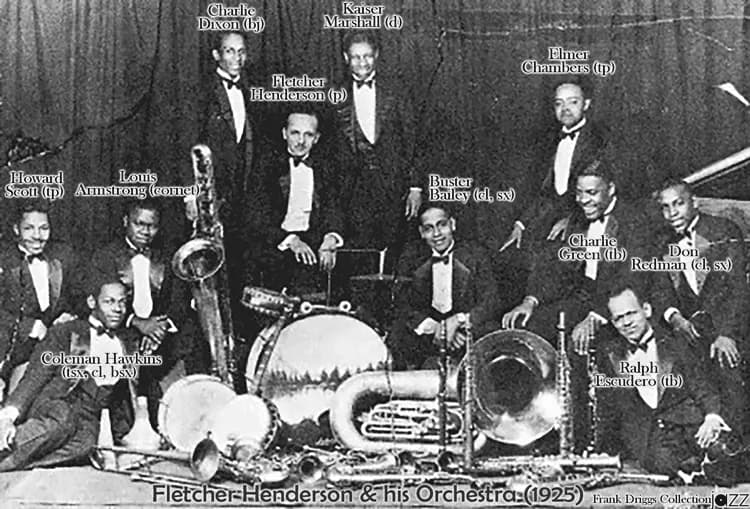
Large dance orchestras existed before jazz, but the jazz big band took shape in New York in the 1920s. Fletcher Henderson's orchestra, with arranger Don Redman, worked out the basic method: reeds against brass, call-and-response between sections, and room for soloists such as Louis Armstrong and Coleman Hawkins. Meanwhile Paul Whiteman led the most commercially successful dance orchestra of the decade. From 1927 Duke Ellington's orchestra, resident at the Cotton Club, took a more personal approach: Ellington wrote for the individual sounds of his players, Bubber Miley's plunger-muted trumpet or, from 1928, Johnny Hodges's alto, instead of for interchangeable section parts.
In Kansas City a different model grew up: bands led by Bennie Moten and then Count Basie built arrangements from simple riffs that the sections passed around, often worked out by ear on the bandstand ("head arrangements"), over a light, swinging rhythm section. Basie's band reached New York in the late 1930s, and "One O'Clock Jump" (1937) became its theme.
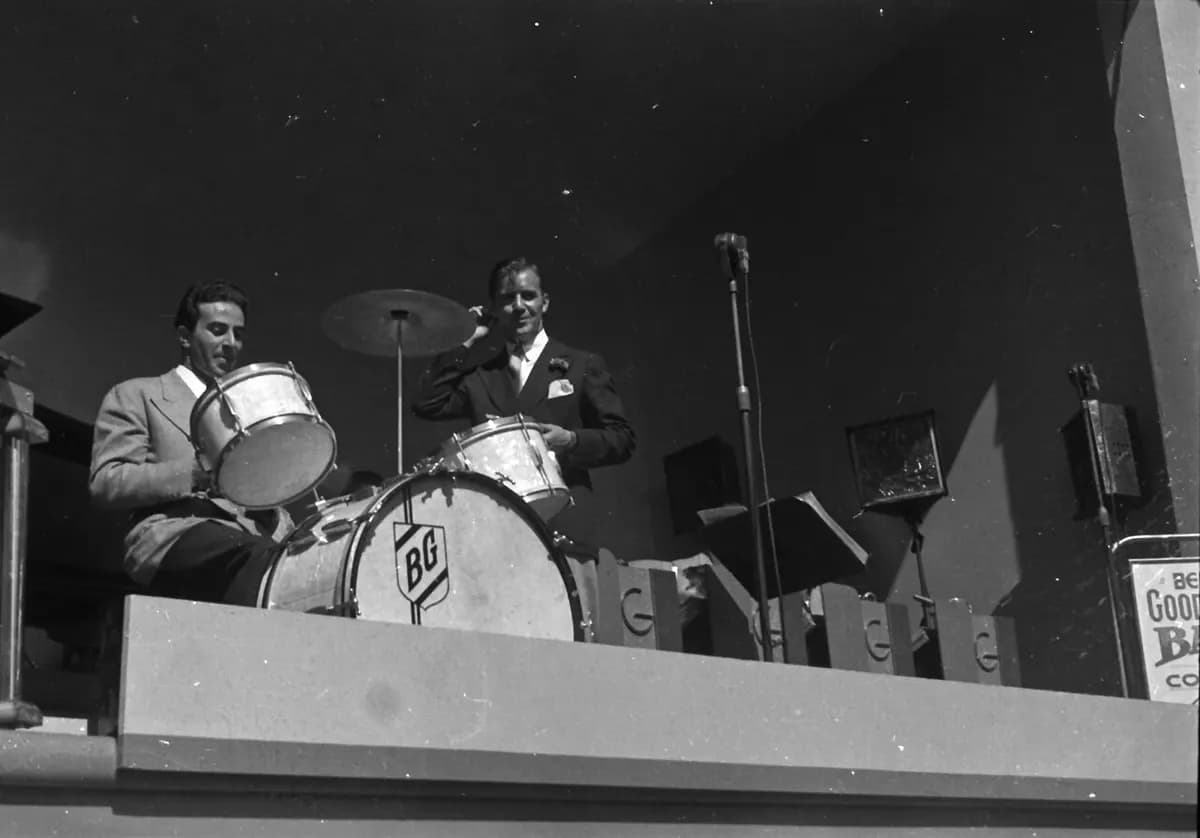
The swing era began in the mid-1930s, when Benny Goodman's band, playing Henderson's arrangements, broke through with young audiences; his 1938 Carnegie Hall concert, with "Sing, Sing, Sing", is one of its landmarks. For about a decade big bands dominated American popular music: Chick Webb at the Savoy Ballroom with Ella Fitzgerald, Jimmie Lunceford, Artie Shaw ("Begin the Beguine", 1938), Tommy Dorsey, Glenn Miller ("In the Mood", 1939), Harry James and Woody Herman. Ellington's band produced some of its greatest work around 1940–1942, including Billy Strayhorn's "Take the 'A' Train".
After the Second World War the economics collapsed. Wartime travel restrictions, the 1942–1944 recording ban by the musicians' union, changing tastes and the rise of solo singers made large touring bands hard to sustain, and several leading orchestras broke up around 1946. The format did not disappear; it changed purpose. Dizzy Gillespie led a bebop big band and, with Chano Pozo, recorded Afro-Cuban pieces such as "Manteca" (1947). Machito's Afro-Cubans fused big band writing with Cuban rhythm. Stan Kenton pushed toward loud, dense "progressive jazz", and Woody Herman's Herds absorbed bebop; "Four Brothers" (1947), written for three tenors and a baritone, gave its name to a saxophone sound.
Basie, who had cut back to a small group in 1950, formed a new big band in 1952. Fans call it the "New Testament" band. Its charts by Neal Hefti, Frank Foster and others became a model for decades; The Atomic Mr. Basie (recorded 1957, released 1958) is arranged entirely by Hefti. Ellington's set at the 1956 Newport Jazz Festival, with Paul Gonsalves's marathon tenor solo on "Diminuendo and Crescendo in Blue", revived his band's fortunes. Gil Evans wrote orchestral settings for Miles Davis (Miles Ahead, Sketches of Spain), and Frank Sinatra recorded with Basie and with arrangers such as Nelson Riddle and Quincy Jones.
From the mid-1960s, the big band became a workshop for composers. The Thad Jones/Mel Lewis Orchestra began playing Monday nights at New York's Village Vanguard in 1966, and the band still plays there today as the Vanguard Jazz Orchestra. Toshiko Akiyoshi, Bob Brookmeyer, Maria Schneider, Darcy James Argue and European radio orchestras such as the WDR Big Band carried the form into the 21st century, alongside repertory ensembles like the Jazz at Lincoln Center Orchestra and a vast network of school and university jazz bands.
Instrumentation & Sections
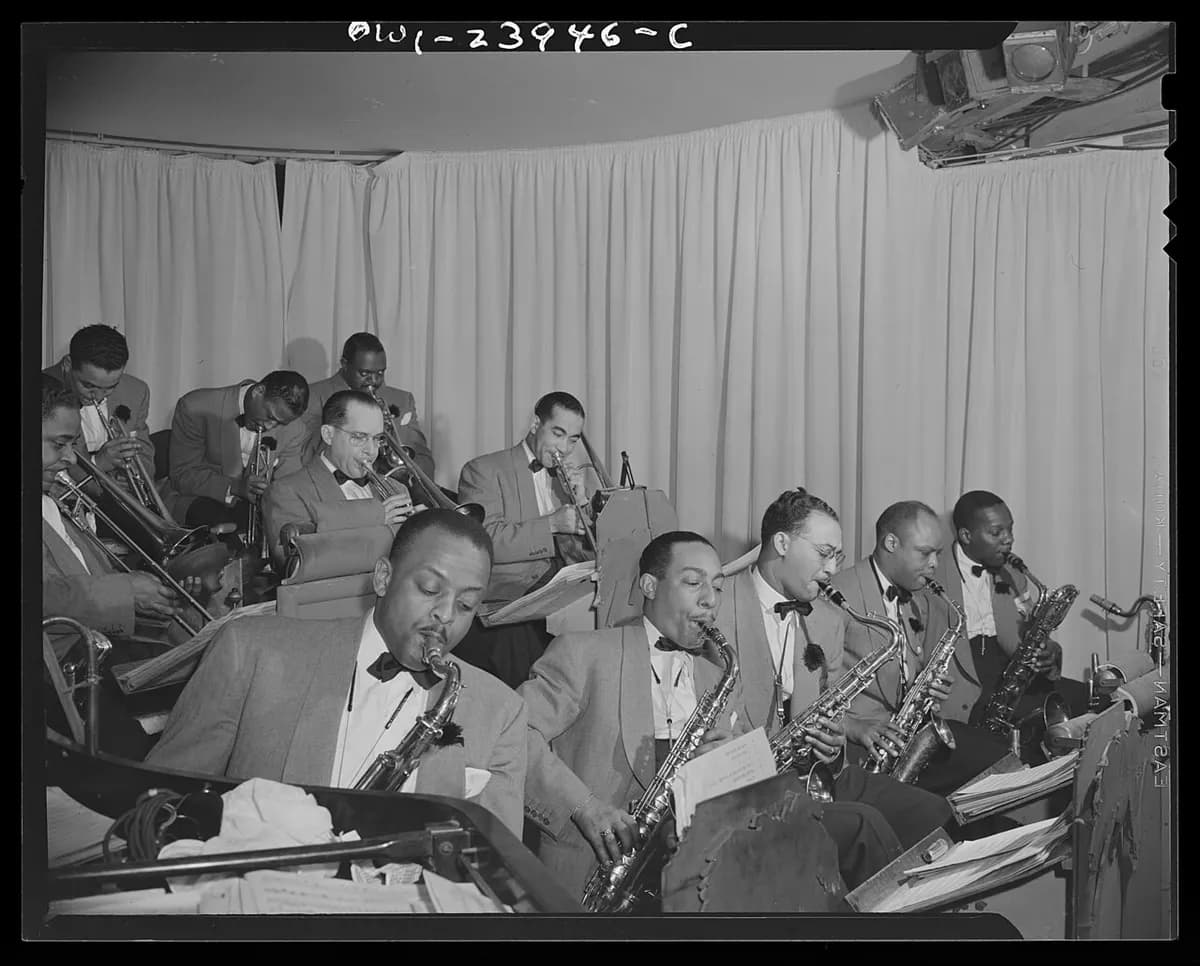
The modern standard big band has 17 players. Numbers vary, but the section logic is constant:
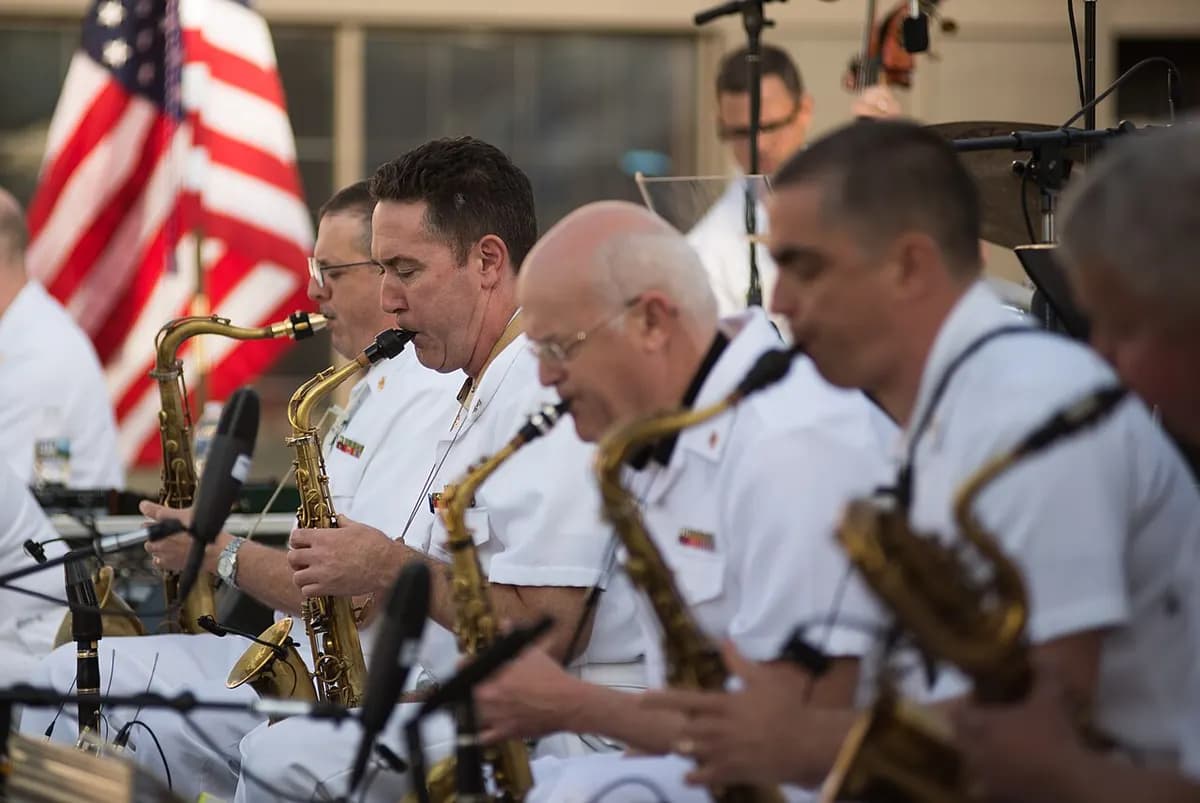
- Saxophones (5): two altos, two tenors and a baritone. The lead alto shapes the phrasing; the baritone anchors the bottom. Players often double on clarinet and flute.
- Trumpets (4–5): the lead trumpet plays the highest notes and sets the band's attack and energy; others fill in harmony and take jazz solos. Flugelhorn and mutes add colour.
- Trombones (3–4): usually three tenors and a bass trombone, giving the brass its warm middle and its weight.
- Rhythm section (4): piano, guitar, double bass and drums. In the swing era rhythm guitar played a chord on every beat (Freddie Green with Basie is the classic example); later bands often drop it or use it less.
- Extras: vibraphone, Latin percussion, French horn, tuba, or a singer. The "band singer" was a fixture of the swing era.
| Section | Instruments | Typical number | Role |
|---|---|---|---|
| Reeds | Alto, tenor and baritone saxophones (with clarinet and flute doubles) | 5 | Melody in close harmony, soft backgrounds, soli passages |
| Trumpets | Trumpets and flugelhorns | 4–5 | Lead line, high-register punch, solos |
| Trombones | Tenor trombones and bass trombone | 3–4 | Middle harmony, weight, counter-lines |
| Rhythm | Piano, guitar, double bass, drums | 4 | Time, harmony, kicks that set up ensemble hits |
| Optional | Vibes, percussion, vocalist | 0–3 | Colour, Latin rhythm, songs |
Arranging & Characteristic Sound
Much of what listeners hear as "big band" is the arranger's toolkit:
- Tempo: anything from ballads around 60–80 BPM to flag-wavers above 250 BPM. Most dance-band charts sit somewhere between about 120 and 200 BPM, where swing-era couples danced the lindy hop and foxtrot.
- Section writing: the melody voiced in four or five parts across a section, so it sounds like one rich instrument.
- Call-and-response: saxes play a phrase and the brass answer. It is the oldest device in the language and still the most used.
- Riffs: short repeated phrases, especially in the Kansas City tradition, stacked across sections to build intensity.
- Backgrounds: soft section figures behind a soloist that grow louder chorus by chorus.
- Soli: a whole section plays a written, solo-like line together. Many charts give the saxophones a soli chorus.
- Shout chorus: near the end, the full band plays the climactic ensemble passage at maximum volume, often with the lead trumpet at the top of its range.
- Drum "kicks": the drummer sets up and reinforces ensemble accents, which ties the band's hits together.
Harmony grew more complex over time. Swing-era charts used the song's chords with sixths and sevenths; postwar writers such as Gil Evans, Thad Jones and Bob Brookmeyer used dense clusters, unusual doublings and long-form compositions closer to concert music.
Big Band Styles & Traditions
- Swing-era dance bands: Goodman, Miller, Shaw, Dorsey, Lunceford, Webb: the big band as popular music. See swing.
- Ellington tradition: writing for individual voices in the band, extended suites, distinctive tone colours.
- Kansas City / Basie tradition: riffs, blues, a light rhythm section and exact ensemble precision.
- Bebop big bands: Dizzy Gillespie, Woody Herman's Herds, Claude Thornhill's band in the late 1940s; see bebop.
- Afro-Cuban and Latin big bands: Machito, Tito Puente, Gillespie with Chano Pozo; the root of much Latin jazz and later salsa horn sections.
- West Coast and progressive: Stan Kenton's loud, brassy orchestras.
- Modern jazz orchestras: Thad Jones/Mel Lewis, Toshiko Akiyoshi, Bob Brookmeyer, Maria Schneider, Darcy James Argue's Secret Society.
- Vocal big band and crooners: Sinatra with Basie, Ella Fitzgerald's songbook albums, and later Michael Bublé.
- Neo-swing and revivals: the 1990s swing revival (Brian Setzer Orchestra, Big Bad Voodoo Daddy) and the school and university jazz band movement.
Key Bands & Essential Recordings
A starter list across the format's history:
| Recording | Band | Year | Why it matters |
|---|---|---|---|
| One O'Clock Jump | Count Basie Orchestra | 1937 | Kansas City riffs and the lightest rhythm section in jazz |
| Sing, Sing, Sing (Carnegie Hall) | Benny Goodman Orchestra | 1938 | The swing era's showpiece, with Gene Krupa's drums |
| In the Mood | Glenn Miller Orchestra | 1939 | The most famous riff tune of the era |
| Take the 'A' Train | Duke Ellington Orchestra | 1941 | Billy Strayhorn's theme for the Ellington band |
| Manteca | Dizzy Gillespie Orchestra | 1947 | Bebop meets Afro-Cuban rhythm with Chano Pozo |
| Ellington at Newport | Duke Ellington Orchestra | 1956 | The live set that revived Ellington's career |
| Miles Ahead | Miles Davis with Gil Evans | 1957 | Orchestral big band writing around a single soloist |
| The Atomic Mr. Basie | Count Basie Orchestra | 1958 | Neal Hefti's charts for the 1950s Basie band |
| Consummation | Thad Jones/Mel Lewis Orchestra | 1970 | All eight pieces composed and arranged by Thad Jones |
| Concert in the Garden | Maria Schneider Orchestra | 2004 | Grammy winner sold only online, through ArtistShare |
Big Band vs Swing vs Dixieland
The most common confusion is between big band and swing, and the simplest answer is that one is a format and the other is a style. Swing describes a rhythmic feel and a historical period, roughly 1935 to 1946, when big bands played dance music and were the mainstream of American pop. Big band describes the ensemble, which existed before that era and continued long after it. A Glenn Miller hit is both swing and big band; a Maria Schneider suite is big band but not swing; a small group playing "Lady Be Good" can swing without being a big band.
Against Dixieland, the difference is organisation. Dixieland bands have one trumpet, one clarinet and one trombone improvising simultaneously; big bands have whole sections reading written arrangements. Big bands grew out of 1920s dance orchestras that absorbed New Orleans jazz, so the two meet in the late 1920s, but they sound very different: a conversation of three voices against a choir of fifteen.
Against small-group modern jazz such as bebop or hard bop, the difference is the balance between composition and improvisation. In a quintet, the written theme is a few bars and the rest is solos. In a big band the arrangement is the main event, and the solos sit inside it.
How AI Detects Big Band
A full big band leaves a dense acoustic trace: a dozen or more horns playing harmonised chords at once, sharp ensemble hits, and a frequency spread from baritone sax and bass trombone up to lead trumpet. A swinging ride cymbal and walking bass place it in jazz. Ensemble climaxes carry the most of those cues; ballads, soft reed passages and quiet solo stretches carry fewer.
Genre AI has a fine label for this, Big Band / Swing, under the coarse Jazz label. Its text prompts also include the phrases "big beat" and "big room", which are electronic genres, so the label's description is broader than the name suggests; for an actual orchestra recording that matters little, because the Jazz coarse label has to win first.
Try a shout chorus and a quiet intro from the same chart in the Genre AI music genre detector and compare; for how tempo figures into the reading, see what BPM means.
In Genre AI, big band has a direct match: the fine label Big Band / Swing, under the coarse Jazz label. Full-ensemble passages with harmonised brass and saxophone sections, a swinging ride cymbal and walking bass are the case most likely to land there. Confusions are more likely at the edges of the format. Modern jazz-orchestra pieces with dense harmony and long improvised solos may drift toward Bebop or Contemporary Jazz; lush ballads and vocal tracks with strings can read as Easy Listening; and Afro-Cuban big band charts with congas and montuno patterns are likely to pick up Latin Jazz, which is a fair description of them. Brass-heavy film or TV themes will rarely come back as Soundtrack: that label has no fine subgenres and wins only when no label with subgenres, such as Jazz, is in the top five.