
Bollywood music, more precisely Hindi filmi song, is the music written for Mumbai's Hindi-language film industry, and one of the most widely heard bodies of popular music in the world. It is a production system more than a single style, and over nine decades it has absorbed Indian classical raga, folk traditions, ghazal, disco, rock, hip-hop and EDM.
This guide covers what Bollywood music is, the playback singing system that made a handful of voices familiar to hundreds of millions of people, the composers who shaped each era, how the songs are built, and why the category describes an industry more than a genre. Curious how a model handles filmi arrangements? Play a few seconds into our free AI music genre detector.
What Is Bollywood Music?
Bollywood music is song written for Hindi films, where musical numbers carry part of the story. A film usually has several songs, performed on screen by actors and sung on the recording by professional playback singers. The soundtrack is normally released before the film, drives its marketing and often outlives it; for much of the twentieth century, Indian popular music and film music were largely the same thing.
Each song is written for a scene, so the range is enormous. A single film can contain a classical raga-based piece, a folk wedding number, a romantic ballad, and a nightclub dance track. What holds the category together is the production system: a music director (composer), a lyricist writing in Hindi and Urdu, playback singers, and an arrangement designed to work with picture and choreography.
The Playback Singing System
Indian film music separates the singing voice from the acting body. Songs are recorded first by playback singers, and actors lip-sync to them on set. As a result a small number of singers provided the voices for generations of stars, and some became more famous than most of the actors they sang for.
Lata Mangeshkar and her sister Asha Bhosle dominated the female side for decades, with catalogues so large that their exact size is still argued over; Guinness World Records listed Bhosle in 2011 for the most studio recordings, reportedly up to 11,000 songs. On the male side Mohammed Rafi, Kishore Kumar and Mukesh held the same position, followed later by Sonu Nigam and Arijit Singh, while Shreya Ghoshal became the leading female voice of the 2000s and 2010s. The same star could be sung by different singers in different films, and the same singer could voice dozens of stars, so audiences learned to recognise the voice separately from the face.
History & Eras
Song was there from the first Indian sound film: Alam Ara, which premiered in Bombay on 14 March 1931, had seven songs, the first of them "De De Khuda Ke Naam Pe", accompanied only by tabla and harmonium. The golden age of the 1950s and 1960s brought Naushad, S.D. Burman and Shankar-Jaikishan, working with orchestras that combined Indian instruments with Western strings and writing melodies rooted in raga and folk forms.
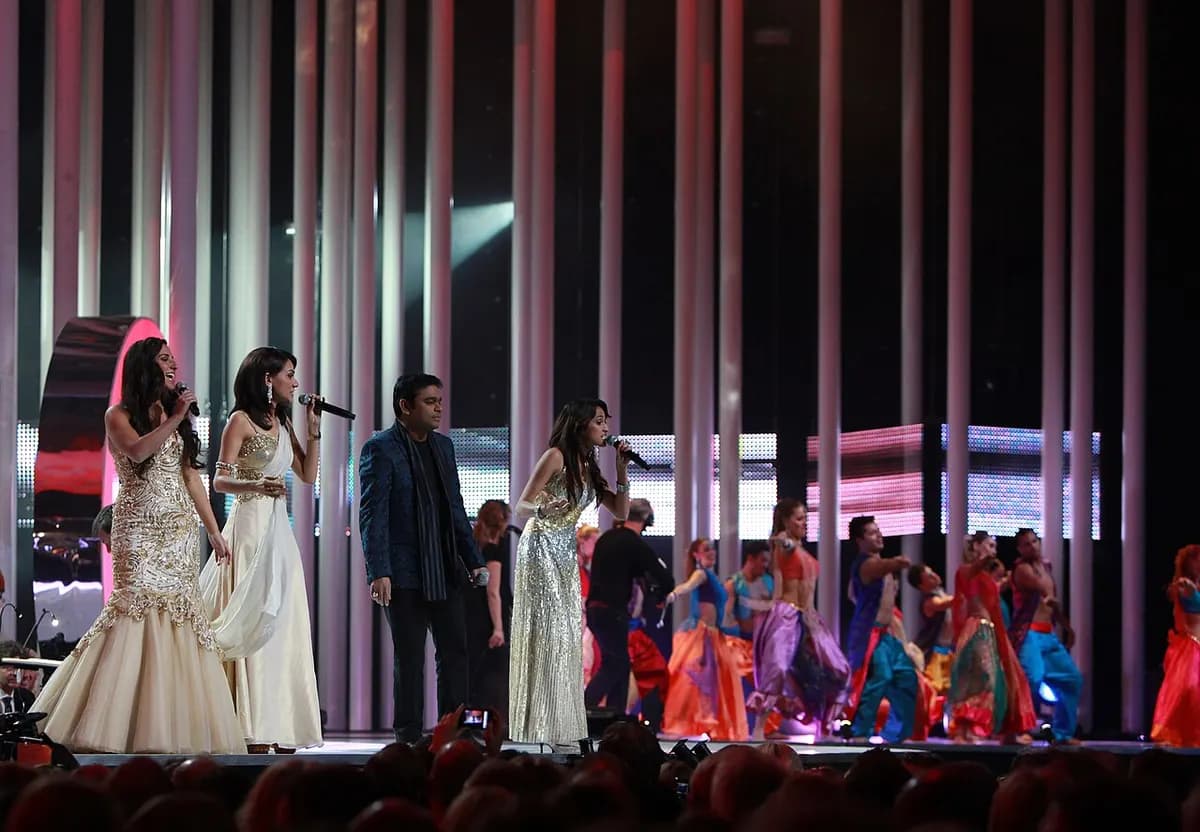
The 1970s belonged to R.D. Burman, who brought rock, funk, Latin percussion and studio experiment into filmi song, and to Laxmikant-Pyarelal. The 1980s brought Bappi Lahiri and an unabashed disco phase. Then A.R. Rahman arrived. His first score, for the Tamil film Roja (1992), became a national hit in its dubbed Hindi version, and his first original Hindi score, Rangeela (1995), confirmed the change: digital production, layered electronic textures and a new approach to arrangement. In February 2009 he won two Academy Awards for Slumdog Millionaire, for the score and for the song "Jai Ho".
The modern era is dominated by Pritam, Shankar-Ehsaan-Loy, Vishal-Shekhar, and Amit Trivedi, and by a distribution shift to streaming and video. T-Series, the largest Hindi film music label, was the most-subscribed channel on YouTube from April 2019 until MrBeast overtook it in June 2024. Independent Indian pop and hip-hop have meanwhile built audiences outside the film system.
Key Characteristics & Sound
What tends to identify filmi music:
- Tempo: very wide, roughly 70–160 BPM depending on whether the number is a ballad or a dance sequence.
- Vocals: front and centre, with a distinctive Indian classical-derived ornamentation (murki, meend) even in pop settings.
- Melody: frequently raga-derived, using scales and inflections uncommon in Western pop.
- Percussion: tabla, dholak, and dhol layered with programmed drums.
- Instruments: sitar, sarangi, bansuri, harmonium and santoor alongside strings, brass, and synthesizers.
- Arrangement: lavish and dense, often with large string sections and choirs.
- Structure: mukhda (the opening hook, which returns) and antara (the verses between), a form that has drifted towards Western verse-chorus.
The eras are distinguishable at a glance:
| Era | Years | Key composers | Sound |
|---|---|---|---|
| Golden age | 1950–1969 | Naushad, S.D. Burman, Shankar-Jaikishan | Raga-based melody, orchestral arrangements |
| Rock and funk | 1970–1979 | R.D. Burman, Laxmikant-Pyarelal | Latin percussion, electric guitar, experimentation |
| Disco era | 1980–1989 | Bappi Lahiri | Synth basslines, four-on-the-floor, glitter |
| Rahman revolution | 1992–2005 | A.R. Rahman | Digital production, world fusion, new textures |
| Contemporary | 2006–present | Pritam, Vishal-Shekhar, Amit Trivedi | Global pop and EDM production, hip-hop crossovers |
Is Bollywood a Genre?
Strictly, no. Streaming services and genre classifiers use the word as if it were a style, but "Bollywood" names an industry and a distribution context, with no fixed set of musical characteristics. A 1960s raga-based ballad, a 1980s disco number, and a 2020 EDM-adjacent dance track are all Bollywood music, and they share almost nothing acoustically.
The term also leaves a lot out. India has several film industries: Tamil, Telugu, Malayalam, Kannada, Bengali, and Punjabi cinema all have their own large music traditions, and "Bollywood" refers only to the Hindi-language industry based in Mumbai. Using it as shorthand for Indian music in general hides that Tamil and Telugu film music have their own composers, stars and very large audiences; Rahman himself came from Tamil cinema.
Notable Composers, Singers & Songs
A starting point across the eras:
- Naushad: Mughal-e-Azam (1960), "Pyar Kiya To Darna Kya."
- S.D. Burman: Guide (1965).
- R.D. Burman: "Dum Maro Dum," "Piya Tu Ab To Aaja."
- Bappi Lahiri: "Jimmy Jimmy Aaja," the disco era's signature.
- A.R. Rahman: Roja (1992), Dil Se ("Chaiyya Chaiyya"), Slumdog Millionaire ("Jai Ho").
- Pritam: "Kabira," "Channa Mereya."
- Lata Mangeshkar: "Lag Ja Gale," "Ajeeb Dastan Hai Yeh."
- Kishore Kumar: "Roop Tera Mastana."
- Mohammed Rafi: "Chaudhvin Ka Chand Ho."
- Arijit Singh: "Tum Hi Ho," the modern era's dominant voice.
Start with "Chaiyya Chaiyya," "Dum Maro Dum," and "Tum Hi Ho" to hear the Rahman shift, the 1970s experiment, and the current ballad style.
How AI Detects Bollywood Music
Bollywood shows the limits of genre classification well. The word describes an industry, so no single acoustic signature covers it. What a model can pick up are the recurring markers of the tradition: vocal ornamentation derived from Indian classical technique, tabla and dholak timbres, raga-based melodic intervals, and dense orchestral-plus-electronic arrangements.
Genre AI's production taxonomy has no Bollywood label. It has a coarse Indian category, but that category has no fine labels, and the classifier prefers a coarse category that has them whenever one is among its top five, so Indian will rarely be the final answer even for a raga-heavy song. A modern Hindi film track produced like a global pop record is likely to land wherever its arrangement points: Electronic Dance for a club number, Rap Hip-Hop for a rap crossover, Rock and Soft / Pop Rock for a guitar ballad. The coarse Pop category has no fine labels either, so it rarely wins; EDM and hip-hop readings are more likely. Test your own examples in the Genre AI music genre detector and read why songs have multiple genres.
Genre AI has no Bollywood label, because the word names where music comes from, not how it sounds. The coarse Indian category exists, but it has no fine labels, and the classifier picks the highest-ranked category that has them, so Indian rarely comes up at all, even for tabla, dholak and raga-inflected singing. A tabla-and-strings song may therefore come back under Jazz as Fusion, whose text prompts include "indian fusion", or under Folk / Country or Classical. A Hindi dance number made with global pop tools is likely to read as Electronic Dance, and a rap crossover as Rap Hip-Hop; the coarse Pop label, which also lacks fine labels, rarely wins, while EDM-style readings describe the arrangement accurately even when the track is plainly Bollywood. The same applies to Tamil and Telugu film songs, which the model cannot tell apart from Hindi ones by region.