Hindustani classical music is the classical music of North India, Pakistan, Nepal and Bangladesh: a tradition built on raga (a melodic framework with its own mood and grammar) and tala (a repeating rhythmic cycle), performed by a soloist over a constant drone, usually with tabla, and given over largely to improvisation that unfolds slowly from silence to speed. A single raga can occupy an hour, and the art lies in how a performer reveals it.
It is the northern sibling of Carnatic music, South India's classical tradition, which shares the same foundations but builds its concerts around composed songs, where a Hindustani recital usually spends most of its time unfolding a single raga. This guide covers what Hindustani music is, its history from the Mughal courts to the global stage, how raga, thaat and tala work, the vocal and instrumental forms, the gharanas, the instruments and the musicians to start with. Want to see where a classifier places a sitar or khayal recording? Try a clip in our free AI music genre detector.
What Is Hindustani Classical Music?
Hindustani music is one of the two great branches of Indian classical music. Both branches rest on the same concepts (svara, the note; shruti, the microtonal pitch; raga and tala), and both trace themselves to ancient Sanskrit theory. They diverged gradually from around the 13th century, as Persian and Central Asian court culture reshaped music in the north, and by the Mughal era they were clearly separate traditions.
What makes the northern branch distinctive is its emphasis on gradual, improvised development. A performance typically begins with an unmetred, wordless or syllabic exploration of the raga, introducing its notes one at a time, before the drum enters and a short composition, often only a few lines long, becomes the springboard for long stretches of improvisation. The composition is the frame; most of the concert is what the performer builds on it. The ornamentation also differs from the south: Hindustani performers favour long, smooth glides between notes (meend) and sustained tones, where Carnatic musicians use denser oscillations.
It is also different from the music that borrows from it. Bollywood film songs often take a raga as their basis, and the Sufi devotional form qawwali shares instruments, gharana training and some vocal technique, but both are song forms built for a different purpose. Hindustani music is unharmonised, organised around a soloist and a drone, and and a full recital can run for hours. In that sense it is closer to the improvising logic of jazz than to the fixed scores of Western classical music.
History & Origins
The theory behind the tradition reaches back to the Natya Shastra, an ancient Sanskrit treatise on performance, and to later works such as Sharngadeva's 13th-century Sangita Ratnakara, which is regarded as a common ancestor text for both the northern and southern traditions.
From the 13th century the courts of the Delhi Sultanate brought Persian musicians and ideas into contact with Indian practice. The poet and musician Amir Khusrau (1253–1325) is traditionally credited with inventing the khayal, the sitar and the tabla; historians treat those attributions as legend, but his era did mark the start of a long Indo-Persian synthesis.
The oldest surviving classical vocal form is dhrupad, which flourished in the 15th and 16th centuries, notably under Raja Man Singh Tomar of Gwalior. Its most famous exponent was Tansen, one of the "nine jewels" of the Mughal emperor Akbar's court in the 16th century, around whom a large body of legend has grown. In the 18th century the lighter, more flexible khayal rose to prominence at the court of Muhammad Shah in Delhi and eventually displaced dhrupad as the main vocal form.
As Mughal power declined, musicians dispersed to princely courts such as Gwalior, Rampur, Jaipur, Indore and Baroda, where hereditary lineages of teaching and style hardened into gharanas. In the early 20th century the musicologist Vishnu Narayan Bhatkhande (1860–1936) collected compositions from many gharanas and organised ragas into the system of ten thaats still used for teaching, while Vishnu Digambar Paluskar, who opened the Gandharva Mahavidyalaya in Lahore in 1901, built music schools that moved training from closed family lineages into institutions open to the public.
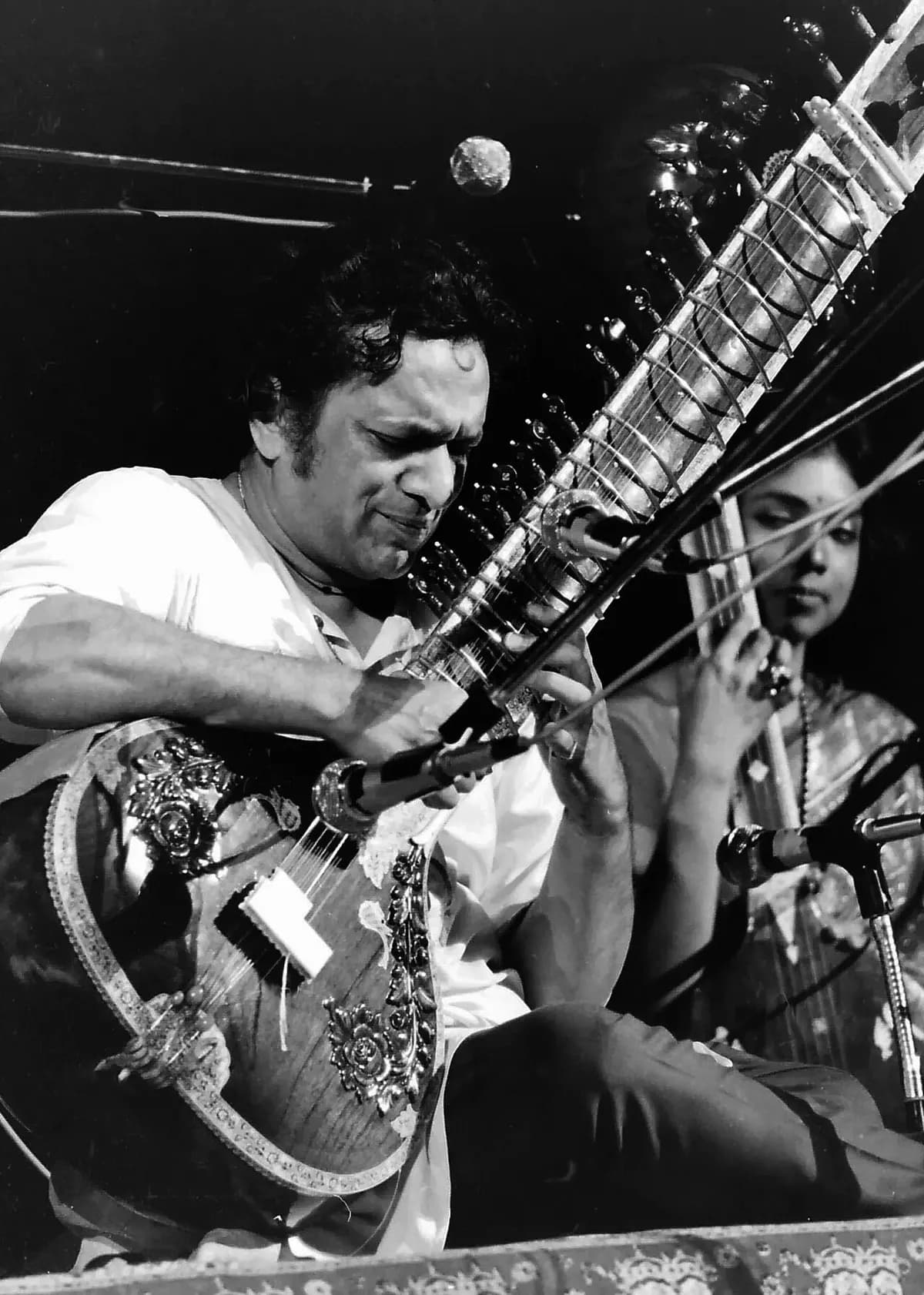
After Indian independence, All India Radio, public concerts and the record industry replaced royal patronage. From the 1950s, musicians such as Ravi Shankar and Ali Akbar Khan, both students of the Maihar-based master Allauddin Khan, took the tradition to Europe and North America. Ravi Shankar's association with George Harrison of the Beatles and his appearances at the Monterey Pop Festival (1967) and Woodstock (1969) made the sitar a familiar sound to Western audiences.
Raga, Thaat, Tala & the Sound
Hindustani music has no fixed tempo or BPM. A performance usually accelerates through three broad speeds, vilambit (slow), madhya (medium) and drut (fast), and the slowest khayals stretch a single cycle across a minute or more. What holds the music together are these frameworks:
- Raga: a melodic framework with an ascent (aroh), a descent (avroh), a most important note (vadi) and a second most important (samvadi), characteristic phrases (pakad) and an associated mood (rasa). Notes are sung as sa re ga ma pa dha ni, with the tonic set to suit the performer.
- Thaat: Bhatkhande's ten parent scales (Bilaval, Khamaj, Kafi, Asavari, Bhairavi, Bhairav, Kalyan, Marva, Purvi and Todi), used to group ragas by their notes. The system was designed for teaching, and many ragas sit awkwardly within it.
- Time of day: by convention many ragas are associated with a time (samay) or season: Bhairav and Todi in the morning, Yaman in the evening, Darbari Kanada and Malkauns late at night, the Malhar family in the monsoon.
- Tala: a rhythmic cycle of a fixed number of beats (matras), divided into sections. The first beat, sam, is the point of arrival where performer and drummer meet after improvisation; the "empty" section (khali) helps listeners keep their place.
- Drone: the tanpura sustains the tonic and usually the fifth or fourth throughout, so every note is heard against a fixed reference instead of a chord progression.
The talas you will hear most often:
| Tala | Beats | Divisions | Typical use |
|---|---|---|---|
| Teentaal | 16 | 4 + 4 + 4 + 4 | The most common tala; khayal, instrumental gats, tarana |
| Ektaal | 12 | 2 + 2 + 2 + 2 + 2 + 2 | Slow (vilambit) khayal, also fast pieces |
| Jhaptaal | 10 | 2 + 3 + 2 + 3 | Medium-tempo khayal and instrumental pieces |
| Rupak | 7 | 3 + 2 + 2 | Lilting compositions; unusually begins with khali |
| Chautaal | 12 | Six sections of 2 | Dhrupad, played on the pakhawaj |
| Keherwa / Dadra | 8 / 6 | 4 + 4 / 3 + 3 | Light classical: thumri, bhajan, ghazal |
Vocal & Instrumental Forms
Hindustani music is divided between strict classical forms and a lighter "semi-classical" repertoire:
- Dhrupad, the oldest form: austere, devotional, sung in a long, syllabic alap followed by a composition with pakhawaj. Associated today with the Dagar family and the Gundecha Brothers.
- Khayal, the dominant vocal form since the 18th century. A bada khayal in slow tempo is followed by a chhota khayal in fast tempo, with improvised alap, bol-taan and rapid taan passages.
- Tarana: a fast vocal piece built on meaningless syllables (ta, na, dir, tom), often closing a khayal performance.
- Thumri, dadra, kajri and chaiti: romantic and devotional light-classical forms, more expressive than strict, often sung at the end of a concert.
- Instrumental performance: on sitar or sarod usually alap (unmetred), jor (a pulse appears), jhala (fast, rhythmic strumming on the drone strings), then a composed gat with tabla and improvised variations.
Compared with its southern counterpart:
| Trait | Hindustani (North) | Carnatic (South) |
|---|---|---|
| Focus | Extended improvisation on one raga | Composed songs with improvisation woven in |
| Ornamentation | Long glides (meend), sustained notes | Dense oscillations (gamakas) |
| Scale classification | Ten thaats | 72 melakartas |
| Main percussion | Tabla, pakhawaj | Mridangam, ghatam, kanjira |
| Main accompaniment | Harmonium or sarangi | Violin |
| Main vocal forms | Dhrupad, khayal, thumri | Kriti, varnam, ragam-tanam-pallavi |
| Lineages | Gharanas | Teacher lineages (sishya parampara) |
The Gharanas
A gharana (from ghar, "house") is a lineage of musicians sharing a style, a repertoire and a teaching method, passed from master to disciple. Two singers trained in different gharanas can perform the same raga in audibly different ways. Among the best-known vocal gharanas:
- Gwalior: usually described as the oldest khayal gharana; clear, balanced presentation of the composition.
- Agra: forceful, rhythmic singing with dhrupad influence; Faiyaz Khan is its most famous voice.
- Kirana: slow, meditative unfolding of notes and attention to pitch; Abdul Karim Khan, Gangubai Hangal and Bhimsen Joshi.
- Jaipur-Atrauli: rare and compound ragas, long winding melodic phrases; Alladiya Khan, Mallikarjun Mansur and Kishori Amonkar.
- Patiala: agile taans and a strong light-classical repertoire; Bade Ghulam Ali Khan.
- Rampur-Sahaswan and Indore, the latter associated with Amir Khan's slow, introspective khayal.
Instrumental traditions have lineages of their own: the Maihar school of Allauddin Khan (Ravi Shankar, Ali Akbar Khan, Annapurna Devi, Nikhil Banerjee) and the Imdadkhani or Etawah lineage of sitar players that produced Vilayat Khan. Tabla has its own gharanas too, including Delhi, Ajrara, Lucknow, Farukhabad, Benares and Punjab.
Instruments
A concert usually has a soloist, a tabla player and one or two tanpuras. The instruments to know:
- Voice: the model for all other instruments; instrumentalists are judged on how "vocal" their playing is.
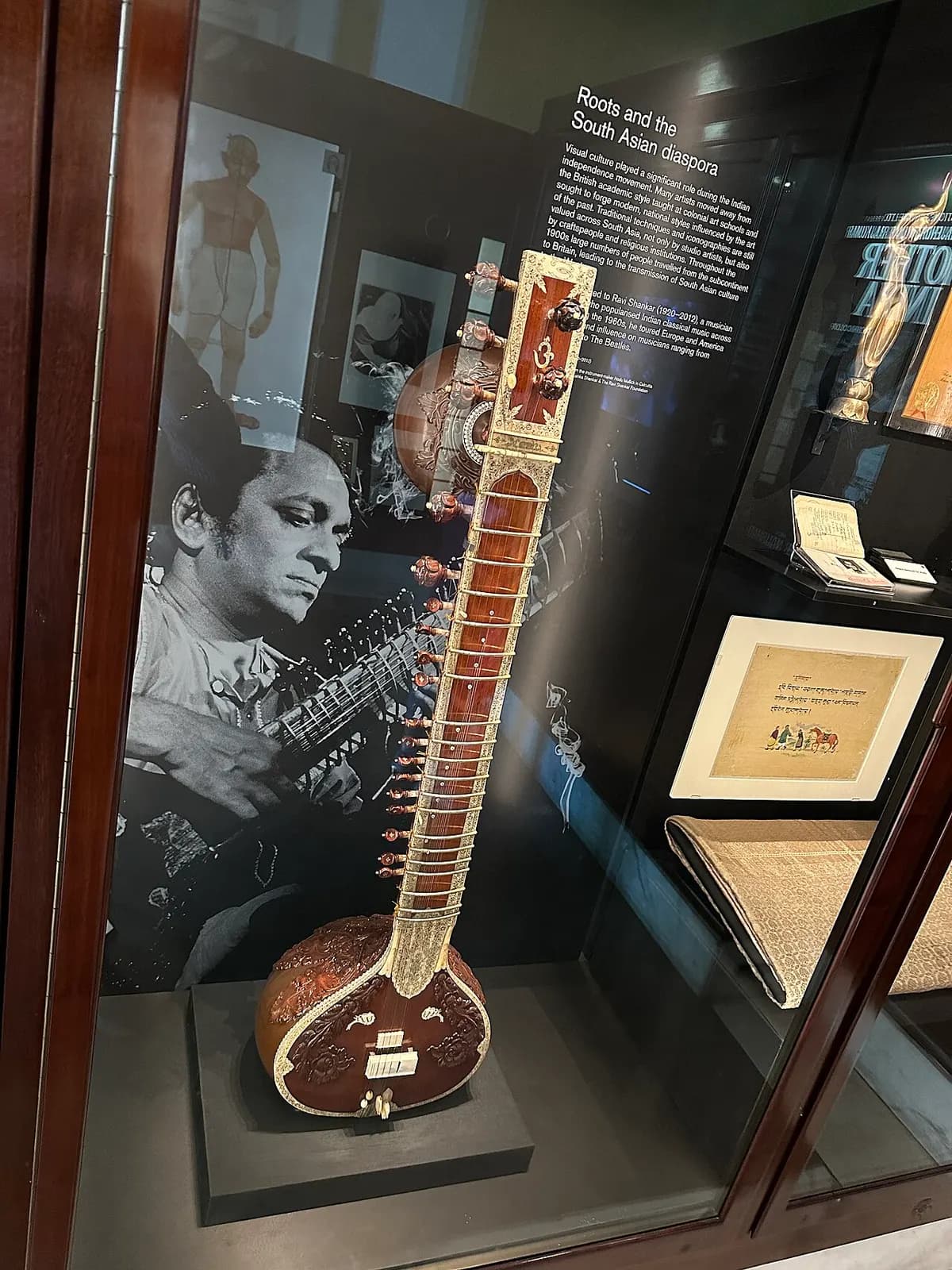
- Sitar: the long-necked plucked lute with movable frets and sympathetic strings, whose buzzing, shimmering tone comes from its curved bridge (jawari).
- Sarod: a fretless lute with a metal fingerboard, giving smooth slides and a darker, punchier tone.
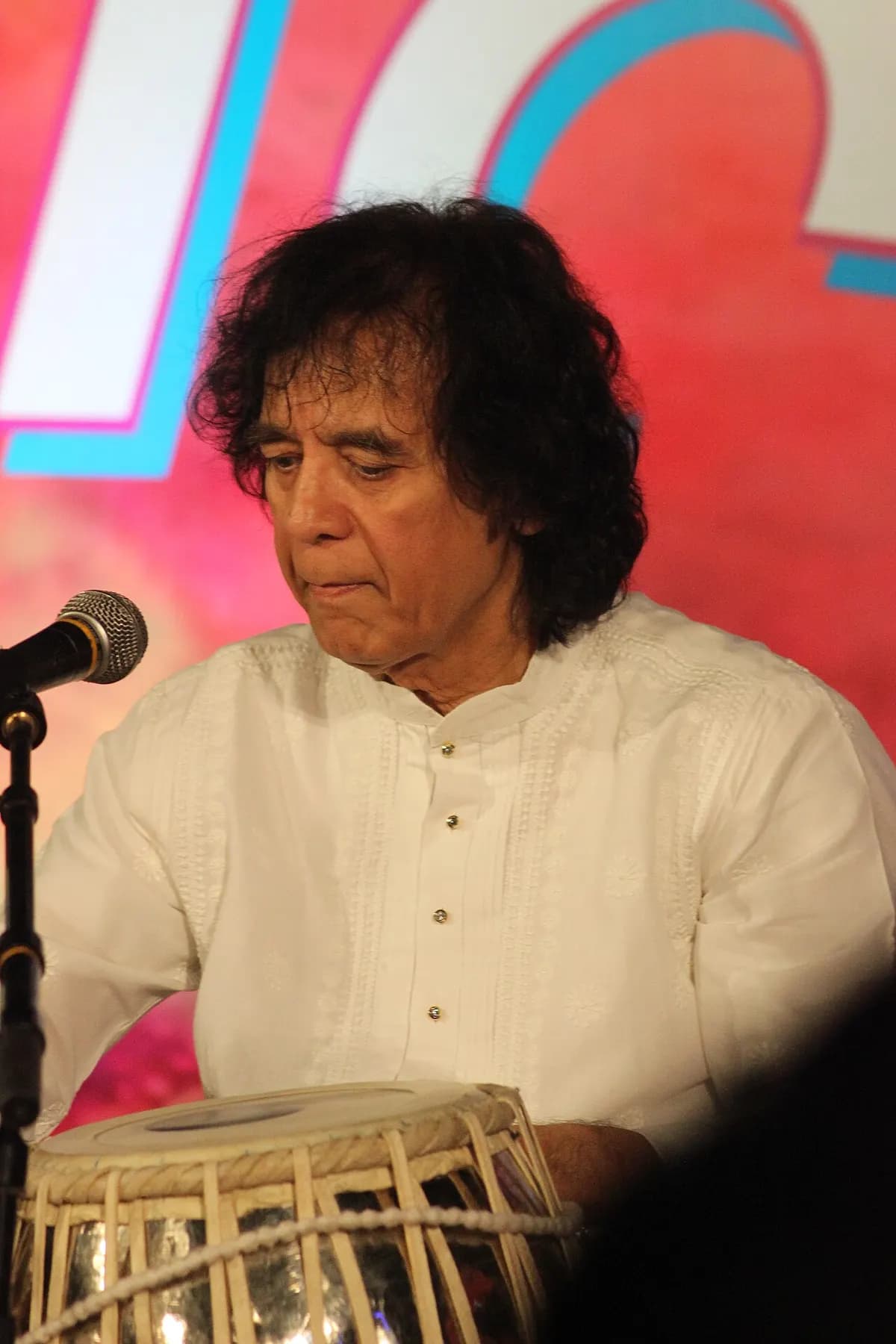
- Tabla: a pair of hand drums: the wooden right-hand dayan, tuned to the tonic, and the larger metal left-hand bayan, which bends pitch under the heel of the hand.
- Pakhawaj: the double-headed barrel drum of dhrupad.
- Tanpura: the unfretted drone lute, plucked continuously.
- Sarangi: a bowed fiddle prized for its voice-like tone, the traditional accompanist of khayal.
- Harmonium: the hand-pumped reed organ introduced in the colonial era, now the most common vocal accompaniment.
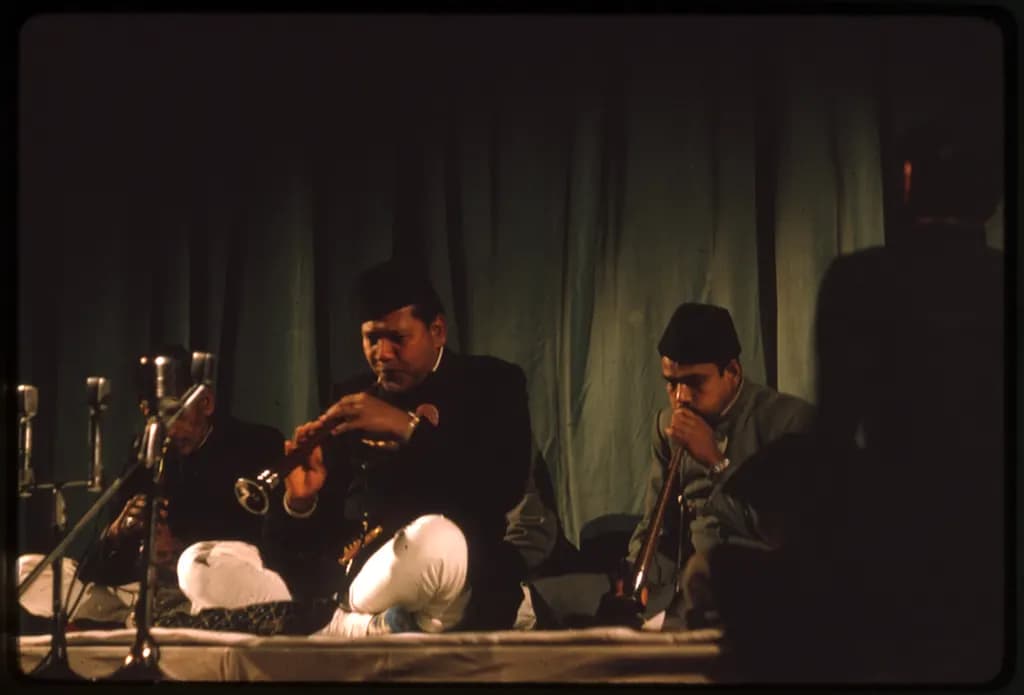
- Bansuri, shehnai and santoor: bamboo flute, double-reed wind and hammered dulcimer, all raised to concert status in the 20th century by Hariprasad Chaurasia, Bismillah Khan and Shivkumar Sharma respectively.
Key Artists & Recordings
Where to start listening:
- Ravi Shankar (sitar), the best-known Indian musician of the 20th century outside India, awarded the Bharat Ratna in 1999; his concerts with tabla player Alla Rakha are a natural entry point.
- Ali Akbar Khan (sarod), Ravi Shankar's brother-in-law and frequent duet partner, who founded the Ali Akbar College of Music in California.
- Vilayat Khan (sitar), known for a gayaki style that imitates the phrasing of the voice.
- Bismillah Khan (shehnai), who took the wedding oboe onto the concert stage and received the Bharat Ratna in 2001.
- Bhimsen Joshi (Kirana), a khayal singer also known for his devotional abhangs and bhajans, named for the Bharat Ratna in November 2008 and presented with it in 2009.
- Kishori Amonkar, Kumar Gandharva, Bade Ghulam Ali Khan and Amir Khan: four very different 20th-century vocal giants.
- Hariprasad Chaurasia (bansuri) and Shivkumar Sharma (santoor), whose 1967 EMI album Call of the Valley, with Brij Bhushan Kabra on slide guitar, is a light-classical concept record built around a day in a Kashmiri shepherd's life.
- Zakir Hussain (tabla, 1951–2024), son of Alla Rakha, who took the instrument to world stages and co-founded the fusion group Shakti with John McLaughlin in 1973.
A good way in is a full-length recorded concert: listen to how the alap introduces notes one at a time, and wait for the moment the tabla enters.
How AI Detects Hindustani Music
Hindustani recordings carry strong acoustic cues: a continuous tanpura drone, the bright buzzing harmonics of a sitar's jawari bridge, the pitch-bending bass strokes of the tabla's bayan, and long vocal glides with no chord changes underneath. The opening alap is unmetred and drumless, so the first minute of a performance can sound quite unlike the rhythmic final section.
The hard distinction is the one between India's two classical traditions, and between classical and light-classical styles. A few seconds of drone and ornamented voice do not always contain enough to separate a khayal from a Carnatic kriti, or from a ghazal or a film song set in the same raga. Try a clip in the Genre AI music genre detector, and read whether AI can identify a genre from a short clip.
What to expect from an audio classifier such as Genre AI. Its production label set has no Hindustani class and no Carnatic class. The closest label is the coarse category Indian, which has no subgenres, so when it wins the answer is simply "Indian". It wins only when none of the coarse labels that do have subgenres (Classical, Jazz, Rock, Folk / Country and others) lands in the model's top five. A solo alap with no percussion is a single melodic line with no beat, and if Classical reaches the top five the answer becomes one of its period labels instead. A sitar-and-drum-kit fusion record may instead tip the result to Jazz, where the Fusion label (its prompts include "indian fusion") is the likely pick. Use the result to place a recording in its broad family; telling North Indian from South Indian classical music still takes a listener.