Mariachi is the traditional ensemble music of western Mexico, above all the state of Jalisco: violins, trumpets, a guitar, and two instruments found almost nowhere else: the high, strummed vihuela and the deep, plucked guitarrón. Its repertoire runs from fast regional sones to the sentimental songs of Mexican cinema, and in 2011 UNESCO inscribed it on the Representative List of the Intangible Cultural Heritage of Humanity.
This guide covers where mariachi came from, how a rural string band became a national symbol in charro suits, what each instrument does, the rhythms that shape the repertoire, and the singers and ensembles to start with. To see how a classifier reads a full mariachi, try a few seconds in our free AI music genre detector.
What Is Mariachi?
The word mariachi names the music, the group that plays it and, in Mexican usage, the individual musician. A modern ensemble usually has between six and a dozen or more players: several violins, two or more trumpets, a Spanish guitar, a vihuela and a guitarrón, sometimes with a folk harp. Most members sing: one or two take the lead vocals while the rest answer in chorus and add the famous grito, the ringing yell that punctuates a song.
Musically, mariachi is a way of performing many genres. The same ensemble plays the son jalisciense (its regional root), the canción ranchera, the huapango, the bolero ranchero, waltzes, polkas and corridos. What holds it together is the sound of the band: violins, trumpets, and a rhythm section made entirely of guitars.
The origin of the word is uncertain. A popular story derives it from the French mariage, from the French intervention in Mexico in the 1860s, but the word is older: church records from 1832 to 1850 already mention a ranch called Mariachi near the Santiago River in Nayarit. An Indigenous origin is often proposed instead; it is not settled.
History & Origins
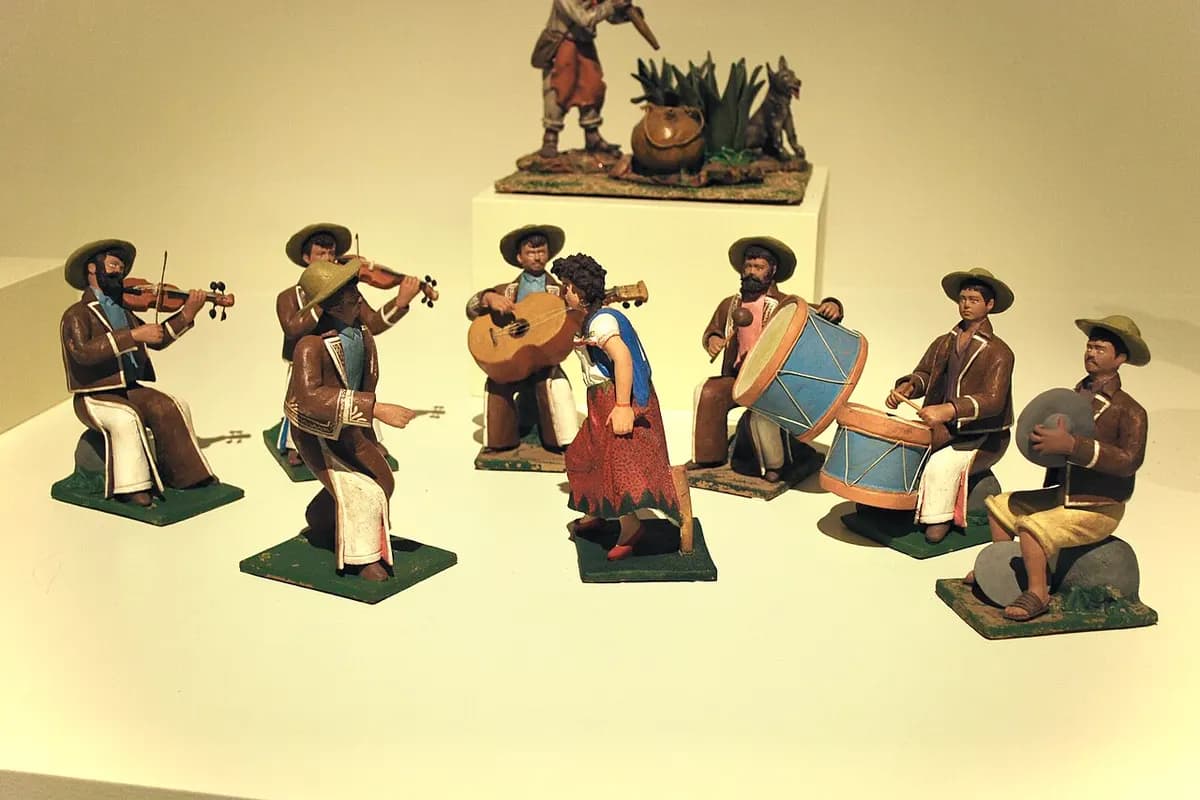
Mariachi grew out of the string-band traditions of rural western Mexico in the nineteenth century. Jalisco has the strongest claim, and most accounts place the modern form's birthplace in Cocula, Jalisco, though Colima, Nayarit and Michoacán claim the music too. Spanish colonial instruments such as the violin, guitar and harp were adopted and reshaped locally, and the music mixed Spanish forms with Indigenous and African influences. Early groups were small: violins, a harp or guitarrón for bass, and vihuela or guitar, playing at fiestas, weddings and religious celebrations.
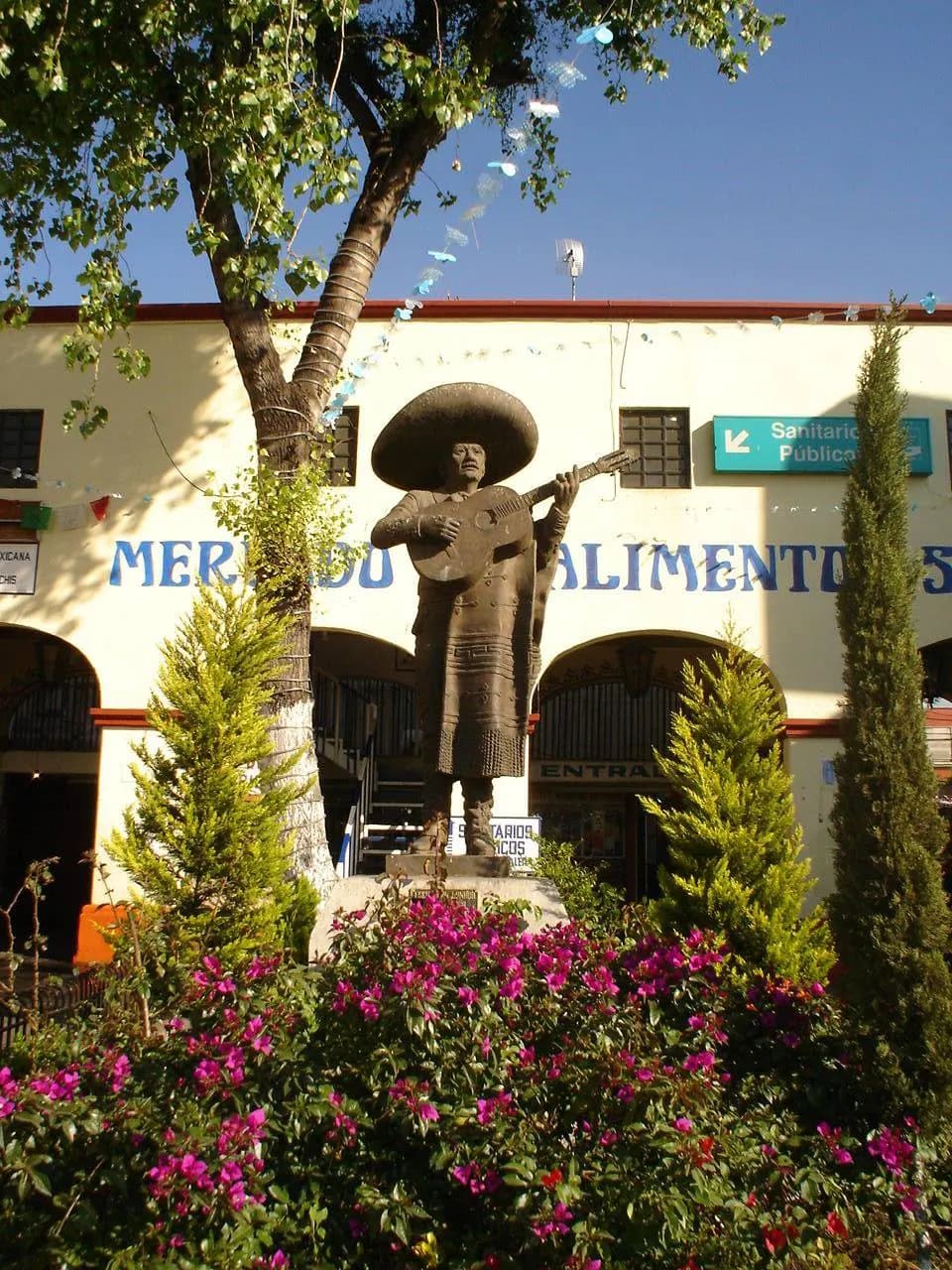
The modern sound took shape in the first half of the twentieth century, once mariachi moved to Mexico City. Groups played for tips around Plaza Garibaldi, still the city's mariachi square, where about 2,500 musicians hold union cards today. After the Revolution the state promoted the music as an emblem of a unified national culture, and the traje de charro, the silver-studded horseman's suit with a wide sombrero, became the standard costume.
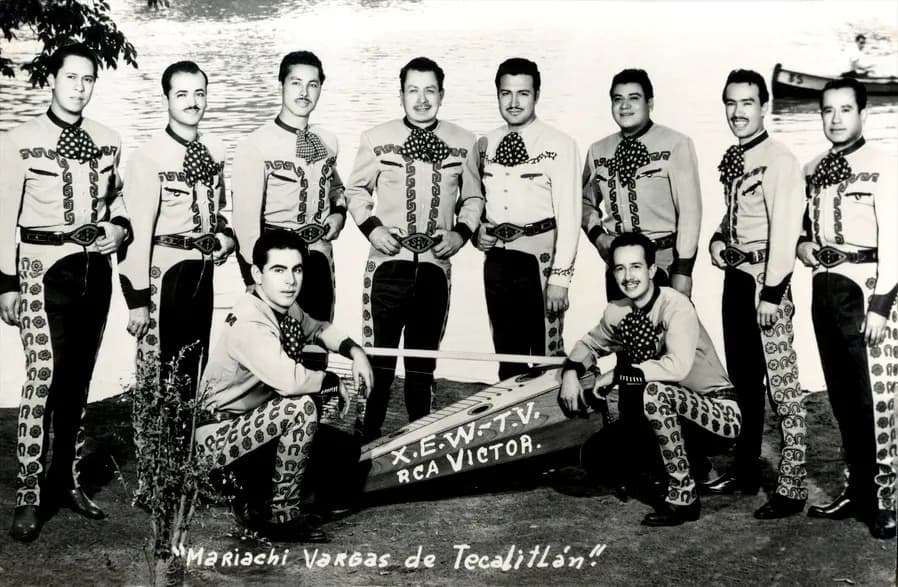
Two forces then fixed the format: radio and the record industry, and Mexican cinema. In Allá en el Rancho Grande (1936) Tito Guízar sang with mariachi on screen, and the comedia ranchera films that followed made singing charros such as Jorge Negrete and Pedro Infante into national stars. Trumpets began entering mariachi in the 1920s, when jazz and Cuban music were in fashion. Mariachi Vargas de Tecalitlán, founded by Gaspar Vargas in Tecalitlán, Jalisco, in the late 1890s, tried a trumpet in 1913, dropped it, and made it a permanent member in 1941. The group appeared in more than 200 films and became the model ensemble, with a large line-up and polished arrangements; Rubén Fuentes joined as violinist and arranger in 1944 and directed its music from 1950.
From the 1950s songwriter José Alfredo Jiménez supplied much of the core ranchera repertoire, and singers such as Lola Beltrán, Javier Solís and later Vicente Fernández carried it across Latin America. Mariachi also put down roots in the United States. The first student mariachi began at UCLA in 1961, Texas held its first mariachi festival in 1979, and at least 500 schools now teach it; professional ensembles such as Mariachi Cobre and Mariachi Los Camperos work there. Linda Ronstadt's Canciones de mi padre (1987), recorded with Mariachi Vargas, won a Grammy and brought the repertoire to a wide English-speaking audience.
In 2011 UNESCO inscribed Mariachi, string music, song and trumpet on its Representative List of the Intangible Cultural Heritage of Humanity, recognising both the music and the way it is passed on, largely by ear and within families.
Instruments of the Mariachi
Each instrument has a fixed job, and the balance between them is what makes a mariachi sound like a mariachi:
| Instrument | What it is | Role in the band |
|---|---|---|
| Violins | Usually three or more | Melody, harmonised lines, counter-melodies under the voice |
| Trumpets | Usually two | Introductions, interludes and fanfare-like answers; added in the 20th century |
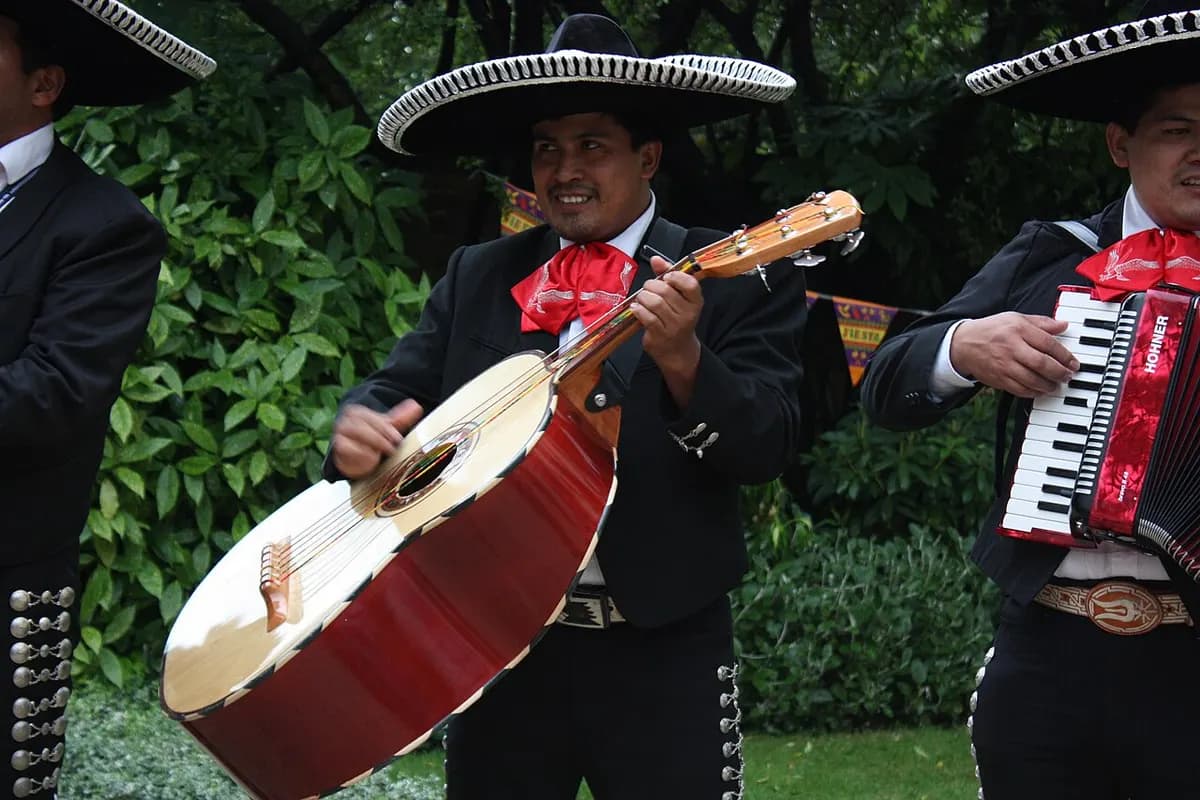
| Vihuela | Small five-string guitar with a rounded back | High, percussive strumming (the mánico) that drives the rhythm |
| Guitarrón | Large six-string bass guitar with a rounded back | Bass line, played in octaves; the low end of the band |
| Guitar | Standard Spanish guitar | Harmony and rhythm, filling between vihuela and guitarrón |
| Harp (arpa) | Folk harp | Bass and arpeggios in traditional groups; optional today |
Rhythm, Tempo & Musical Forms
Mariachi has no single tempo, because it is a repertoire of forms, each with its own beat. The ones to know:
- Son jalisciense: the regional core. It alternates or superimposes 6/8 and 3/4 (a hemiola, called sesquiáltera), so the accent shifts between two groups of three and three groups of two. "El Son de la Negra" is the signature example.
- Jarabe: a medley of sones and dance tunes; the "Jarabe Tapatío" is internationally known as the Mexican Hat Dance.
- Canción ranchera: the sung ballad of cinema and radio, in 2/4, 3/4 or 4/4, with a dramatic vocal, held high notes and violin and trumpet interludes.
- Huapango: from the Huasteca region, in a fast triple metre with falsetto breaks in the vocal line.
- Bolero ranchero: the slow romantic bolero in mariachi arrangement, popularised by Javier Solís.
- Polka, waltz and corrido: borrowed dance and narrative forms that every working mariachi also plays.
Tempos follow from the forms: sones and huapangos are fast and dance-driven, rancheras range from a lilting mid-tempo to slow and rubato, and boleros rancheros are slow. A BPM range says little here. The reliable markers are the guitar rhythm section, the paired trumpets, the massed violins and the vocal style: open and powerful, with long sustained notes and the grito.
Styles & Neighbouring Forms
It helps to separate mariachi from the other regional Mexican styles it is often lumped with:
- Traditional mariachi: string-only groups with harp and no trumpets, still played in Jalisco and studied by revival ensembles.
- Modern or "urban" mariachi: the trumpet-and-violin format of Mexico City and the film era, now the standard.
- Ranchera and corridos: closely related song forms. Ranchera is a song type mariachis play constantly; corridos are narrative ballads also performed by norteño and banda groups.
- Norteño: the accordion and bajo sexto music of northern Mexico, closer to polka than to mariachi.
- Banda: the brass-band music of Sinaloa, with tuba and clarinets instead of strings.
- Son jarocho and son huasteco: the other great Mexican son traditions, from Veracruz and the Huasteca, played by small string groups.
Within the broader Latin umbrella, mariachi stands apart from Caribbean dance music such as salsa: it has no clave, no congas and no piano montuno, and its rhythm comes entirely from guitars.
Key Artists & Recordings
A working list across the tradition:
- Mariachi Vargas de Tecalitlán: the reference ensemble; "El Son de la Negra", "La Bikina" (written by Rubén Fuentes in 1966).
- Jorge Negrete: the first great singing charro of the cinema era; "México lindo y querido".
- Pedro Infante: film star and singer; "Amorcito corazón".
- José Alfredo Jiménez: the great ranchera songwriter; "El Rey", "Ella", "Si nos dejan".
- Lola Beltrán: a defining female voice of ranchera; "Cucurrucucú paloma" (by Tomás Méndez).
- Javier Solís: the leading singer of the bolero ranchero.
- Vicente Fernández: the dominant ranchera voice of the late twentieth century; "Volver, volver", "El Rey".
- Juan Gabriel: songwriter and singer who brought pop songwriting into the mariachi format.
- Linda Ronstadt: Canciones de mi padre (1987), with Mariachi Vargas.
- Alejandro Fernández and Pepe Aguilar: the next generation of ranchera singers.
If you want only a few tracks to begin: "El Son de la Negra" for the son, "El Rey" for the ranchera, "Cucurrucucú paloma" for the huapango-flavoured ballad.
How AI Detects Mariachi
Acoustically, mariachi is easy to tell apart. A model hears a block of bowed violins, paired trumpets entering in short fanfares, a high strummed vihuela producing rapid chordal attacks and a guitarrón bass in clean octaves, all under a powerful solo voice with heavy vibrato. Few other popular styles combine massed strings and trumpets with a rhythm section that has no drums at all.
Genre AI's production taxonomy has no mariachi label. The nearest coarse label, Latin, has no subgenres, and the model prefers any coarse label that has them once it appears among its top five candidates, so Latin will rarely be the answer. The result is more likely a subgenre of a neighbouring family: Folk / Country › Folk for string-led sones, Jazz › Latin Jazz where trumpets dominate, or Classical › Modern Era, whose text prompts include "ranchera". Test a son and a ranchera side by side in the Genre AI music genre detector.
Mariachi has no label of its own in Genre AI. The closest coarse class, Latin, has no subgenres, and in practice it rarely comes up, because the model prefers a coarse label with subgenres whenever one is among its top five. What you see instead depends on the instrumentation. A string-only traditional group with harp is likely to land on Folk / Country › Folk; a slow ranchera with violins and a held vocal may go to Classical › Modern Era, a label whose prompts include "ranchera" and "grupera"; a trumpet-heavy son may read as Jazz › Latin Jazz. The model hears instruments and texture and does not count the son's hemiola, so a mariachi recording can come back under a different family from one song to the next.