Carnatic music is the classical music of South India: a tradition of raga (melodic mode) and tala (rhythmic cycle) carried by a vast repertoire of devotional compositions, sung or played by a soloist with violin, the mridangam drum and a drone. Its heartland is Tamil Nadu, Karnataka, Kerala, Andhra Pradesh and Telangana, and its capital is Chennai, where the December Music Season fills the city with hundreds of concerts every year.
This guide covers what Carnatic music is, how it differs from its northern sibling, Hindustani music, how raga and tala work, the forms of a concert, the instruments and the musicians to start with. Want to see where a classifier places a Carnatic recording? Try a clip in our free AI music genre detector, and read the note below on what its labels can and cannot say about this tradition.
What Is Carnatic Music?
Carnatic music is one of the two great branches of Indian classical music. The other is the Hindustani tradition of North India. Both share the same foundations: shruti (pitch), svara (note), raga (mode or melodic framework) and tala (rhythmic cycle). They began to diverge around the 12th and 13th centuries, as Persian and Islamic court culture reshaped music in the north; Sharngadeva's 13th-century treatise Sangita Ratnakara is often treated as the last major text the two traditions share.
The most important difference is that Carnatic music is composition-centred. Students learn through a large body of fixed songs, most of them devotional, and a concert is built around those compositions, with improvisation woven in and around them. Hindustani performance, by contrast, typically gives far more time to the free, unfolding exploration of a single raga. The Carnatic voice is also more densely ornamented: its gamakas (oscillations, slides and shakes on and between notes) are part of a raga's identity, not decoration.
It is distinct, too, from the film music it has heavily influenced. South Indian cinema and Bollywood regularly borrow ragas and Carnatic vocal technique, but film songs are short, harmonised and orchestrated for the screen. Carnatic music is improvised in performance, unharmonised, and organised around a melodic soloist, a drone and a dense rhythmic dialogue with the percussion. In that respect it is closer to the improvising traditions of jazz than to Western classical music, where the score is fixed.
History & Origins
The tradition looks back to ancient Indian musical theory and to the Vedic chant of the Samaveda, but its recognisable modern form was shaped between the 15th and 19th centuries.
Purandara Dasa (1484–1564), a devotional poet-composer from the Vijayanagara period, is called the pitamaha (grandfather or father) of Carnatic music. He organised the graded lessons, beginning in raga Mayamalavagowla, through which students still learn today.
In the mid-17th century the scholar Venkatamakhin, working at the Thanjavur court, set out in his Sanskrit treatise Chaturdandi Prakasika a mathematical scheme for classifying scales. Later standardised into the system in use today, it yields the 72 melakarta ("parent") ragas, from which hundreds of other ragas are derived.
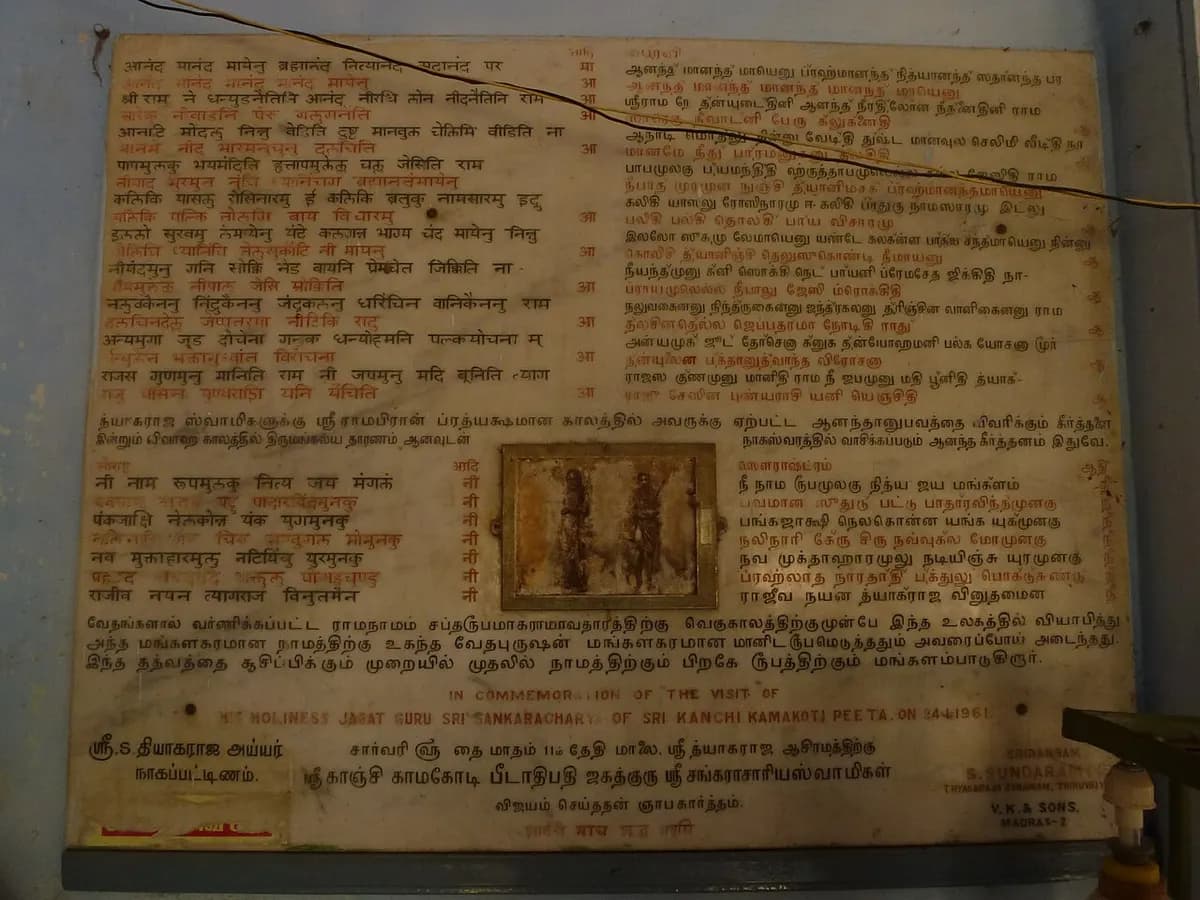
The decisive era came in the late 18th and early 19th centuries with the Trinity of Carnatic music, three composers born within a few years of each other in the town of Thiruvarur: Tyagaraja (1767–1847), Muthuswami Dikshitar (1775–1835) and Syama Sastri (1762–1827). Their thousands of kritis, mostly in Telugu and Sanskrit, form the core of the concert repertoire. Each signed his songs with a mudra (Tyagaraja with his own name, Dikshitar with "Guruguha", Syama Sastri with "Syamakrishna"), so a listener can identify the composer inside the text.
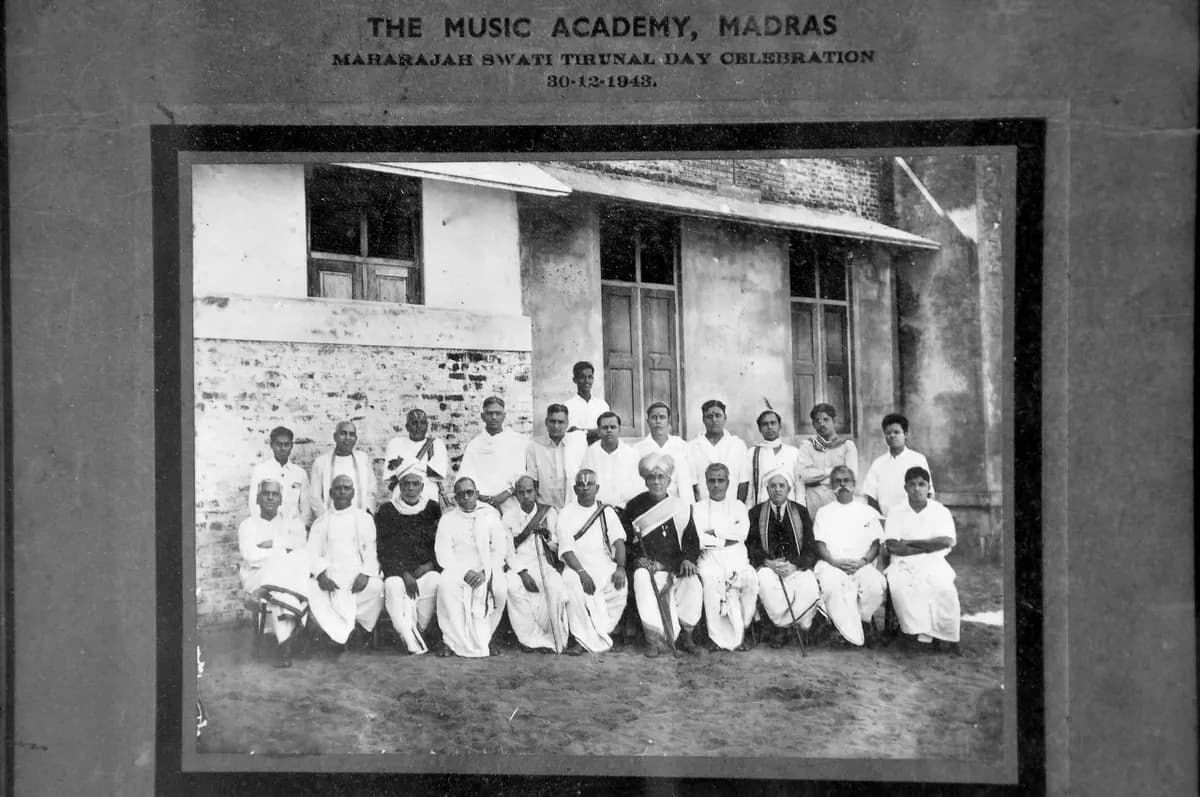
The European violin entered the tradition in the early 19th century (its adoption is traditionally credited to Baluswami Dikshitar, Muthuswami's brother) and became the standard accompanying instrument. In the 20th century, the court patronage of Thanjavur, Mysore and Travancore gave way to public concerts in Madras (now Chennai). The singer Ariyakudi Ramanuja Iyengar is credited with shaping the modern concert format, and the founding of the Madras Music Academy in 1928 launched the December Music Season, which now fills the city with hundreds of concerts each year.
Raga, Tala & the Sound of Carnatic Music
Carnatic music has no single tempo or BPM. It is organised by two frameworks:
- Raga: more than a scale; it is a set of notes with prescribed ascending (arohanam) and descending (avarohanam) paths, characteristic phrases, emphasised and sparingly used notes, and specific gamakas. The notes are sung as sa ri ga ma pa da ni, with the tonic chosen to suit the performer's voice.
- Melakarta system: the 72 parent ragas use all seven notes in a fixed order; 36 have the natural fourth and 36 the raised fourth. Derived (janya) ragas omit or reorder notes.
- Tala: a repeating rhythmic cycle, counted visibly by the musicians and audience with claps, finger counts and waves of the hand. Tala is built from units called angas (the laghu, drutam and anudrutam), so the same cycle can be subdivided in many ways.
- Drone: the tambura (tanpura) sustains the tonic and fifth throughout, so all melody is heard against a fixed reference and there are no chord changes.
- Voice-first aesthetic: even instrumentalists play in a vocal style, phrasing as if singing the words of a composition.
The most commonly heard talas:
| Tala | Beats per cycle | Grouping | Where you hear it |
|---|---|---|---|
| Adi | 8 | 4 + 2 + 2 | The most common tala; a large share of kritis and varnams |
| Rupaka | 6 (often counted as 3) | 2 + 4 | Many kritis, lighter pieces |
| Misra chapu | 7 | 3 + 2 + 2 | Kritis and devotional songs with a lilting asymmetric feel |
| Khanda chapu | 5 | 2 + 3 | Brisk compositions and folk-derived songs |
| Jhampa | 10 | 7 + 1 + 2 | Less common; heard in some classic kritis |
Forms of a Carnatic Concert
A typical concert, or kutcheri, lasts about three hours and moves through fixed and improvised forms:
- Varnam: an étude-like composition that opens many concerts, establishing the raga's key phrases.
- Kriti: the central form: a composed song in three sections, pallavi, anupallavi and charanam.
- Alapana: unmetred improvisation that unfolds a raga before a composition, without words or tala.
- Niraval: improvised melodic variations on a single line of a composition's lyric, kept in tala.
- Kalpanaswaram: improvised passages sung in note names, landing back on a chosen point of the composition.
- Tani avartanam: the extended percussion solo, played after the main piece by the mridangam and any secondary percussionists.
- Ragam-tanam-pallavi: the summit of improvisation: free raga exploration, rhythmic tanam, then a single line developed in complex rhythmic transformations.
- Lighter pieces: padams, javalis, devotional songs and the brisk tillana, usually towards the end.
The comparison with Hindustani practice is instructive:
| Trait | Carnatic (South) | Hindustani (North) |
|---|---|---|
| Centre of performance | Composed songs plus improvisation | Extended improvisation on one raga |
| Ornamentation | Dense gamakas, integral to raga identity | Smoother glides (meend), more sustained notes |
| Main percussion | Mridangam, ghatam, kanjira | Tabla, pakhawaj |
| Main melodic accompanist | Violin | Harmonium or sarangi |
| Scale classification | 72 melakartas | Ten thaats |
| Main vocal genres | Kriti, varnam, ragam-tanam-pallavi | Khayal, dhrupad, thumri |
Instruments
The standard ensemble is a principal performer, a violinist, a mridangam player and a tambura drone. Beyond that:
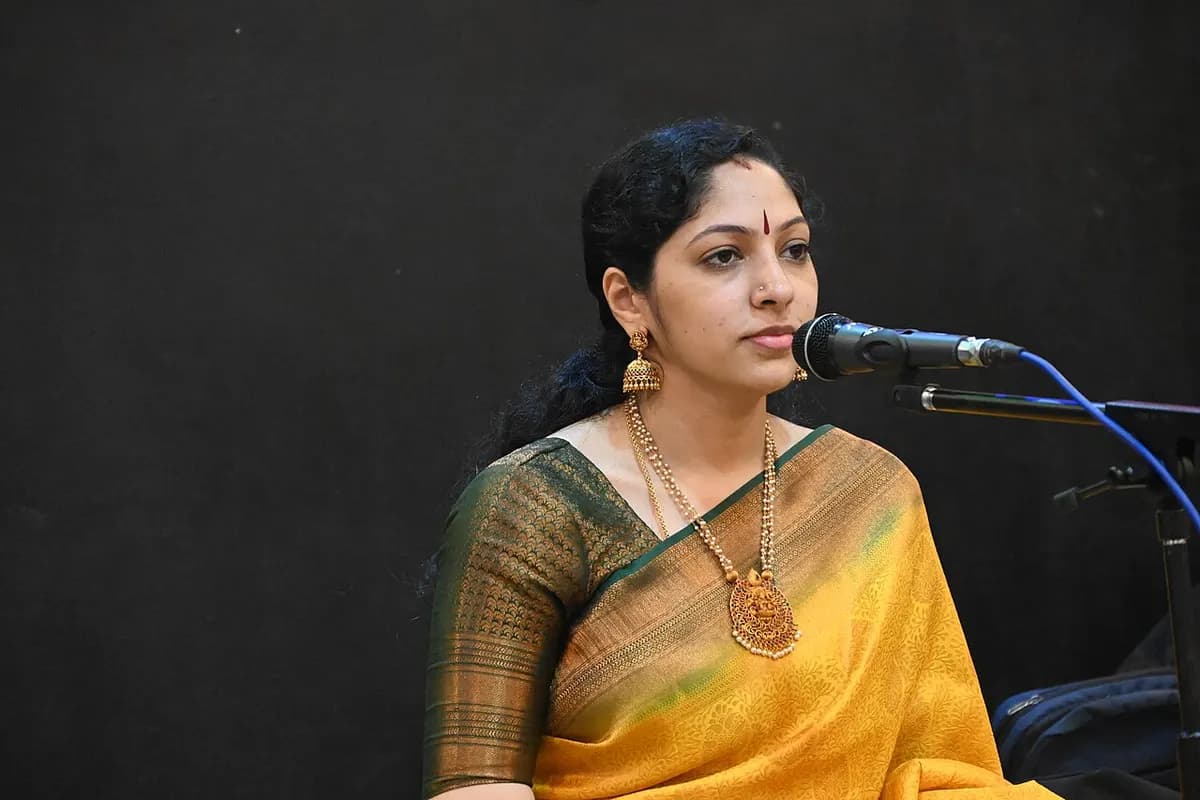
- Voice: the primary instrument of the tradition and the model for all others.
- Violin: tuned to the tonic and fifth and played seated, with the scroll resting on the player's foot; it shadows the singer and answers in improvised sections.
- Mridangam: the double-headed barrel drum at the rhythmic heart of every concert.
- Ghatam, kanjira and morsing: a clay pot, a small frame drum and a jaw harp, used as secondary percussion.
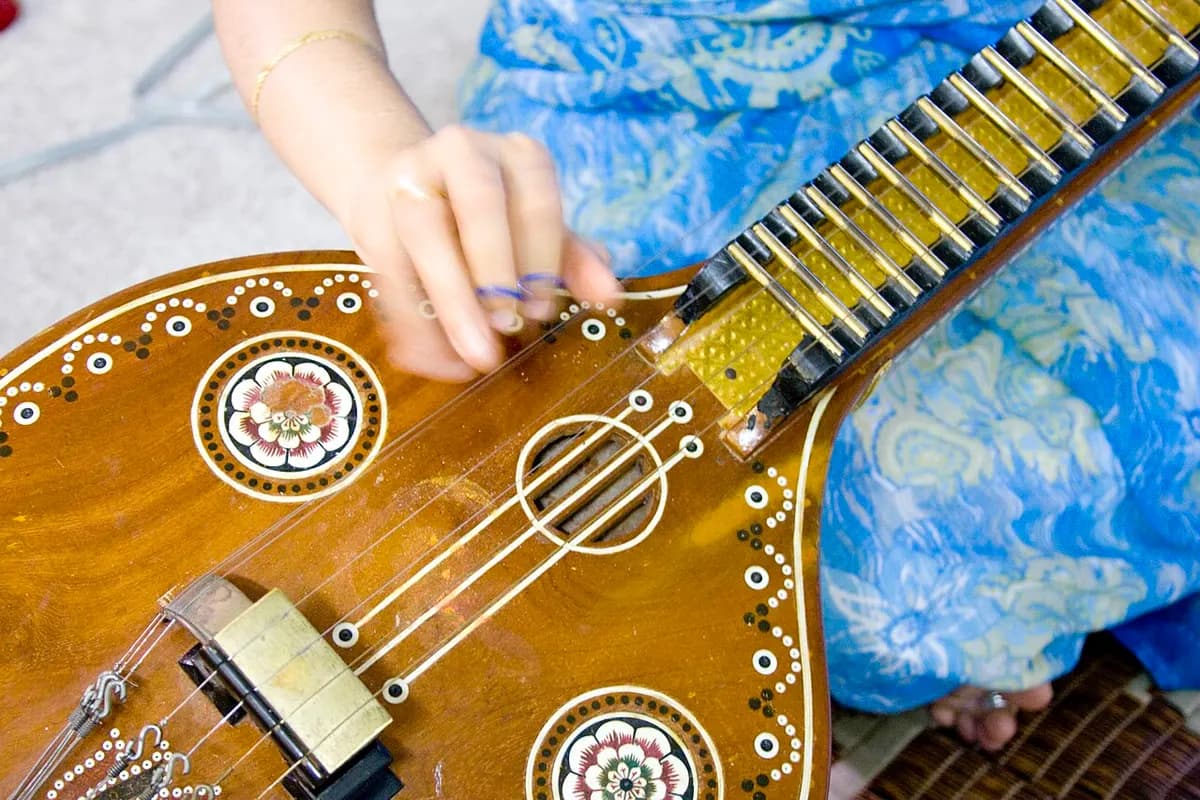
- Saraswati veena: the classic South Indian plucked lute, considered the instrument closest to the voice.
- Venu: the bamboo flute.
- Nadaswaram and thavil: the loud double-reed and its drum partner, the sound of South Indian temples and weddings.
- Adopted instruments: mandolin (U. Srinivas), saxophone (Kadri Gopalnath) and others, played in Carnatic idiom.
Key Artists & Recordings
Where to start:
- M. S. Subbulakshmi: who sang at the United Nations General Assembly in 1966 and in 1998 became the first musician to receive the Bharat Ratna, India's highest civilian honour.
- D. K. Pattammal and M. L. Vasanthakumari: with Subbulakshmi, the three women who transformed the concert stage in the mid-20th century.
- Ariyakudi Ramanuja Iyengar, Semmangudi Srinivasa Iyer and G. N. Balasubramaniam: male vocalists who shaped the modern concert.
- M. Balamuralikrishna: singer, composer and multi-instrumentalist with an exceptionally wide range.
- Lalgudi Jayaraman: the violinist whose singing style on the instrument became a school of its own.
- Palghat Mani Iyer: one of the most influential mridangam players of the 20th century.
- U. Srinivas: the mandolin prodigy who brought a new instrument into the tradition.
- T. M. Krishna, Sanjay Subrahmanyan and Bombay Jayashri: leading contemporary vocalists.
Begin with a Tyagaraja kriti sung by M. S. Subbulakshmi, then listen to a full concert recording with a tani avartanam to hear how the parts fit together.
Carnatic Music in Fusion & Film
Carnatic musicians have long crossed into other worlds. The group Shakti, formed in the mid-1970s by guitarist John McLaughlin with violinist L. Shankar, tabla player Zakir Hussain and ghatam player T. H. "Vikku" Vinayakram, blended Carnatic and Hindustani rhythm and melody with jazz fusion and remains the best-known example. Western jazz and progressive musicians have studied Carnatic rhythmic systems, in particular the spoken drum syllables called konnakol, as a way of thinking about odd metres.
In South Indian cinema, composers have drawn on ragas for generations, and many film songs are introduced to listeners by the name of the raga they are set in. A film song in a Carnatic raga is not itself Carnatic music, but it is often the doorway through which new listeners find the tradition.
How AI Detects Carnatic Music
To an audio model, Carnatic music offers several strong signals: a constant tambura drone, the ringing double-headed strokes of the mridangam, a violin closely shadowing a heavily ornamented voice, and no chord changes at all. Sections like the tani avartanam are percussion-only and sound completely different from the rest of the concert.
The challenge is the fine distinction. Carnatic and Hindustani music share the drone, the raga principle and much of the vocal palette, and an excerpt of a few seconds may not contain enough gamaka or percussion to separate them. Genre AI's production taxonomy has neither a Carnatic nor a Hindustani label; the nearest is the coarse Indian label, which has no finer breakdown, so even a perfect reading could not name the tradition. Try a clip in the Genre AI music genre detector, and read whether AI can identify a genre from a short clip.
A note on how Genre AI handles this tradition. Its production label set has no Carnatic class and no Hindustani class either. The closest category is the coarse Indian label, but it has no finer subgenres, and the classifier prefers coarse labels that do, so Indian rarely comes up at all: it wins only when no family with subgenres is among the top five candidates. What wins instead depends on the recording. Solo instrumental recordings, especially veena or violin without percussion, may be filed under Classical, because the model hears a single virtuoso instrument and an unharmonised line. A voice with drone and mridangam may come back as Folk. A fusion recording with a drum kit or electric guitar may lean toward Jazz, where one of the text prompts for the Fusion label is literally "indian fusion". Use the result to place the recording in a broad family, not to tell South Indian from North Indian classical music.