Cool jazz is the restrained, lyrical branch of modern jazz that emerged in the late 1940s as a reaction to the heat and speed of bebop. It favours soft dynamics, a light tone with little vibrato, moderate tempos, and written arrangements that use counterpoint borrowed from classical music. Miles Davis's Birth of the Cool sessions, Gerry Mulligan and Chet Baker's pianoless quartet, the Dave Brubeck Quartet and the Modern Jazz Quartet are its landmarks; on the West Coast in the 1950s it became known simply as West Coast jazz.
This guide covers where cool jazz came from, what it sounds like, the New York and California scenes, the records to start with and how it differs from hard bop. Curious how a quiet, brushed small group reads to an algorithm? Try a clip in our free AI music genre detector.
What Is Cool Jazz?
Cool jazz is modern jazz played with the temperature turned down. Its harmony comes from bebop: extended chords, chord substitutions, the same standards. Its priorities are different. In place of very fast tempos and dense solos, cool jazz values space, a pure and often breathy tone, melodic lines in the middle of the instrument's range, and arrangements in which two or more instruments play independent lines at once.
Its ancestors are easy to hear. The tenor saxophonist Lester Young had shown in the 1930s that a jazz horn could swing with a light, floating sound and very little vibrato. The Claude Thornhill Orchestra of the 1940s, arranged partly by Gil Evans, used French horns, tuba and sustained, cloud-like voicings closer to impressionist orchestral music than to a swing band. Cool jazz took those colours into small-group modern jazz.
The word "cool" describes the mood, not a fixed rulebook, and many players moved freely between cool, bebop and later styles. Miles Davis, the figure most associated with its birth, spent the mid-1950s leading one of the great hard bop quintets and then pioneered modal jazz. The soft, arranged sound itself carried on without him, mostly on the West Coast and in the work of Brubeck, the Modern Jazz Quartet and Stan Getz.
History & Origins
In the late 1940s a group of musicians gathered in Gil Evans's basement apartment on West 55th Street in New York, behind a Chinese laundry. Among them were Miles Davis, baritone saxophonist Gerry Mulligan, pianist and composer John Lewis and alto saxophonist Lee Konitz. Out of those discussions came a nonet: trumpet, trombone, French horn, tuba, alto and baritone saxophones, piano, bass and drums. It played in public only for two weeks, at the Royal Roost club in September 1948, but recorded three sessions for Capitol in 1949 and 1950. Eleven of those sides were collected on a Capitol LP titled Birth of the Cool in 1957, and the title gave the movement its name after the fact.
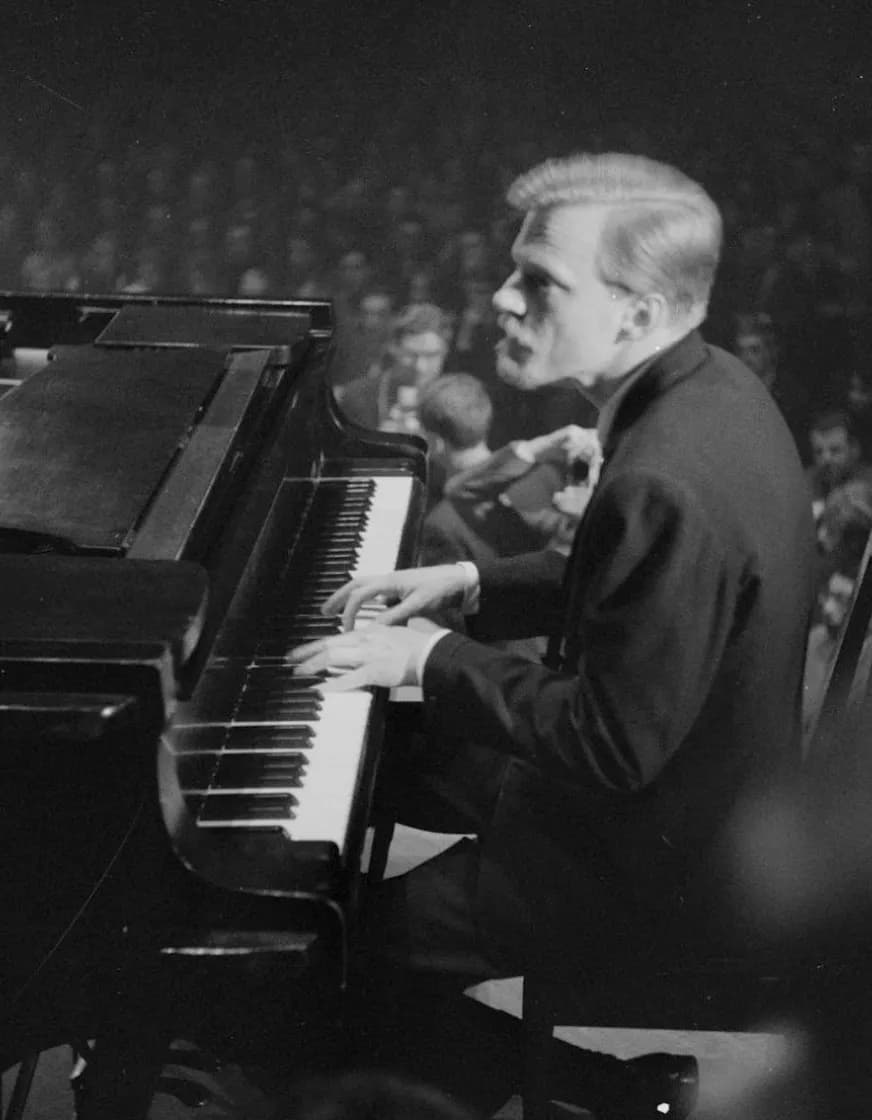
Another strand ran through the pianist Lennie Tristano and his students Lee Konitz and tenor saxophonist Warne Marsh, whose long, cool-toned, contrapuntal lines were an intellectual counterpart to bebop. Tristano's 1949 recordings also included early experiments in free collective improvisation.
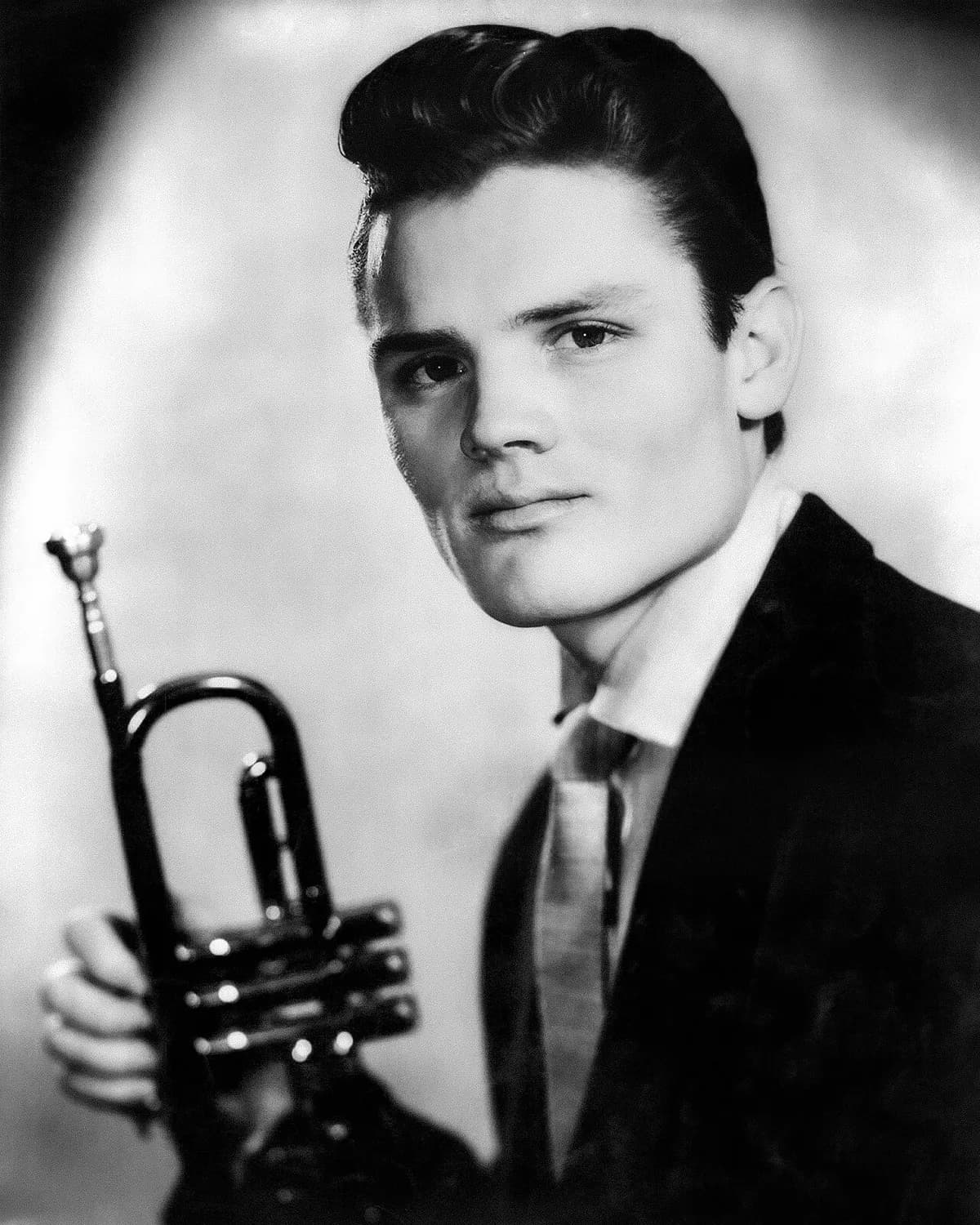
The style found its largest audience in California. Gerry Mulligan moved to Los Angeles and in 1952 formed a pianoless quartet with trumpeter Chet Baker: without piano chords, the baritone and trumpet improvised in counterpoint over bass and drums. Their versions of "Bernie's Tune" and "My Funny Valentine" made Baker a star, and Chet Baker Sings (1954) added his soft, vibrato-light voice to the picture. Around them a Los Angeles scene of studio-trained players, among them Shorty Rogers, Shelly Manne, Art Pepper, Jimmy Giuffre and Bud Shank, recorded for labels such as Pacific Jazz and Contemporary, and "West Coast jazz" became a marketing category of its own.
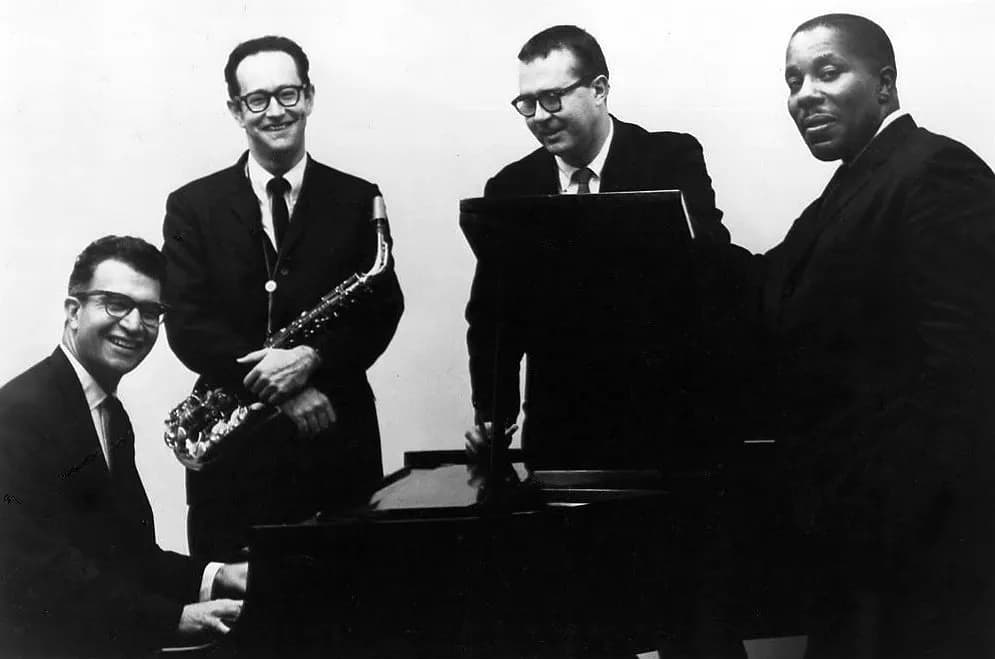
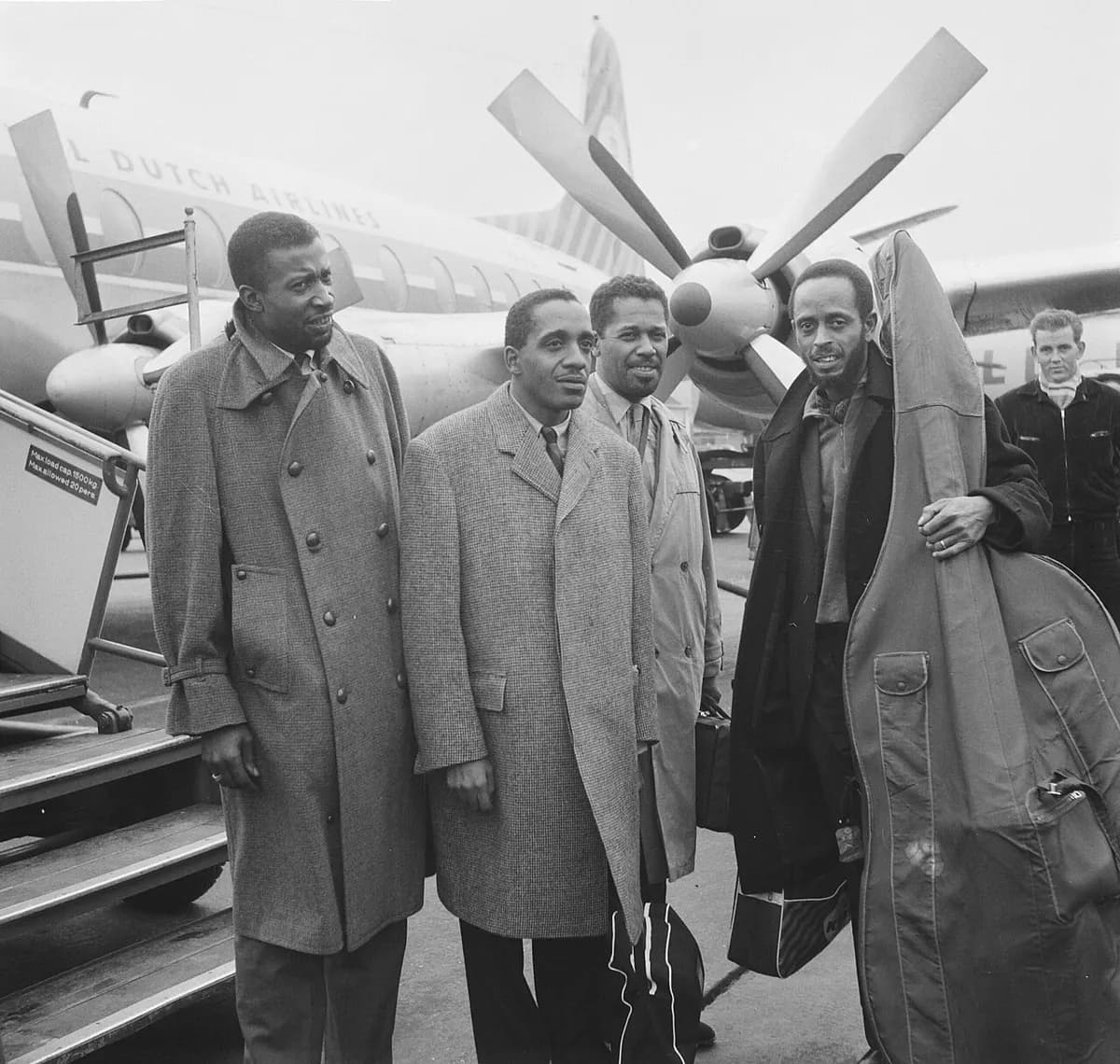
Two of the most successful groups of the decade came from the cool aesthetic. The Modern Jazz Quartet (John Lewis, vibraphonist Milt Jackson, bassist Percy Heath and drummer Connie Kay, who replaced Kenny Clarke in 1955) performed in formal dress and wrote fugues and suites alongside blues. The Dave Brubeck Quartet, with alto saxophonist Paul Desmond, toured college campuses and in 1959 released Time Out, whose Desmond composition "Take Five" in 5/4 became one of the best-selling jazz singles ever.
From the mid-1950s, the louder, blues-based hard bop drew most of the critical attention, but cool jazz kept going in other forms. It fed Third Stream music, a term coined by Gunther Schuller in 1957 for the meeting of jazz and classical composition, into Miles Davis and Gil Evans's orchestral albums Miles Ahead (1957) and Sketches of Spain (1960), and bossa nova in Brazil. Stan Getz's collaborations with João Gilberto and Antônio Carlos Jobim, above all Getz/Gilberto (1964), took that meeting with bossa nova onto the pop charts; the album won the Grammy for Album of the Year.
Key Characteristics & Sound
- Tempo: mostly slow to medium, roughly 60–90 BPM for ballads and 120–180 BPM for swingers. Fast tunes exist, but most of the repertoire sits in the relaxed middle.
- Tone: light, pure, often with little or no vibrato; alto and tenor saxophones sound airy, without rasp; trumpets frequently play with a Harmon mute or in the middle register.
- Dynamics: quiet. Drummers often use brushes, and the ride cymbal is played lightly.
- Arrangement: written ensemble passages, counterpoint between two horns, unusual instrumental colours (French horn, tuba, flute, vibraphone, cello).
- Harmony: bebop's extended chords, with a fondness for lush voicings and classical devices such as fugue, canon and rondo.
- Metre: mostly 4/4, but cool and West Coast players were early experimenters with odd metres: "Take Five" in 5/4, Brubeck's "Blue Rondo à la Turk" in 9/8.
- Mood: introspective and lyrical, often wistful; feeling is understated.
| Trait | Cool Jazz | Hard Bop |
|---|---|---|
| Emergence | Late 1940s (New York), 1950s West Coast | Mid-1950s, East Coast |
| Tone | Light, little vibrato | Full, hard-edged |
| Dynamics | Soft, brushes common | Loud, sticks, strong backbeat |
| Arrangement | Written counterpoint, unusual instruments | Two-horn themes, blues riffs |
| Influences | Lester Young, Thornhill orchestra, classical | Bebop, blues, gospel |
| Signature record | Birth of the Cool / Time Out | Moanin' |
Instruments & Arrangement
Cool jazz is unusually open about instrumentation, because colour is part of the point:
- Alto saxophone: the central voice: Lee Konitz, Paul Desmond, Art Pepper, Bud Shank.
- Baritone saxophone: Gerry Mulligan made the low horn a lyrical, agile instrument.
- Trumpet: Chet Baker and Miles Davis, often in the middle register, sometimes muted.
- Tenor saxophone: Stan Getz, Zoot Sims and the "Four Brothers" sound of Woody Herman's band.
- French horn and tuba: the signature colours of the Birth of the Cool nonet.
- Vibraphone: Milt Jackson in the Modern Jazz Quartet, with a soft, ringing attack.
- Clarinet and flute: Jimmy Giuffre and Bud Shank brought woodwinds back into modern jazz.
- Piano or no piano: Brubeck and John Lewis used it orchestrally; Mulligan famously did without it.
- Drums with brushes: Connie Kay, Shelly Manne and Joe Morello kept time softly.
Recordings of the period, especially on the West Coast, tend to sound clean and spacious, with less room noise and a softer drum sound than New York hard bop sessions.
Scenes & Related Styles
- New York cool: the Birth of the Cool circle and the Tristano school: Davis, Evans, Mulligan, Lewis, Konitz, Marsh.
- West Coast jazz: Los Angeles and San Francisco in the 1950s: Mulligan and Baker, Shorty Rogers, Shelly Manne, Art Pepper, Brubeck, the Contemporary and Pacific Jazz catalogues.
- Chamber jazz: the Modern Jazz Quartet and Jimmy Giuffre's trios, with more written form and quieter group playing.
- Third Stream: Gunther Schuller and John Lewis's fusion of jazz and classical composition.
- Bossa nova and jazz samba: the Brazilian connection through Stan Getz and Charlie Byrd. See bossa nova.
- Later echoes: the hushed, spacious end of modern jazz, much of the ECM label's catalogue, and the lounge side of smooth jazz and easy listening all owe something to cool's restraint.
Key Musicians & Essential Records
Where to start:
| Record | Artist | Year | Why it matters |
|---|---|---|---|
| Birth of the Cool | Miles Davis | 1949–50 (LP 1957) | The nonet sessions with Gil Evans, Mulligan and Lewis |
| Gerry Mulligan Quartet sessions | Gerry Mulligan & Chet Baker | 1952–53 | Pianoless counterpoint; 'Bernie's Tune', 'My Funny Valentine' |
| Chet Baker Sings | Chet Baker | 1954 | The soft vocal side of cool |
| Django | Modern Jazz Quartet | 1956 | Chamber jazz with fugue and blues |
| Art Pepper Meets the Rhythm Section | Art Pepper | 1957 | West Coast alto with Miles Davis's rhythm section |
| Miles Ahead | Miles Davis & Gil Evans | 1957 | Cool orchestration on a large scale |
| Time Out | Dave Brubeck Quartet | 1959 | 'Take Five' in 5/4 and 'Blue Rondo à la Turk' in 9/8 |
| Getz/Gilberto | Stan Getz & João Gilberto | 1964 | Cool jazz meets bossa nova; 'The Girl from Ipanema' |
Cool Jazz vs Bebop, Hard Bop & Smooth Jazz
Against bebop, cool jazz shares the harmony and drops the heat: it is slower, quieter and more arranged. Against hard bop, the contrast is almost total. Hard bop turns up the blues, the drums and the tone; cool turns them down and brings in counterpoint.
The comparison listeners most often get wrong today is with smooth jazz. Both are relaxed and easy on the ear, but smooth jazz is a 1980s radio format built on electric bass, programmed or R&B-style drums, synthesisers and short, melody-led solos. Cool jazz is acoustic, swings in the traditional sense, and improvises over the full harmonic language of modern jazz. It is also distinct from modal jazz, though the calm surface of Kind of Blue (1959) and Bill Evans's piano on it owe a lot to cool jazz.
How AI Detects Cool Jazz
For a classifier, cool jazz is identifiable as jazz from the instruments: double bass, saxophone or trumpet, and a drummer keeping a swung pattern. What separates it from its neighbours is mostly level and texture: lower loudness, softer transients from brushes, a smoother horn spectrum with less upper-harmonic bite, and sometimes vibraphone or French horn. The same cues describe easy listening, lounge music and quiet modern jazz, so the boundary is blurry. Genre AI has no cool jazz label; the coarse Jazz category is the likely answer, and the shown result will be one of its seven fine labels: Big Band / Swing, Bebop, Contemporary Jazz, Easy Listening, Fusion, Latin Jazz or Smooth Jazz.
Run a track through the Genre AI music genre detector and look at the alternatives under the main answer. They are always other jazz labels, so they show which corner of jazz the recording resembles, not whether it is jazz at all.
Genre AI will most likely place cool jazz in the coarse Jazz category from the walking bass and the horn timbres. There is no cool jazz label in the production taxonomy, so the specific answer will be a neighbour. A quiet, brushed small group with breathy saxophone may come back as Smooth Jazz or Easy Listening: the model hears low intensity, soft attacks and consonant harmony, and it has no explicit rule for acoustic versus electric instruments, which is how a human listener tells cool jazz from smooth jazz. Faster West Coast sides with more cymbal and denser solos may read as Bebop, larger arranged pieces in the Birth of the Cool or Gil Evans mould may pull toward Big Band / Swing, and Getz-era bossa nova is likely to move to Latin Jazz once the guitar's syncopated pattern takes over. One quirk of the taxonomy: the text prompts for Latin Jazz also include the phrase "modal jazz", so the calm, cool-influenced modal records of the late 1950s may land there too.