New age music is a broad, mostly instrumental style made to relax, uplift and create a calm atmosphere: slow-moving synthesizer pads, solo piano and acoustic guitar, flutes and harps, nature sounds and drones, usually with no drums or only soft hand percussion and almost no harmonic tension. It took shape in the United States in the 1970s, became a major record-store category in the 1980s through labels such as Windham Hill, and got its own Grammy in 1987.
This guide covers where the style came from, what the records are made of, the main strands under the umbrella, the artists to start with, and where the line runs with ambient, the neighbour it is most often confused with. To see how a calm piano or synth-pad track reads to a classifier, run a short clip through our free AI music genre detector.
What Is New Age Music?
New age is defined more by purpose than by instrumentation. A new age record can be a solo piano album, a synthesizer suite, a flute improvisation over ocean waves, or a choir of overdubbed voices; what links them is intent. The music is meant to calm the listener down: phrases are long, dynamics stay within a narrow band, loud accents and sudden changes are avoided, and the harmony rests on consonant major and modal sonorities that never need to resolve urgently.
That makes it partly a marketing category, and the people who make it have always said so. Many musicians filed under "new age" had no connection to New Age spirituality and disliked the label (Kitaro and Paul Winter both rejected it, Winter preferring "earth music"); record stores used it for instrumental music that did not fit jazz, classical or rock bins. In practice the term covers two overlapping things: music composed explicitly for meditation, yoga, massage and healing, and a larger body of gentle instrumental music sold in the same rack.
It is close to, but not the same as, ambient. Brian Eno framed ambient as music that could be either ignored or listened to closely, and the ambient tradition leans toward texture, abstraction and sometimes darkness. New age is usually more melodic and more openly comforting, with a tune you can hum and a tonal centre that never wavers. It also borders easy listening, which shares the soft dynamics but is song-based and arranged for orchestra, and Celtic music, from which Enya and many later new age artists borrowed melody and atmosphere.
History & Origins
The precursors arrived in the 1960s. Jazz clarinettist Tony Scott's Music for Zen Meditation (1964), recorded with Japanese musicians on shakuhachi and koto, is often named as the first new age recording. Flautist Paul Horn recorded Inside (1968) alone inside the Taj Mahal, using the building's long reverberation as an instrument. Irv Teibel's Environments series (1969–1979) sold LPs of ocean surf and other natural sound for listening at home, a format that new age would later absorb wholesale. The synthesizer and minimalism also fed in, as did the spacious electronic records coming out of Germany in the early 1970s.
The movement proper is usually dated to Steven Halpern's Spectrum Suite (1975), a set of slow electric-piano pieces conceived explicitly for relaxation and healing. Halpern released it himself and sold it through health-food shops, yoga studios and metaphysical bookstores, the network that later carried much of the genre; sources differ on the title of the very first pressing, which Halpern has said was renamed because shops did not understand it. Around the same time Paul Winter was mixing jazz, folk, world instruments and recorded whale and wolf sounds with the Paul Winter Consort, and the German musician Deuter was mixing flute, guitar and electronics with the sound of the sea on D (1971) and Aum (1972).
The commercial turning point came from a small label in Palo Alto, California. Windham Hill Records, founded in 1976 by guitarist William Ackerman and Anne Robinson, started on a $300 investment and built a catalogue of quiet, closely recorded acoustic music: Ackerman's own guitar, pianist George Winston's seasonal albums Autumn (1980) and December (1982), guitarist Michael Hedges, pianist Liz Story. Ten years after its founding it was grossing more than $26 million a year without radio hits. In 1984 Peter Baumann, formerly of Tangerine Dream, launched Private Music, whose early signings included Yanni and Suzanne Ciani, and labels such as Narada grew alongside it.
Radio gave the style a home of its own. Hearts of Space, Stephen Hill's programme of slow, spacious music, began on Bay Area radio in 1973 and was picked up by NPR for national syndication in 1983, defining a "space music" wing of the genre. In 1987 the Recording Academy introduced a Grammy for Best New Age Recording; the first award went to the Swiss harpist Andreas Vollenweider for Down to the Moon. The category was Best New Age Performance from 1988 to 1991, became Best New Age Album in 1992 and, from 2023, Best New Age, Ambient or Chant Album.
The late 1980s and 1990s brought the genre's biggest sellers. Kitaro, the Japanese synthesist who scored NHK's documentary series The Silk Road from its first broadcast in April 1980, signed to Geffen in the mid-1980s and reached a world audience. Enya, the Irish singer formerly of Clannad, released Watermark (1988), whose single "Orinoco Flow" was an international hit, and later Shepherd Moons (1991), layered multi-tracked vocals over synthesizer and piano; she has won the new age Grammy four times, and A Day Without Rain reached No. 2 on the Billboard 200 in 2001. Yanni's Live at the Acropolis, filmed in Athens in September 1993 and released in 1994, turned the style into orchestral spectacle and became one of the most successful pledge-drive programmes in PBS history. Projects such as Enigma (MCMXC a.D., 1990) and Deep Forest mixed new age pads with dance beats and sampled chant.
Since the 2000s the style has split in two directions. Commercially it lives on as functional music: meditation, sleep, spa and study playlists on streaming services, where gentle piano and pads are produced in enormous quantity. Critically it has been rediscovered: the reissue label Light in the Attic's I Am the Center: Private Issue New Age Music in America 1950–1990 (2013) and its Japanese environmental-music compilation Kankyō Ongaku (2019) put private-press and long-unavailable records of the 1970s and 1980s back into print for a new audience.

Key Characteristics & Sound
What identifies a new age record:
- Tempo: frequently no steady pulse at all; where there is one, it is slow and gentle, with no backbeat to dance to. Rhythm, when present, comes from arpeggiated piano or guitar, not a drum kit.
- Harmony: diatonic and consonant, with major keys, Lydian and Dorian colours, suspended chords, and long pedal tones. Progressions move slowly and avoid dominant tension.
- Melody: simple, singable, often pentatonic, and repeated, with little development in the classical sense.
- Dynamics: a narrow range with soft attacks; crescendos are gradual swells that do not build to a climax.
- Space: long reverb tails, wide stereo pads and plenty of silence between phrases. Recording quality is a selling point: Windham Hill's close, clean acoustic sound was part of its identity.
- Texture: sustained synthesizer pads, drones and overdubbed voices form a bed under one lead instrument.
- Field recordings: water, birdsong, rain, wind and whale song, either as background or as the main event.
- Vocals: rare in the early years; later wordless choirs, chant (Tibetan, Sanskrit, Gregorian) and, after Enya, layered ethereal singing.
The instruments that recur most often:
| Instrument | Typical role | Associated artists |
|---|---|---|
| Solo piano | Lead melody and arpeggiated rhythm | George Winston, Liz Story, Yanni |
| Steel-string acoustic guitar | Open tunings, percussive fingerstyle | William Ackerman, Michael Hedges |
| Synthesizer pads and sequencers | Harmonic bed, slow evolving textures | Kitaro, Vangelis, Steve Roach |
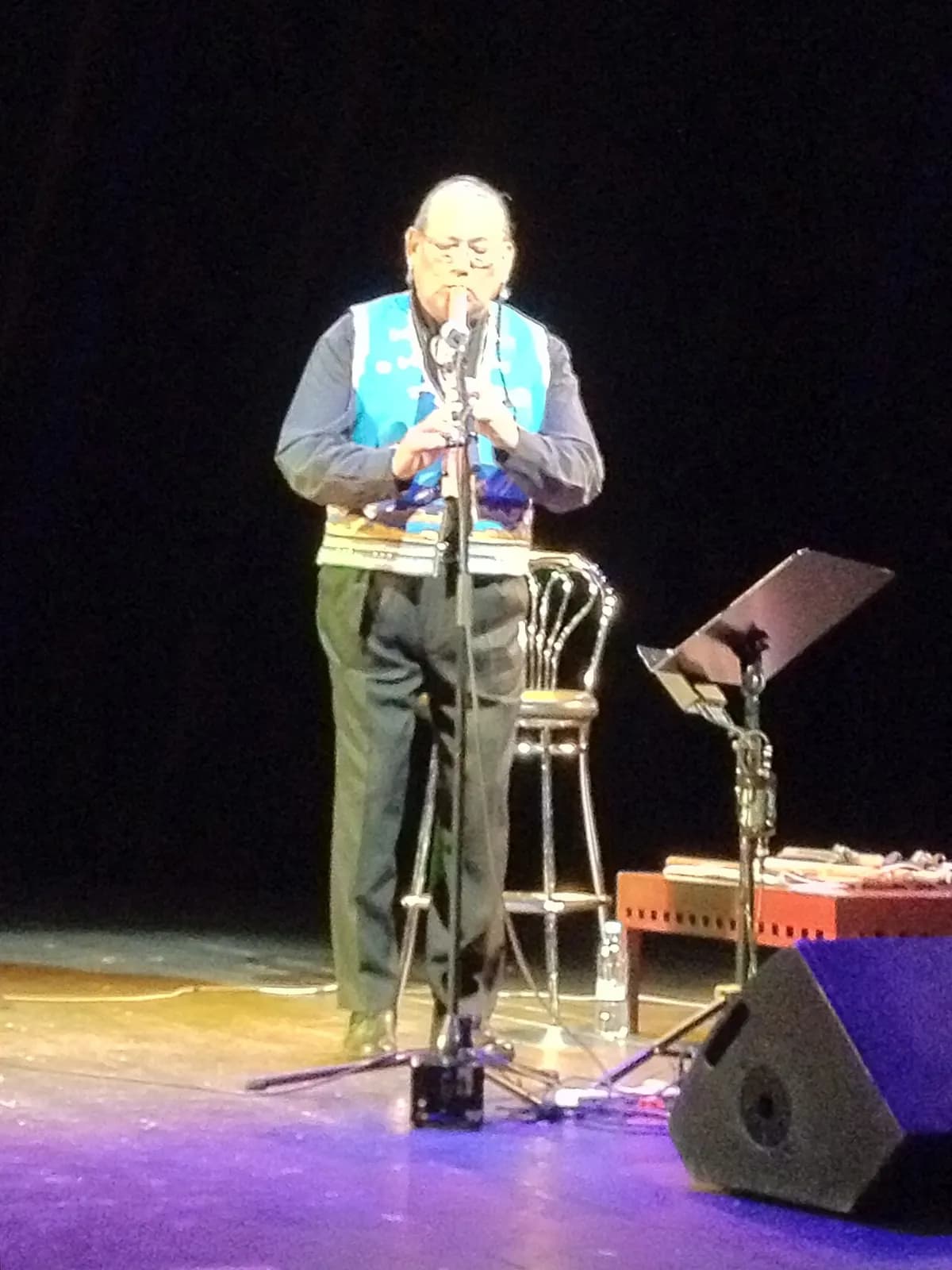
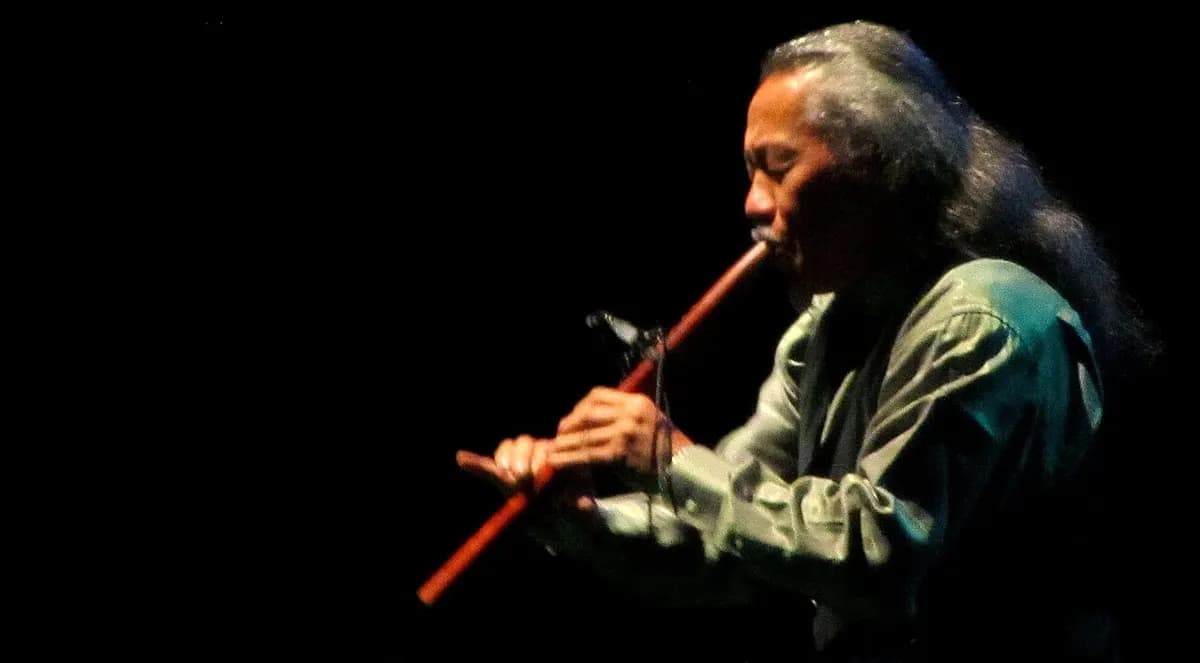
| Flute and shakuhachi | Breathy lead lines over drone | Paul Horn, Deuter, R. Carlos Nakai (Native American flute) |
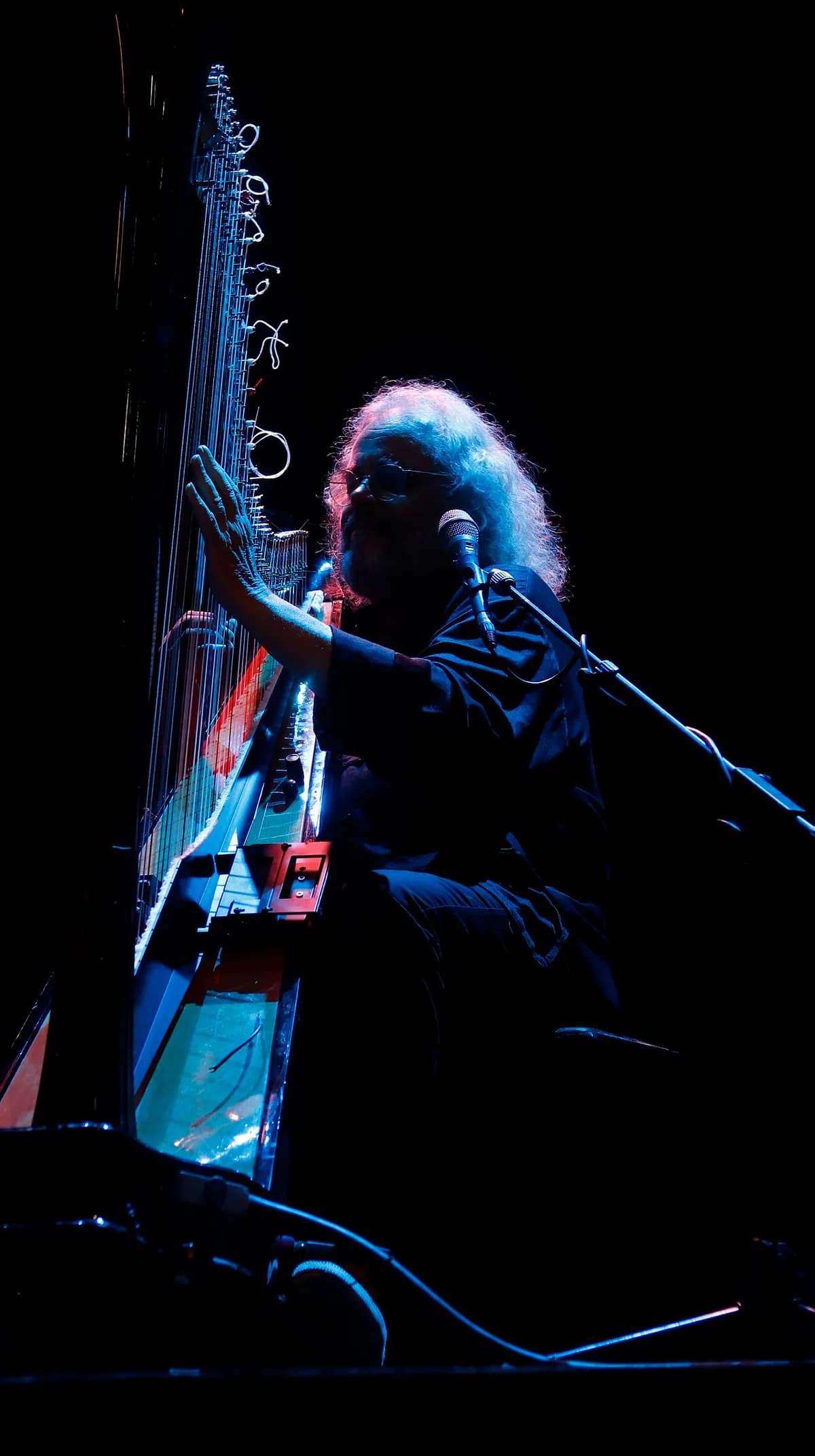
| Electric or Celtic harp | Glistening arpeggios and lead | Andreas Vollenweider |
| Layered voice | Choir-like pads, wordless melody | Enya |
| Singing bowls, gongs, tanpura | Drones and resonance for meditation | Meditation and healing releases |
Strands & Subgenres
"New age" is an umbrella, and record shops and streaming services use several narrower labels under it:
- Meditation and healing music: music composed specifically to accompany meditation, yoga or bodywork, from Steven Halpern to the chant albums of Deva Premal.
- Acoustic or "Windham Hill" new age: solo piano and guitar, intimate and melodic, close to folk and chamber music.
- Space music: slow electronic textures with no clear beat, as featured on Hearts of Space; it overlaps heavily with ambient.
- Contemporary instrumental: larger, more cinematic productions with orchestra and drums, the lane of Yanni and Mannheim Steamroller.
- Celtic new age: Enya, Loreena McKennitt and their followers, drawing on Irish melody, harp and pipes; see Celtic music for the traditional source.
- Native American flute: R. Carlos Nakai's records made the cedar flute one of the genre's signature sounds.
- New age with beats: Enigma, Deep Forest and later chill-out compilations that put new age pads over a groove, shading into downtempo.
- Japanese environmental music: kankyō ongaku, made in the 1980s by composers such as Hiroshi Yoshimura and Satoshi Ashikawa for spaces and everyday life, now widely reissued.
Key Artists & Recordings
Where to start:
- Paul Horn: Inside (1968), solo flute recorded in the Taj Mahal.
- Steven Halpern: Spectrum Suite (1975), the record most often credited with starting the movement.
- George Winston: Autumn (1980) and December (1982) on Windham Hill, the template for solo new age piano.
- William Ackerman: founder of Windham Hill and its guitar voice; later winner of the Grammy in the category, in 2005, for Returning.
- Michael Hedges: Aerial Boundaries (1984), percussive two-handed guitar technique that influenced acoustic players far beyond the genre.
- Andreas Vollenweider: Down to the Moon (1986), winner of the first new age Grammy.
- Kitaro: the Silk Road soundtracks and decades of synthesizer suites, with 16 nominations in the new age category and one win, for Thinking of You (2001).
- Enya: Watermark (1988) and Shepherd Moons (1991), her first new age Grammy winner; "Orinoco Flow" is the genre's best-known single.
- Yanni: Live at the Acropolis (1994), new age as a televised orchestral concert, filmed at the Herodes Atticus theatre.
- Paul Winter Consort: jazz, folk and nature recordings; Winter has six wins in the category, four with the Consort and two under his own name.
- Ray Lynch: Deep Breakfast (1984), bright, melodic synthesizer pieces that Lynch first released on his own label and that went Platinum in 1993.
New Age vs Ambient, Classical & Easy Listening
New age sits between several larger categories, and the boundaries are mostly matters of intent and arrangement:
| Trait | New Age | Ambient | Easy Listening | Classical |
|---|---|---|---|---|
| Main goal | Calm, uplift, meditation | Atmosphere, texture, attention optional | Pleasant background for everyday life | Concert listening, formal development |
| Melody | Simple and prominent | Often absent or fragmentary | Familiar song melodies | Developed themes |
| Harmony | Consonant, static, modal | Anything from consonant to dissonant drones | Tonal pop and standards harmony | Full tonal or post-tonal language |
| Pulse | None or slow, no drum kit | Usually none | Steady, light rhythm section | Varies widely |
| Typical forces | Piano, guitar, synth pads, flute, nature sounds | Synths, processed recordings, drones | Orchestra, strings, light vocals | Orchestra, chamber ensembles, soloists |
| Key names | Winston, Kitaro, Enya, Yanni | Eno, Harold Budd, Stars of the Lid | Mantovani, Percy Faith, Bert Kaempfert | From Bach to Pärt |
How AI Detects New Age Music
To an audio model, new age is defined by an absence: with no drum kit, the low-frequency onset pattern that drives most genre decisions is missing or very weak. What fills the spectrum instead is sustained harmonic energy (pads and drones with slow envelopes, piano with long decays, wide reverberant stereo) plus, in many recordings, broadband nature sound such as rain or surf.
That absence also makes it hard to separate. Calm piano can just as easily be classical, a pad-and-drone piece is acoustically close to ambient, and an orchestral Yanni track overlaps with a film score. The cues that set new age apart are subtle: a simple, repeated melody, consonant harmony, and none of the dynamic contrast typical of concert music. Genre AI's production taxonomy has no new age label of its own. Try a clip in the Genre AI music genre detector and look at the alternatives listed under the top answer as well as the first label.
In Genre AI the most likely answer for new age is the coarse Classical label. The model prefers coarse labels that have subgenres, and Classical does; it is also where the words "new age" sit in the label set, as one of the text descriptions of the Gilded Age subgenre, so a fine answer of Gilded Age, Contemporary Classic or Modern Era is plausible even for synthesizer music. Solo piano in the George Winston style should land there most consistently, because a single acoustic piano with sustain pedal sounds much the same in both genres. The coarse Ambient label has no subgenres and wins only when no family with subgenres makes the top five, so for Hearts of Space-style pad and drone pieces it is possible but not the default; Electronic Dance, with a sibling such as Abstract / IDM / Leftfield or Techno (the latter is described partly as "ambient techno"), is the other likely home for purely electronic tracks. There is no film score or downtempo label either, so orchestral Yanni tracks will most likely come back as Classical, and Enigma-style tracks with a gentle beat as Electronic Dance. A recording that is mostly rain, surf or wind may not be treated as music at all, since the model first checks for background noise. Treat the answer as a family placement and read the runners-up together.