Qawwali is the devotional music of the Sufis of South Asia: long, slowly building songs in which a lead singer and a chorus repeat lines of mystical poetry over harmonium, tabla and rhythmic handclapping, building in intensity with the aim of carrying listeners into a state of spiritual ecstasy. It grew up around the shrines of the Chishti Sufi order in Delhi and today belongs equally to Pakistan, India and the South Asian diaspora.
This guide explains what qawwali is for, where it came from, how a performance is built, the poetic forms it sings, the instruments of a qawwal "party" and the artists who carried it from shrine courtyards to world stages. If you have a recording and want to know how a machine hears it, try a clip in our free AI music genre detector, and read the note further down on why devotional traditions like this one are hard for genre classifiers.
What Is Qawwali?
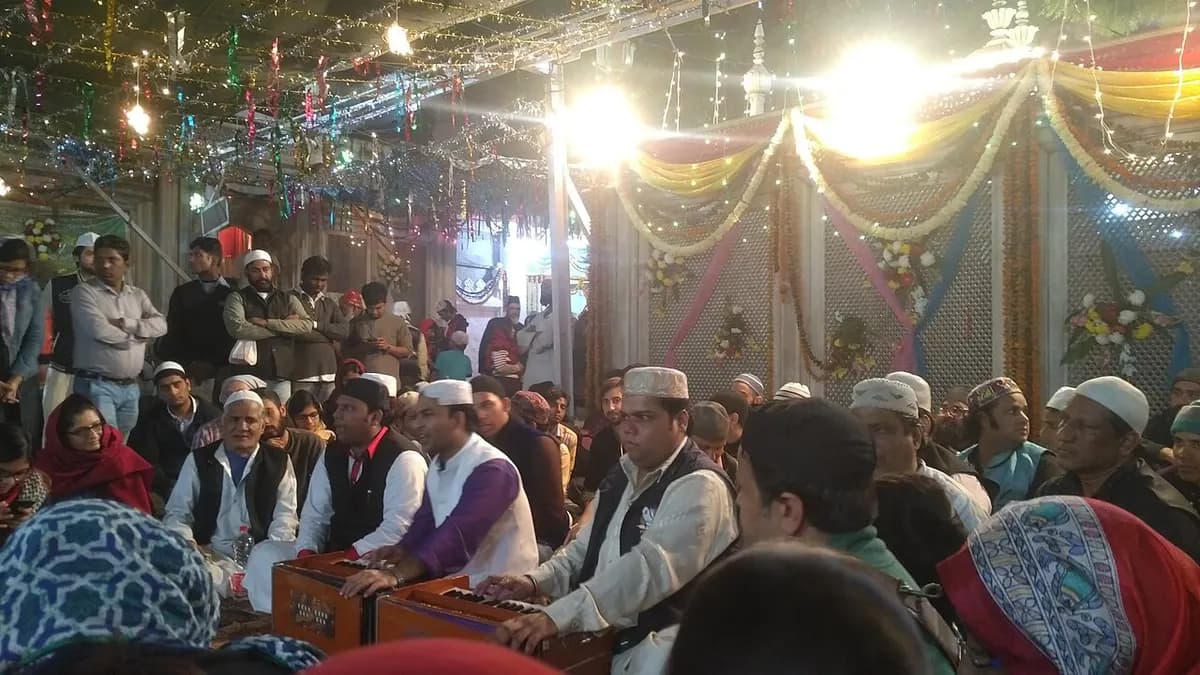
Qawwali is first of all a religious practice, and only second a genre. Its home is the mehfil-e-sama, the "assembly for listening", in which Sufi devotees gather, often at a dargah (the shrine of a saint), to hear poetry sung in praise of God, the Prophet Muhammad, Imam Ali and the saints of the order. Sama, "listening", is regarded within the Chishti tradition as a legitimate spiritual discipline: music is the vehicle, and the goal is remembrance of God and the awakening of divine love.
The word comes from the Arabic qaul, "saying" or "utterance"; a qawwal is one who sings the qaul, and a qawwali is what he sings. Performers are traditionally men from hereditary musical families, singing as a group called a party. The languages are those of the Sufi poetic canon in the subcontinent: Persian, Urdu, Punjabi, Hindi and the older Hindavi and Braj, with Saraiki and Sindhi in the west.
What separates qawwali from other devotional music is the way a performance builds. A single piece may last twenty minutes or more. The lead singer chooses a line, the party repeats and varies it, the clapping and the tabla tighten, and the music climbs in waves, with no fixed verse–chorus plan. It shares the call-and-response and communal energy of gospel, but its melody works within a raga, with no Western chord progression underneath. Compared with the qawwali songs of Bollywood, it is longer, freer and addressed to a congregation.
History & Origins
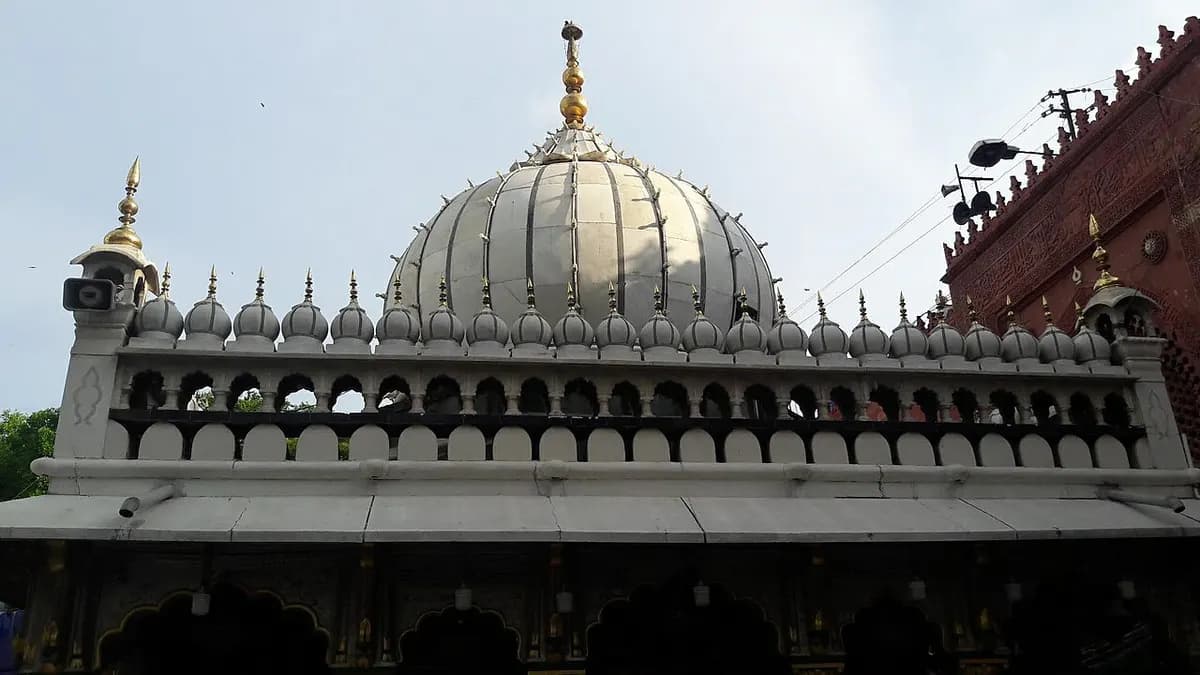
The roots of qawwali lie in the musical gatherings of Persian and Central Asian Sufism, which arrived in the subcontinent with the Sufi orders from the 11th and 12th centuries. Of these, the Chishti order, whose great saints include Moinuddin Chishti of Ajmer and Nizamuddin Auliya of Delhi, embraced sama most fully, and it is around Chishti shrines that qawwali took shape.
Tradition credits the form's foundation to Amir Khusrau (1253–1325), the poet, musician and devoted disciple of Nizamuddin Auliya in the Delhi Sultanate. Khusrau is said to have joined Indo-Persian poetic and musical practice to Indian raga, writing devotional verse in Persian and Hindavi for the sama gatherings, and several pieces still sung today are attributed to him, among them the qaul "Man Kunto Maula", built on the Prophetic saying "of whomever I am master, Ali is his master", and the closing song "Aaj Rang Hai". How much of this repertoire Khusrau personally composed cannot be proven, and scholars treat the attributions as tradition, not documented authorship. What is clear is that the lineage of qawwals in Delhi, known as the Qawwal Bachchon ka Gharana, traces itself back to the circle of singers around Khusrau.
For centuries qawwali remained a shrine practice. The 20th century changed its scale. Gramophone and radio carried it out of the dargah, and after the Partition of 1947 the tradition flourished on both sides of the new border. Indian cinema adopted the filmi qawwali as a set-piece: "Na To Karvaan Ki Talaash Hai" from Barsaat Ki Raat (1960) is a classic long example and topped the music charts that year. In Pakistan, qawwali became one of the country's most popular musics.
The Sabri Brothers were the first qawwals to perform in the United States and other Western countries: their 1975 American tour included a concert at Carnegie Hall, and their promoter on that tour, Beate Gordon, suggested the short name the group has used since. A decade later Nusrat Fateh Ali Khan began his own international career, appearing at the WOMAD festival in London in the summer of 1985. He sang on Peter Gabriel's soundtrack for The Last Temptation of Christ (released as Passion, 1989) and signed to Gabriel's Real World label in 1989, where he recorded five traditional albums and the experimental Mustt Mustt (1990) with Canadian guitarist Michael Brook. He died in 1997; his Real World records and festival appearances, along with those of the Sabri Brothers, were the main route by which qawwali reached audiences outside South Asia.
Key Characteristics & Sound
You can usually recognise qawwali by these traits:
- Raga-based melody: the music sits within a raga of North Indian classical practice, with the tonic held by the harmonium and no chord progression.
- Tala: rhythm runs in cycles of Hindustani tala, most often the 8-beat keherwa and the 6-beat dadra, marked by the tabla or dholak and by the chorus's handclaps. Tempo is not fixed: a piece typically starts slowly and accelerates over its length.
- Lead and chorus: one or two lead singers improvise and ornament; side singers and the chorus repeat key lines, answering and reinforcing.
- Repetition as method: a single line can be sung dozens of times, each time with new emphasis, drawing the listener further into its meaning.
- Sargam and wordless passages: virtuoso solmisation runs (sa-re-ga-ma) and rhythmic syllables punctuate the poetry, especially in the Punjabi style popularised by Nusrat.
- Girah: the lead singer inserts verses from other poems into the song being sung, an improvised commentary that connects one text to another.
- Building to a peak: the performance is shaped to reach states of spiritual ecstasy (hal or wajd) in listeners; dynamics and tempo climb toward that point.
Qawwali repertoire is organised by the kind of devotional poem being sung:
| Form | Addressed to | Typical place in a session |
|---|---|---|
| Hamd | God (Allah) | Often at or near the opening |
| Qaul | The Prophet's saying about Ali | Traditional opening, e.g. "Man Kunto Maula" |
| Naat | The Prophet Muhammad | Early in the programme |
| Manqabat | Imam Ali, the Prophet's family, Sufi saints | Middle of the session, often for the shrine's saint |
| Ghazal | The Beloved, read mystically as God | Middle of the session |
| Kafi | Mystical Punjabi or Sindhi poetry | Regional repertoire, e.g. Bulleh Shah |
| Rang | Celebration of the master–disciple bond | Traditional closing, "Aaj Rang Hai" |
Instruments & the Qawwal Party
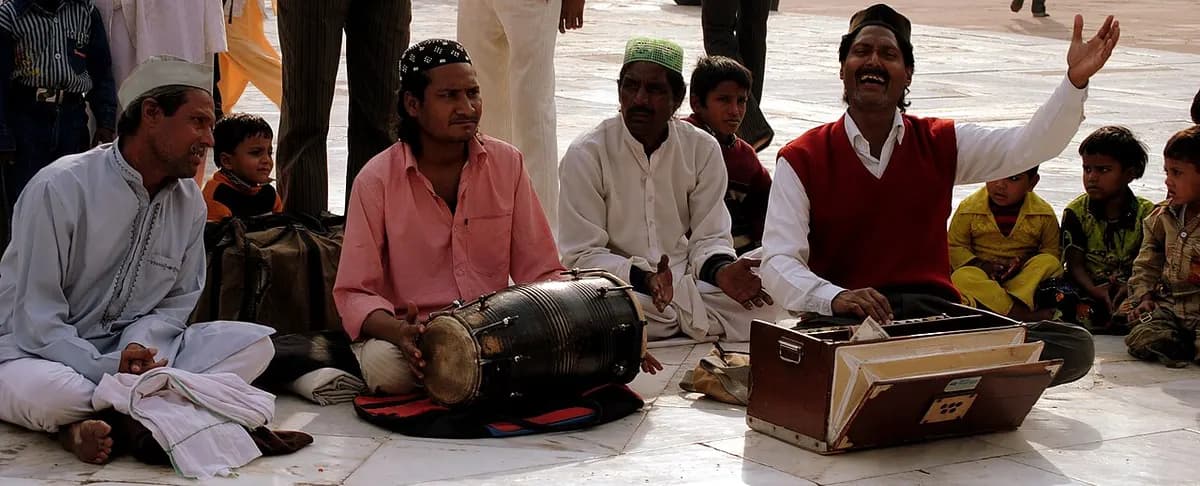
A traditional qawwal party has eight or nine men, seated cross-legged on the ground in two rows:
- Lead singer: chooses the poetry, sets the raga, improvises and shapes the arc of the performance.
- Side singers: one or two, who take over phrases, support the lead and answer him.
- Harmonium: one or two hand-pumped reed organs, which may be played by the lead singer, a side singer or someone else. The hand-pumped harmonium was adapted in India from European reed organs in the late 19th century and became standard in qawwali in the 20th; before it, the bowed sarangi accompanied the voice.
- Tabla and dholak: the tabla pair or the barrel-shaped dholak drives the tala; a single percussionist may play both at once, one with each hand.
- Chorus and handclaps: four or five men in the back row repeat key verses and clap on the beats of the cycle, a sound as central to qawwali as the palmas are to flamenco.
Recordings of shrine performances are often raw, with open air and crowd noise, while studio and concert recordings close-mic the voices and harmonium. Fusion projects from the late 1980s onward added bass, drum machines, guitars and strings, and Pakistan's Coke Studio television series, on air every year since 2008, made polished live-band qawwali a mainstream format for a new generation.
Styles, Lineages & Offshoots
Qawwali is one tradition with several clearly audible branches:
- Shrine (dargah) qawwali: the original setting, at shrines such as Nizamuddin in Delhi, Ajmer Sharif and Data Darbar in Lahore, especially during the urs (death anniversary) of a saint.
- Delhi lineage: the Qawwal Bachchon ka Gharana, with its emphasis on the Khusrau repertoire and classical refinement; Fareed Ayaz and Abu Muhammad are well-known modern exponents.
- Punjabi style: the powerful, sargam-heavy style of the Fateh Ali Khan family, built for large audiences and long climbs.
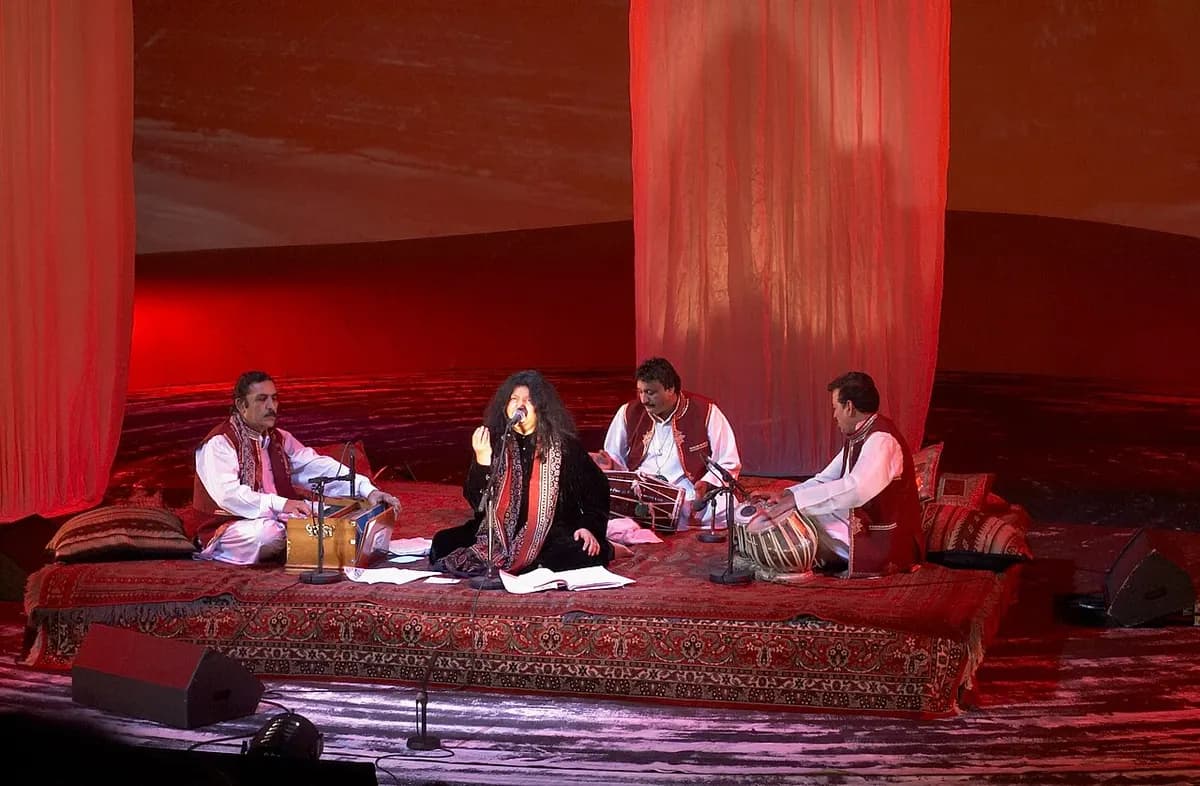
- Concert qawwali: shortened, staged performances for audiences outside the Sufi context, from Carnegie Hall to European festivals.
- Filmi qawwali: the Indian film version: a set-piece song-and-dance scene, frequently secular or romantic, sometimes devotional. A. R. Rahman's "Khwaja Mere Khwaja" (Jodhaa Akbar, 2008) and "Kun Faya Kun" (Rockstar, 2011) are well-known modern examples.
- Fusion and remix: Nusrat's collaborations with Michael Brook, remixes for club audiences, and Coke Studio arrangements that place the qawwali core inside a rock or electronic band.
- Sufi song (kafi): closely related solo singing of Punjabi and Sindhi mystical poetry, associated with singers such as Abida Parveen, and often grouped with qawwali by listeners.
Key Artists & Recordings
Where to start:
- Nusrat Fateh Ali Khan (1948–1997): the singer who made qawwali global; start with "Allah Hoo", "Dam Mast Qalandar" and the Real World releases, then Mustt Mustt (1990) for the fusion side.
- Sabri Brothers: Ghulam Farid Sabri and Maqbool Ahmed Sabri; start with "Tajdar-e-Haram", which they also recorded for the Pakistani film Sahaaray in 1982, and "Bhar Do Jholi Meri".
- Aziz Mian: known for very long, philosophical, fiercely delivered performances.
- Fareed Ayaz & Abu Muhammad: leading voices of the Delhi lineage, now based in Karachi.
- Rahat Fateh Ali Khan: Nusrat's nephew, who bridged the family tradition with Bollywood playback singing.
- Rizwan-Muazzam: brothers and nephews of Nusrat, performing together as a qawwali group since the late 1990s.
- Atif Aslam: his version of "Tajdar-e-Haram" opened Coke Studio's eighth season in 2015 and brought the Sabri classic to a pop audience.
- Abida Parveen: the great Sufi singer of kafi, essential listening alongside qawwali.
A short route through it: the Sabri Brothers' "Tajdar-e-Haram" for the classic form, a live Nusrat "Dam Mast Qalandar" for the ecstatic climb, and Coke Studio's "Tajdar-e-Haram" for how the tradition sounds to its youngest listeners.
Listening to Qawwali Today
Qawwali now lives in two worlds at once. At shrines it remains worship: performances take place on Thursday evenings and during the urs festivals, listeners offer money to the singers as a gesture of devotion, and the poetry is understood as prayer. On streaming platforms and festival stages it is heard as music by audiences who may not follow the words at all.
Knowing the first context helps with the second. The repetitions that can feel long on a playlist are the method of the form, and the accelerations are built for a gathering of listeners. Reading a translation of the poem first changes how the music lands; English versions of the best-known qawwalis are easy to find. A qawwali in a film is usually cut to a few minutes, while a devotional performance of the same text can run far longer.
How AI Detects Qawwali
Acoustically, qawwali has a distinctive cluster of features: a sustained harmonium drone and melody, tabla or dholak strokes, dense handclaps on a repeating cycle, a strong male lead voice with heavy ornamentation, and a chorus repeating short phrases. Over a long excerpt you can also hear the characteristic accelerando.
The difficulty is that almost none of this is unique to qawwali. Harmonium and tabla are shared with Hindustani classical music, ghazal, bhajan, Punjabi folk and much of Bollywood. What makes a performance qawwali is mostly in the words and the setting: the Sufi poetry, the devotional function, the shrine. So a genre classifier can at best place qawwali in a broad family of related music. Run a clip through the Genre AI music genre detector, and see our explainer on why songs get multiple genre labels.
Genre AI's production taxonomy has no Qawwali class, and neither "qawwali" nor "Sufi" appears among the labels' text prompts. The closest label is the broad Indian one: harmonium, tabla and raga-based melody point there. Indian has no subgenres, though, and the model gives priority to any family that does have them whenever one appears in its top five. A party with a strong chorus and handclaps may therefore come back as Funk / Soul › Gospel, a sparse harmonium-and-voice recording as Folk / Country › Folk, and a studio fusion version with drum kit and bass under a Rock or Electronic Dance label. Arab / Middle Eastern, the other plausible broad reading for ornamented, melismatic singing, has no subgenres either and faces the same hurdle. Treat any result as a rough family resemblance, not a verdict on whether a recording is qawwali.