Free jazz is the form of jazz that abandons some or all of the rules that held the music together until the late 1950s (fixed chord changes, regular song forms, a steady tempo, even a shared key) in favour of collective improvisation in which the players shape the structure as they go. It emerged in New York and Los Angeles around 1959–1960 with Ornette Coleman and Cecil Taylor, took its name from Coleman's 1961 album Free Jazz, and reached its most intense point in the mid-1960s with Albert Ayler and late John Coltrane.
This guide explains what "free" means in practice, how the movement developed in the US and Europe, what the music sounds like, the records to start with, and how it differs from modal jazz and other avant-garde styles. Want to see what a classifier makes of a collective free improvisation? Try it in our free AI music genre detector; the note below explains why this is one of the hardest jazz styles for any model.
What Is Free Jazz?
Every earlier style of jazz rests on agreements. In bebop and hard bop, everyone follows the same chord progression and the same 32-bar or 12-bar form at a fixed tempo. Modal jazz loosens the harmony but keeps the form and the beat. Free jazz is defined by which agreements it drops, and different musicians dropped different ones.
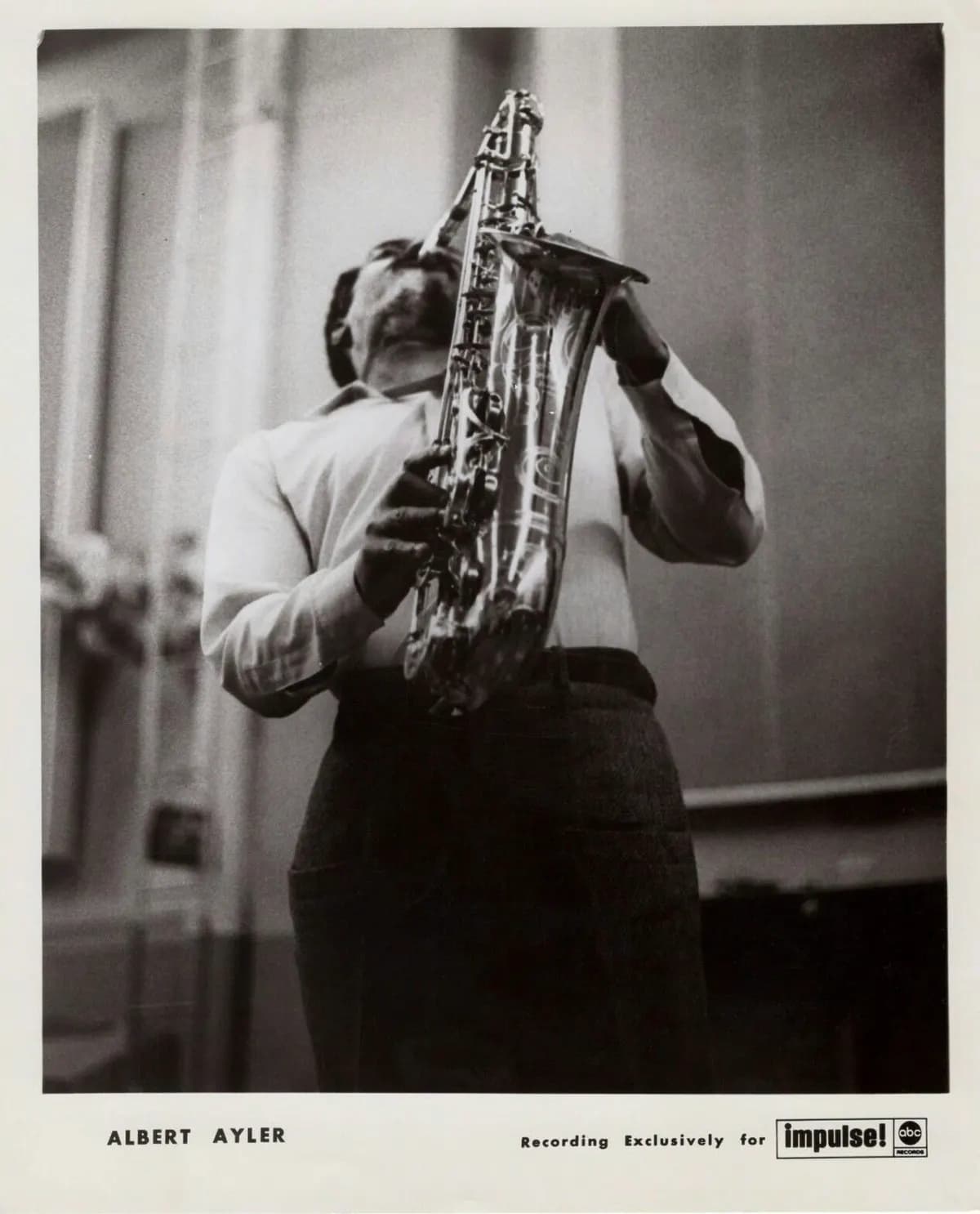
Ornette Coleman's early quartet kept a swinging pulse and wrote catchy themes, but after the theme the soloists improvised without a predetermined chord sequence, following the melody wherever it led and expecting bass and drums to follow them. Cecil Taylor kept detailed composed material but dropped swing for dense, percussive piano clusters and an energy that surged and receded with no steady beat. Albert Ayler set simple themes that sound like hymns and marches against explosive, vibrato-drenched saxophone. And in the most radical forms, a group improvises collectively from silence with no themes at all.
"Free" therefore does not mean random. The best free jazz is intensely interactive: players listen closely and respond in real time, and the music has shape (build-up, climax, release) even when no one could write it down in advance. It is also closely tied to its era. The civil rights movement, Black nationalism and spiritual searching shaped how many musicians spoke about it, and titles such as "Black Unity" and "Spirits Rejoice" come from that climate.
History & Origins
There were precursors. Lennie Tristano recorded freely improvised pieces, "Intuition" and "Digression", in 1949; Charles Mingus experimented with open forms in the 1950s; and Cecil Taylor's debut Jazz Advance (1956) was already far outside bebop convention. The turning point came in November 1959. Atlantic Records had just released Ornette Coleman's The Shape of Jazz to Come, and on 17 November his quartet, with Don Cherry on pocket trumpet, Charlie Haden on bass and Billy Higgins on drums, opened at the Five Spot Café in New York. The booking was meant to last two weeks and ran for about two and a half months. Coleman played a white plastic alto saxophone, and his tunes, including the haunting "Lonely Woman", divided critics and musicians sharply.
On 21 December 1960 Coleman recorded Free Jazz: A Collective Improvisation with a double quartet: Coleman, Don Cherry, Scott LaFaro and Billy Higgins in the left channel, Eric Dolphy on bass clarinet, Freddie Hubbard on trumpet, Charlie Haden and Ed Blackwell in the right. The two groups improvise together for about 37 minutes, held together by short written ensemble passages. Atlantic released it in 1961 with a Jackson Pollock painting, The White Light, on the cover, and its title became the name of the movement.
The mid-1960s were the movement's most intense years. Albert Ayler's Spiritual Unity, recorded in July 1964 for the small New York label ESP-Disk with bassist Gary Peacock and drummer Sunny Murray and released in 1965, replaced the beat with a free-floating "pulse". In 1964 the trumpeter Bill Dixon organised the "October Revolution in Jazz", a series of concerts that led to the short-lived Jazz Composers Guild. John Coltrane, who had pushed modal jazz to its limits, recorded Ascension in 1965 with a large ensemble including Pharoah Sanders, Archie Shepp and Marion Brown, and his final years with Sanders, Alice Coltrane and drummer Rashied Ali were fully free. Sun Ra and his Arkestra, active since the 1950s, combined big-band swing, space-age mythology and free collective passages.
In Chicago, the Association for the Advancement of Creative Musicians (AACM) was founded in 1965, with pianist Muhal Richard Abrams among its founders. It produced the Art Ensemble of Chicago, whose motto was "Great Black Music: Ancient to the Future", and the saxophonist and composer Anthony Braxton, whose solo saxophone album For Alto became a landmark. St. Louis had its own collective, the Black Artists' Group.
Europe developed a parallel scene that moved even further from jazz. In Germany, saxophonist Peter Brötzmann's Machine Gun (1968) and Alexander von Schlippenbach's Globe Unity Orchestra pushed volume and density; in Britain, guitarist Derek Bailey and saxophonist Evan Parker developed "free improvisation", which often avoided jazz rhythm altogether; in the Netherlands, Misha Mengelberg and Han Bennink combined freedom with humour. Musician-run labels such as FMP (Germany) and Incus (UK) documented the work.
In the 1970s the American scene continued in the New York "loft" spaces, and free jazz fed spiritual jazz, the noise and no-wave scenes and the saxophone squall of some rock records. Musicians such as William Parker, Matana Roberts and Mats Gustafsson carry the tradition today.
Key Characteristics & Sound
- No fixed chord changes: improvisation follows melody, motif, texture or energy instead of a harmonic progression.
- Flexible or absent tempo: some pieces swing hard at 250+ BPM, others float on a "pulse" with no countable beat. A BPM figure often simply does not apply.
- Collective improvisation: several players improvise at once instead of taking turns, an echo of early New Orleans jazz.
- Extended techniques: overblowing, multiphonics, screams and squeals on saxophone; clusters and forearm chords on piano; arco and percussive bass; drummers who colour the music without keeping time.
- Free form: pieces can last from a few minutes to a full LP side, shaped by build-up and release with no chorus structure.
- Themes optional: Coleman and Ayler wrote memorable melodies; other groups start from nothing.
- Timbre as content: the sound of a note, its grain, pitch bend and intensity, counts as much as which note it is.
| Element | Bebop / Hard Bop | Modal Jazz | Free Jazz |
|---|---|---|---|
| Chord changes | Fast, functional | Slow, scale-based | None fixed |
| Form | 12- or 32-bar choruses | Choruses or vamps | Open, shaped in performance |
| Tempo | Steady | Steady | Steady, flexible or absent |
| Solos | One at a time | One at a time, longer | Often collective |
| Tone | Conventional | Conventional | Extended techniques common |
| Reference record | Moanin' | Kind of Blue | Free Jazz / Spiritual Unity |
Instruments & Roles
Free jazz uses the jazz instruments but rethinks what each of them does:
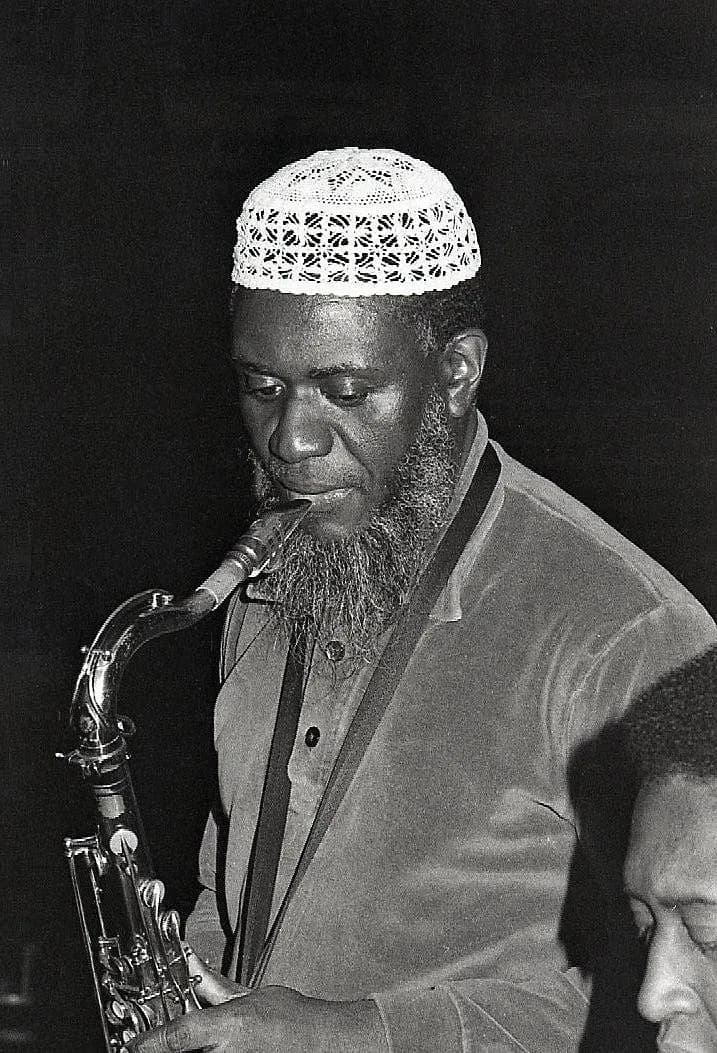
- Saxophones, the emblematic instrument: Coleman's vocal alto, Ayler's huge-vibrato tenor, Pharoah Sanders's screaming upper register, Brötzmann's raw volume, Evan Parker's circular-breathing soprano.
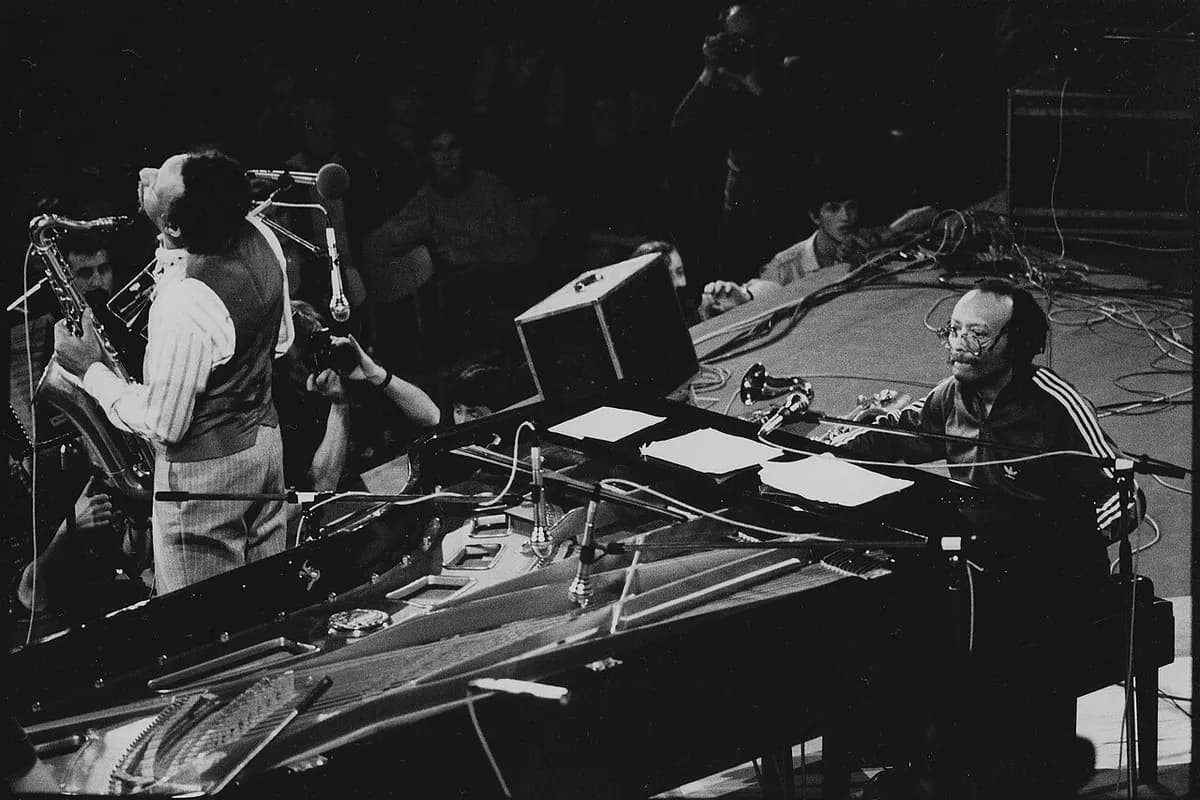
- Piano: the critic Val Wilmer described Cecil Taylor's playing as "eighty-eight tuned drums", with clusters, cascades and percussive attack.
- Double bass: often bowed or played as a melodic and rhythmic voice in its own right; free jazz groups sometimes used two basses.
- Drums: from Billy Higgins's swinging time to Sunny Murray's and Rashied Ali's free pulse, Milford Graves's polyrhythms and Han Bennink's theatrical percussion.
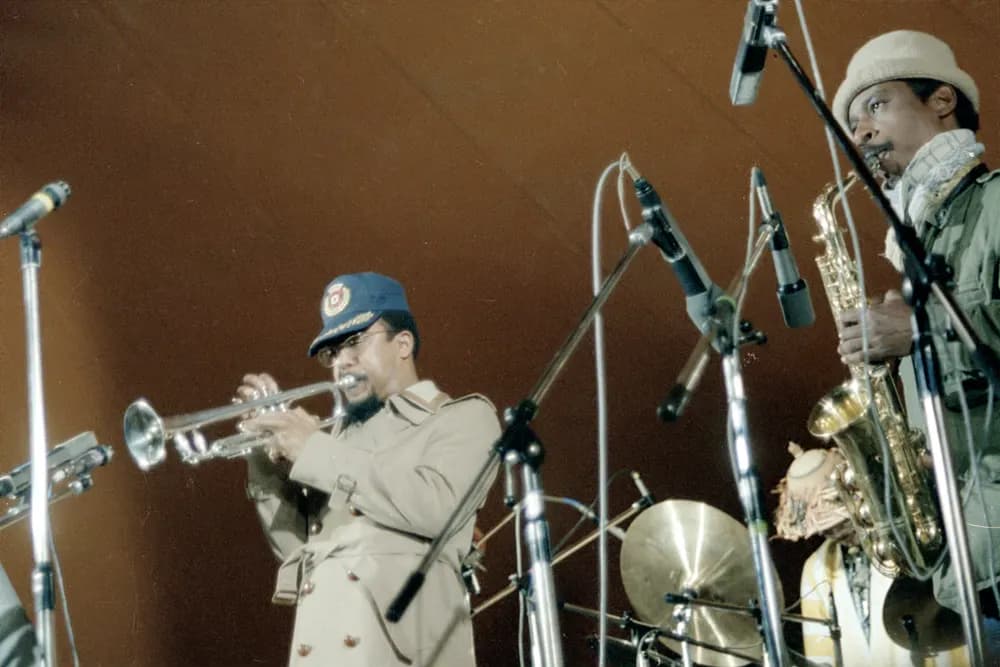
- Trumpet and brass: Don Cherry's pocket trumpet, Lester Bowie's growls and smears, Bill Dixon's quiet, breathy textures.
- "Little instruments": the Art Ensemble of Chicago brought bells, gongs, whistles and bike horns onto the stage.
Branches & Related Styles
- Avant-garde jazz: the broader term, covering composed and semi-structured experimental jazz as well as fully free playing. Eric Dolphy's Out to Lunch! (1964) sits at the composed end.
- Spiritual jazz: Pharoah Sanders, Alice Coltrane and late Coltrane combined free passages with drones, modal vamps and devotional intent.
- Free improvisation: the European, largely non-idiomatic practice of Derek Bailey and Evan Parker, with no jazz rhythm or form.
- Loft jazz: the music of the musician-run New York venues of the 1970s.
- Harmolodics and free funk: Ornette Coleman's later electric band Prime Time and James Blood Ulmer applied his ideas to funk rhythms.
- Noise and rock crossovers: free jazz saxophone and collective intensity influenced noise music, no wave and parts of post-rock and math rock.
Key Musicians & Essential Albums
Start with the more melodic records and move outward (years are release years):
| Album | Artist | Year | Why it matters |
|---|---|---|---|
| The Shape of Jazz to Come | Ornette Coleman | 1959 | Melodic themes, free solos; 'Lonely Woman' |
| Free Jazz: A Collective Improvisation | Ornette Coleman Double Quartet | 1961 | The record that named the movement |
| Out to Lunch! | Eric Dolphy | 1964 | Composed avant-garde at the edge of freedom |
| Spiritual Unity | Albert Ayler Trio | 1965 | Pulse instead of beat; 'Ghosts' |
| Ascension | John Coltrane | 1966 | Large-ensemble collective improvisation |
| Unit Structures | Cecil Taylor | 1966 | Composed structures and percussive free piano |
| Machine Gun | Peter Brötzmann Octet | 1968 | European free jazz at full volume |
| Karma | Pharoah Sanders | 1969 | Spiritual jazz; 'The Creator Has a Master Plan' |
Free Jazz vs Modal Jazz & Fusion
The line with modal jazz is about agreements: a modal piece still has a scale, a form, a tempo and a metre that every player follows. Free jazz lets at least one of those go. Coltrane's career shows how gradual the move could be, from Kind of Blue in 1959 to Ascension six years later.
Against jazz fusion the difference is direction. Both came out of the late 1960s, but fusion moved toward rock and funk grooves, electric instruments and tighter forms, while free jazz moved away from groove and form altogether. Against the noisier ends of industrial or experimental rock, free jazz usually keeps acoustic instruments, an improvising jazz ensemble and a lineage you can trace back through bebop and the blues.
How AI Detects Free Jazz
Free jazz removes most of the regularities that audio models lean on: there may be no steady beat for tempo tracking, no repeating chord loop, no predictable song structure and very irregular loudness. What remains is timbre. Saxophone, double bass, cymbals and piano still say "jazz" clearly, but overblown saxophone at high volume has a noisy spectrum that can resemble much louder music from outside jazz.
Genre AI has no free jazz label. When the model settles on Jazz, the answer is one of that family's subgenres: Bebop, Big Band / Swing, Contemporary Jazz, Fusion, Latin Jazz, Smooth Jazz or Easy Listening. Test a recording in the Genre AI music genre detector, and compare a calm, thematic passage with an all-out collective climax from the same piece.
For Genre AI, free jazz is a stress test: the production taxonomy has no free jazz class. Melodic, swinging records like Ornette Coleman's early quartet are likely to land in Jazz, probably as Bebop, because the walking bass and ride cymbal are still there. One quirk of the label set: the text prompts for Latin Jazz include "modal jazz", so a long modal vamp in the late-Coltrane manner may come back as Latin Jazz. The further the music moves from pulse and tonality, the less predictable the reading. Solo piano in the Cecil Taylor manner may be heard as classical and shown as one of its subgenres, such as Modern Era or Contemporary Classic; dense, overblown saxophone climaxes may tip the whole answer into Rock or Metal. Ambient has no subgenres, so it will rarely be the answer even for sparse, quiet improvisation. The alternatives shown come only from the winning family, so a Jazz answer lists other jazz subgenres and never Classical or Rock. Expect lower confidence than usual; in this style the model's uncertainty is a fair description of the music.