Psytrance (psychedelic trance) is the branch of trance built on a rolling, nonstop bassline, layered acid leads and heavily modulated sound design. It grew out of the all-night beach parties of Goa, India. It runs at 138–150 BPM and has its own festivals, labels and touring circuit, largely separate from the rest of dance music.
This guide covers what psytrance is, how Goa trance became a worldwide scene, the kick-and-bass pattern that drives it, its subgenres from full-on to darkpsy, and the artists to start with. Curious how a model handles 16th-note basslines? Play a few seconds into our free AI music genre detector.
What Is Psytrance?
Psytrance is defined by its rhythm section. A short, punchy kick lands on every quarter note, and a bass note fills the three sixteenth-note slots between kicks. People often call this the "rolling" or "triplet" bassline, though the notes are normally 16ths. Because the kick and bass never overlap, the low end feels continuous without turning muddy, and a track can keep that forward push for eight minutes without a break.
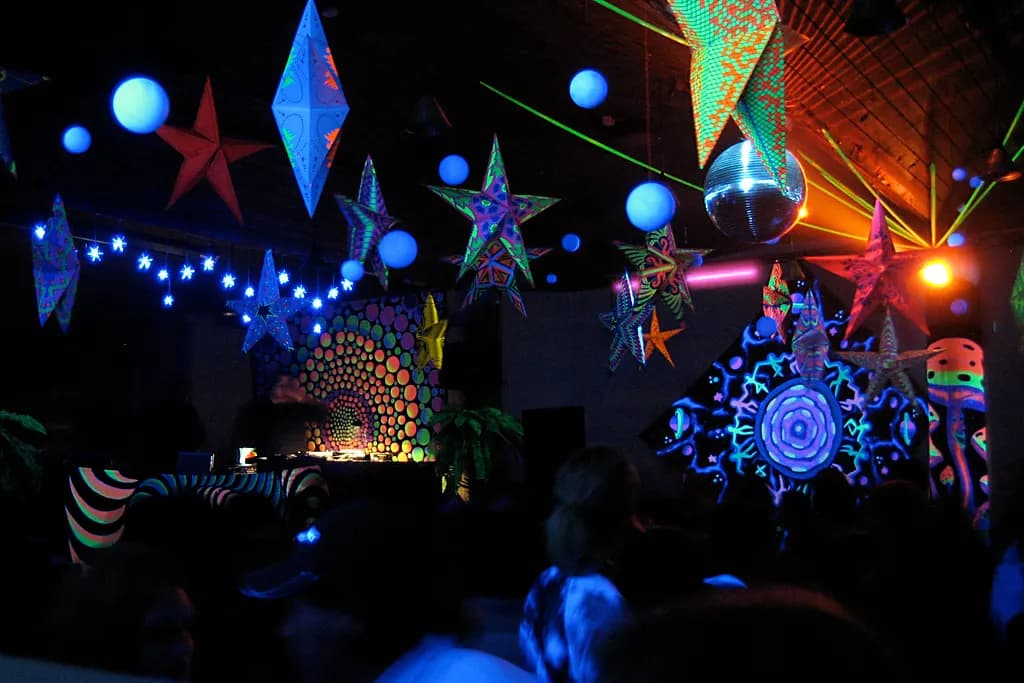
Above that sits the psychedelic layer: acid-derived lead lines, heavily modulated synth patterns, FM textures, granular and reversed sounds, spoken samples from science fiction and mysticism, and long automated filter sweeps. Tracks are usually instrumental and arranged as long builds and drops, with no verse or chorus. The music grew up with outdoor festivals, fluorescent stage art and all-night sets, and the scene still runs on all three.
History & Origins
The genre began in Goa, the Indian coastal state that drew Western travellers from the late 1960s onward. By the mid-1980s DJs there, Goa Gil among the best known, were playing EBM (electronic body music) and early acid house at all-night beach parties, editing tapes to remove vocals and keep the momentum going. European producers picked up that approach, and Goa trance emerged as a distinct style in the early 1990s.
Its peak ran from roughly 1994 to 1998. Hallucinogen (Simon Posford), whose "LSD" (1995) is one of the best-known tracks of the period, Astral Projection from Israel, Man With No Name, Juno Reactor and labels such as Dragonfly and TIP defined the sound: bright, melodic and Eastern-tinged, with layered arpeggios inherited from the TB-303 and from early trance.
Around 1998–2000 the sound changed into psytrance proper: cleaner production, a heavier kick and bass, and less obvious melody. Israel became a major production centre (Infected Mushroom, Astrix, later Vini Vici), and the scene spread to Brazil, South Africa, Japan and across Europe.
Today psytrance lives mainly at festivals. Boom in Portugal, Ozora in Hungary, Universo Paralello in Brazil and dozens of smaller events draw tens of thousands of people for several days at a time. The scene has its own labels and touring circuit, and much of its audience has followed it since the 1990s.
Key Characteristics & Sound
What identifies psytrance:
- Tempo: 138–150 BPM for most styles; progressive psy sits at 132–138, darkpsy runs 150–190.
- Kick and bass: the defining interlock. The kick is on the beat, three bass 16ths fall between, and they never overlap.
- Leads: heavily modulated acid-derived and FM synth lines, often several layered.
- Sound design: constant movement in filters and pitch, plus granular effects and reversed or glitched textures.
- Samples: spoken word from films, documentaries and mystical sources.
- Structure: long arrangements, often 7–9 minutes.
- Vocals: rare beyond samples and processed phrases.
The subgenres are separated mainly by tempo and mood:
| Subgenre | Typical BPM | Character |
|---|---|---|
| Goa trance | 135–148 | Melodic, Eastern scales, layered arpeggios |
| Full-on | 140–148 | Bright, energetic, big leads; the festival mainstream |
| Progressive psy | 132–138 | Groovy, restrained, closer to techno |
| Darkpsy | 150–190 | Fast, dissonant, sinister sound design |
| Forest psy | 145–160 | Organic, murky, mid-range-focused |
| Hi-tech | 170–200+ | Extremely fast, dense, chaotic |
| Psybient / psychill | 70–110 | Downtempo, ambient, Shpongle-style |
Production & Sound Design
Psytrance producers spend most of their effort on sound design and on the low end:
- Kick design: short, tight and tuned to the track's key. The whole groove depends on it.
- Bass: a single-cycle or short sine-based sound, sidechained or gated so it never collides with the kick.
- Synthesis: FM, granular and wavetable synthesis; Serum, Zebra and hardware modular systems are common in the scene.
- Modulation: near-constant automation of filter, pitch and effect parameters, so no sound stays static for long.
- Effects: long reverbs, ping-pong delays, phasers and heavy stereo widening.
- Mixing: loud and dense, tuned for large outdoor sound systems more than for headphones.
The scene shares its techniques openly. Producers swap templates, sample packs and detailed tutorials, and they talk about the kick-bass relationship in terms of milliseconds and phase, the way engineers would.
Related Styles
Beyond its internal subgenres, psytrance connects to several neighbours:
- Classic trance: the shared ancestor, with different bass mechanics and song structure.
- Psybient or psychill: the downtempo wing (Shpongle, Ott, Entheogenic).
- Psy-breaks: psychedelic sound design over breakbeat rhythms.
- Psy-techno: the crossover with techno that grew in the 2020s.
- Neo-goa: a revival of the 1990s melodic Goa style.
- Festival trance crossover: Vini Vici's "Great Spirit" (2016), made with Armin van Buuren and Hilight Tribe, brought psytrance elements to mainstage EDM festivals.
Notable Artists & Tracks
A route through the scene:
- Hallucinogen: "LSD", "Angelic Particles".
- Astral Projection: "Mahadeva", "People Can Fly".
- Infected Mushroom: Classical Mushroom (2000), "Becoming Insane".
- Juno Reactor: "Pistolero", plus music co-written with Don Davis for The Matrix Reloaded and The Matrix Revolutions.
- Shpongle: Are You Shpongled? (1998), the album that set the template for psybient.
- Astrix: "Deep Jungle Walk", "Type 1".
- 1200 Micrograms: "Ayahuasca", the opening track of their 2002 debut album.
- Vini Vici: "The Tribe" (2015); their 2016 remix of Hilight Tribe's "Free Tibet" was the first psytrance track to enter Beatport's overall top 10.
- Ace Ventura and Liquid Soul: leading names in progressive psy.
- Ott: Blumenkraft (2003), dub-facing psychedelic downtempo.
Start with "LSD", "Mahadeva" and "The Tribe" to hear the Goa era, the Israeli melodic sound and the modern festival crossover.
How AI Detects Psytrance
Psytrance is one of the easier genres for a classifier because its rhythmic signature is so specific: a very high onset rate in the low frequencies (four kicks plus twelve bass notes per bar), tempos in the 140s, and dense, constantly modulating mid- and high-frequency content. Very few other styles produce that pattern.
The ambiguity is mostly internal. Full-on, forest and darkpsy differ in mood and speed, not in mechanism, so a model may return one label for all of them. Progressive psy at 134 BPM can also read as techno or progressive house. Test your own tracks in the Genre AI music genre detector and read how AI music genre detection works for the details.
Testing this genre in Genre AI ourselves, Psytrance is among the easiest electronic styles to identify, and the reason is mechanical: the interlocked kick-and-16th-bass pattern produces a low-frequency onset density that almost nothing else matches. Readings are strongest at 140–148 BPM. Slow it to the low 130s and remove the rolling bass, and the model moves to Progressive House or Techno. Push past 160 with dissonant leads and it stays in the same family, though a single label cannot express the difference between full-on and darkpsy. Strip the drums entirely and it reads Ambient, which is the correct answer for psychill.