
Post-rock is rock instrumentation used for something other than rock songs: guitars, bass and drums arranged into long instrumental pieces that build slowly, peak once, and dissolve. It emerged in Britain and North America in the early 1990s, and its patient crescendo has since become a stock device in film trailers, documentaries and emotional montages.
This guide covers where post-rock came from, how the crescendo actually works, how it differs from math rock and ambient, and which albums to start with. To hear how a track reads to a classifier, run a clip through our free AI music genre detector.
What Is Post-Rock?
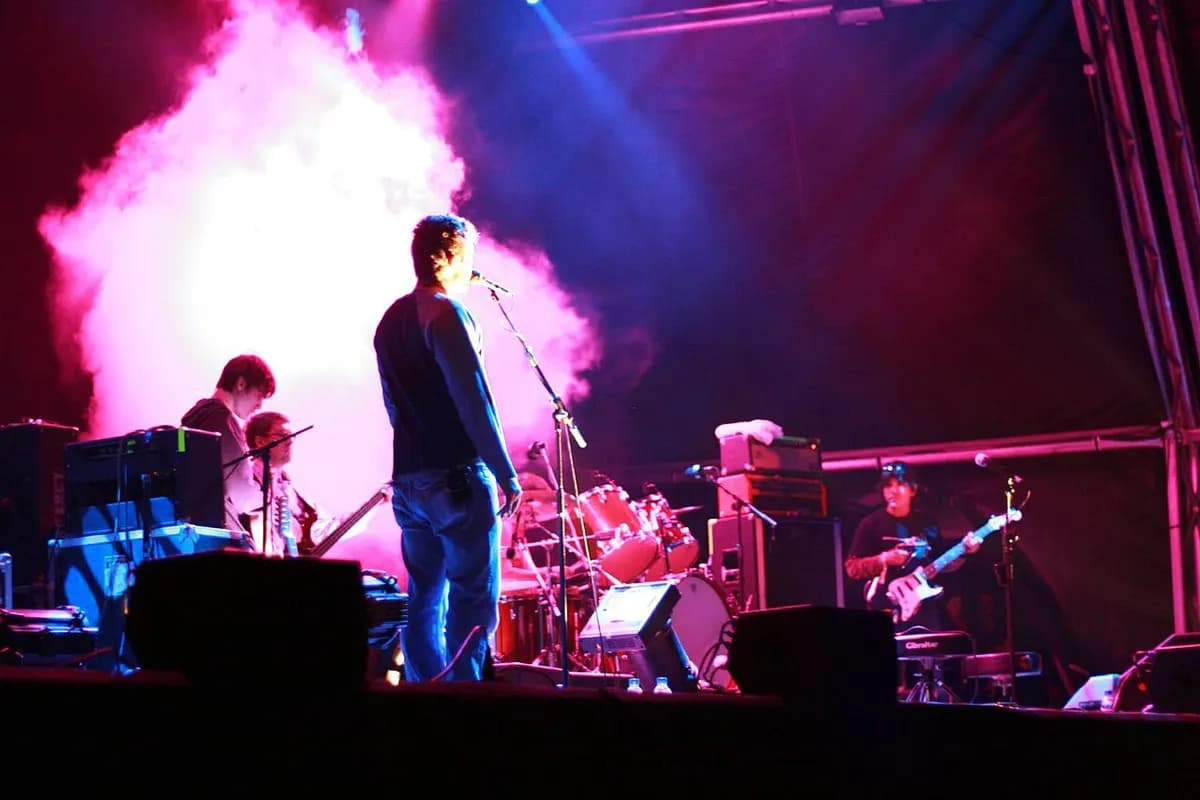
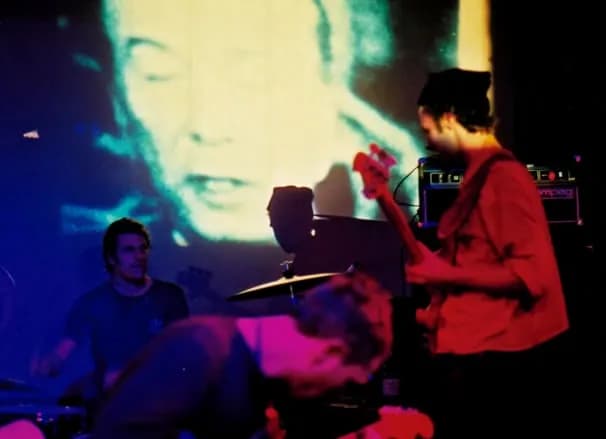
Post-rock keeps the rock band and discards nearly everything rock does with it. There are usually no vocals, no verses or choruses, no riffs in the traditional sense and no solos. The music is organised by dynamics and duration instead: a figure is introduced softly, repeated with layers added over several minutes, brought to a full-band climax, and released.
Guitars behave like textural instruments (tremolo picking, e-bow, heavy delay and reverb), so individual notes matter less than the accumulating mass. Drums often start as a pulse and only become a rock beat at the peak. Pieces commonly run eight to twenty minutes, and albums are sequenced as continuous arcs.
The critic Simon Reynolds used the term in Melody Maker in 1993 and defined it in The Wire in May 1994 as "using rock instrumentation for non-rock purposes"; he later found it had been in occasional use for years. Several of the bands it was applied to, including Tortoise, Mogwai and Godspeed You! Black Emperor, rejected it. Fans and critics also use "crescendocore", sometimes fondly and sometimes as a jab, for how predictable the formula became.
History & Origins
Two records from opposite traditions set it up. Talk Talk, a successful British synth-pop band, made Spirit of Eden (1988) for EMI and, after leaving the label, Laughing Stock (1991) for Verve: improvised, sparse albums drawing on jazz and classical music that abandoned pop structure entirely. In Louisville, Kentucky, Slint's Spiderland (1991) supplied the other half: whispered and spoken vocals, unstable metre and the quiet-loud dynamic that much of what followed would use.
Chicago built the first scene. Tortoise's Millions Now Living Will Never Die (1996) mixed jazz fusion, dub and krautrock into something with no obvious genre home, and the city's studios and labels (Thrill Jockey, Steve Albini's engineering) supported a dozen related bands.
Two of the best-known versions followed. In Montreal, Godspeed You! Black Emperor made F♯ A♯ ∞ (1997) and Lift Your Skinny Fists Like Antennas to Heaven (2000): orchestral in scale, political in intent, built from field recordings and twenty-minute movements. In Glasgow, Mogwai's Young Team (1997) made the same structure louder and more violent.
The 2000s made it emotional and portable. Explosions in the Sky's The Earth Is Not a Cold Dead Place (2003) refined the crescendo to its simplest form, and the band's score for the film Friday Night Lights (2004) showed how well this music works under images, a lesson trailer and advert editors took up. Iceland's Sigur Rós, singing in Icelandic and in a made-up language of wordless syllables, reached arena scale with the same tools; Mono in Japan added string sections; This Will Destroy You, Caspian and Russian Circles extended it.
By the 2010s many critics considered the formula exhausted, and the genre split. Its heavy wing became post-metal (Isis, Cult of Luna); its quiet wing merged into modern classical and ambient; and its structural vocabulary moved into film, television and video-game scoring, where many listeners now hear post-rock without knowing the name.
Key Characteristics & Sound
What identifies a post-rock track:
- Instrumental: no vocals, or vocals used as wordless texture.
- Crescendo structure: a long quiet build to a single loud peak, then release; often this is the whole form of the piece.
- Duration: 6–20 minutes is normal, and albums are sequenced to be heard whole.
- Guitar as texture: tremolo picking, delay, reverb, e-bow and volume swells in place of riffs.
- Tempo: typically 70–140 BPM, though tempo says little here, since a piece may hold one tempo for fifteen minutes.
- Wide dynamic range: the gap between the quietest and loudest passages is far larger than in most rock or pop.
- Additive arrangement: the same motif repeated while instruments are layered on, with little harmonic development.
- Field recordings and spoken samples used as introductions and connective tissue.
Where it sits among its neighbours:
| Trait | Post-Rock | Math Rock | Ambient | Post-Metal |
|---|---|---|---|---|
| Organising idea | Dynamic build | Rhythmic puzzle | Texture, stasis | Weight plus build |
| Track length | 6–20 min | 3–5 min | 5–30 min | 8–15 min |
| Time signatures | Mostly 4/4 | Odd, shifting | Often none | 4/4 with odd sections |
| Guitar tone | Reverberant, tremolo | Clean, tapped | Processed or absent | Distorted, layered |
| Drums | Build to full kit | Busy throughout | Rare | Heavy throughout |
| Reference album | Lift Your Skinny Fists | American Football | Music for Airports | Oceanic |
Instruments & Production
Post-rock is a genre of signal chains and patience:
- Delay and reverb as compositional tools: repeats timed to the tempo so a single note becomes a pattern.
- Tremolo picking: rapid repeated notes that turn a guitar line into a sustained wash.
- Volume swells and e-bow to remove the attack from notes, so guitars enter like strings.
- Multiple guitars in counterpoint, panned wide, each playing a fragment of the whole figure.
- Light compression: these records are usually mastered to keep the quiet passages quiet, which is why they sound thin on phone speakers and huge on headphones.
- Strings, brass and glockenspiel added for the peaks, particularly in the Montreal and Japanese scenes.
- Field recordings (street noise, radio, sermons) used to open pieces and to establish a place.
Subgenres & Related Styles
The family around it:
- Post-metal / atmospheric sludge: the heavy branch; Isis, Neurosis, Cult of Luna. See sludge metal.
- Crescendocore: the nickname for the Explosions in the Sky formula.
- Space rock and krautrock: the repetitive ancestors; Neu!, Can.
- Math Rock: the rhythmic sibling, with Slint as a shared origin.
- Shoegaze: the texture-first neighbour that kept songs inside the noise.
- Ambient and modern classical: where post-rock's quiet wing ended up.
- Film Score: not a subgenre but a destination, since post-rock's build is now common scoring vocabulary.
Notable Artists & Albums
Where to start:
- Talk Talk: Laughing Stock (1991).
- Slint: Spiderland (1991).
- Tortoise: Millions Now Living Will Never Die (1996).
- Mogwai: Young Team (1997).
- Godspeed You! Black Emperor: Lift Your Skinny Fists Like Antennas to Heaven (2000).
- Sigur Rós: Ágætis byrjun (1999), ( ) (2002).
- Explosions in the Sky: The Earth Is Not a Cold Dead Place (2003).
- Mono: Hymn to the Immortal Wind (2009).
- This Will Destroy You: Young Mountain (2006).
- Russian Circles: Station (2008).
Three albums for the arc: Spiderland for the origin, Lift Your Skinny Fists for the scale, The Earth Is Not a Cold Dead Place for the version most later bands imitated.
How AI Detects Post-Rock
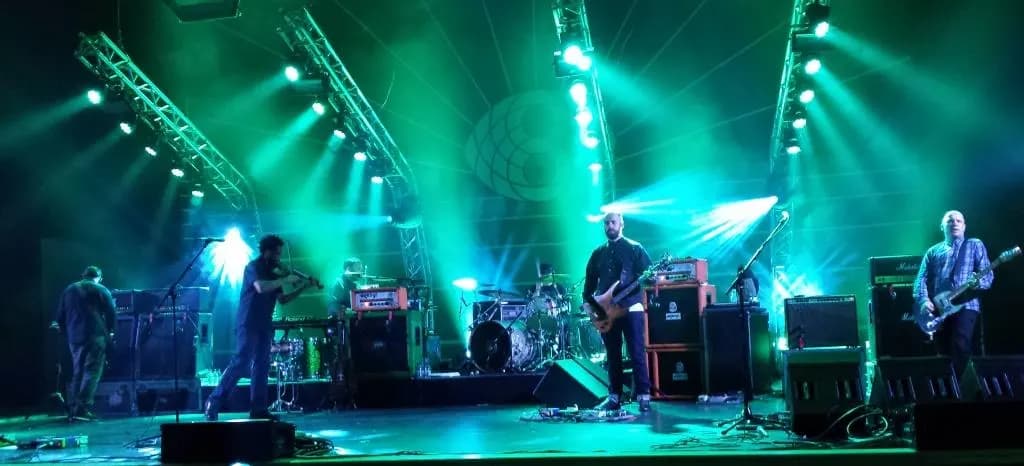
Post-rock is an awkward case, because its identity lives on a timescale of ten minutes or more. A short passage is either a quiet guitar figure, which could pass for ambient, folk or indie rock, or a full-band climax, which sounds like rock, alternative or even metal. Each reading is a fair description of the passage it heard.
Genre AI's live model has no post-rock label. The nearest classes are Indie / Alternative and Progressive / Psychedelic Rock in the Rock family, plus the Ambient family. For a file, the model takes up to six 18-second windows from the middle of the track, skipping the start and end, and averages them, so a long piece is reduced to a blend of its quiet and loud stretches. The cues that survive any single window are the missing vocal, heavy reverb, tremolo-picked guitar texture, and a rhythm that repeats without harmonic movement. Test one in the Genre AI music genre detector, and see our full explainer on post-rock for more on the scene.
Post-rock makes the strongest case in our catalogue for listening to more than a few seconds. By our reasoning (this is not a measured result), the opening minutes of a Godspeed piece sit closest to Ambient or Classical, while the climax nine minutes later sits closer to Rock or Metal. Neither would be an error, because the track contains both. What defines the genre is the movement from one to the other, and a model that averages several 18-second windows sees that movement only as a mixture. One snapshot cue does carry information: guitar, bass and drums at rock volume with no voice anywhere is uncommon outside instrumental metal.