Power metal is the bright, fast, melodic branch of metal: galloping riffs at 160–200 BPM over relentless double-bass drumming, a high clean tenor in place of a growl, keyboards or orchestral layers, and choruses written for a festival crowd to sing back. Where extreme metal moves towards darkness, power metal moves towards uplift: the harmonies resolve, the vocal climbs, and the lyrics deal with fantasy, myth, battles and, in some bands, military history.
This guide covers the NWOBHM roots, the German breakthrough that defined the style, the Italian, Finnish and Swedish scenes that followed, what the records are actually made of, and where the boundary with thrash metal sits. To hear how a galloping, keyboard-heavy track reads to a classifier, run a few seconds through our free AI music genre detector.
What Is Power Metal?
Power metal takes the speed of 1980s metal and points it somewhere optimistic. The tempo is high, the drumming is dense and the guitars are fast, but the tuning stays at standard E or D, the guitar tone keeps its mid-range instead of scooping it out, and the vocal is a trained, high, fully sung line. The result is music that is aggressive in energy and consonant in harmony, which is an unusual combination in metal.
The other defining trait is scale. Arrangements are layered: multi-tracked vocal choirs, keyboard pads or a full orchestral bed, twin lead guitars playing harmonised thirds, and a chorus that lifts a tone or arrives with the whole band singing. Songs typically run four to six minutes, and many albums close with a single long epic: Helloween's "Halloween" runs over thirteen minutes.
Two scenes carry the name. European power metal, the usual sense of the term, is melodic, keyboard-friendly and descends from Helloween. US power metal is darker, heavier and closer to thrash, with bands such as Jag Panzer, Savatage and Iced Earth trading fantasy escapism for something grimmer. Both share the high clean vocal and the refusal to slow down.
History & Origins
The documentary maker and anthropologist Sam Dunn traces the lyrical side back to the late 1970s and Ronnie James Dio's fantasy writing. The musical raw material comes from the New Wave of British Heavy Metal. Iron Maiden supplied the galloping eighth-and-two-sixteenths rhythm heard on "Run to the Hills" (1982) and "The Trooper" (1983), the harmonised twin-guitar lead, and the long narrative song. Judas Priest supplied the vocal ceiling: Rob Halford's range, and later the machine-gun double bass of Painkiller (1990). A third input came from a guitarist: Yngwie Malmsteen's Rising Force (1984) made harmonic-minor, Baroque-derived shredding a standard part of the vocabulary.
The style crystallised in Germany. Helloween, formed in Hamburg in 1984, recruited the 18-year-old Michael Kiske from the local band Ill Prophecy and released Keeper of the Seven Keys Part I in 1987 and Part II in 1988 on Noise Records, with Kai Hansen and Michael Weikath writing. Those two albums fixed the template: "Future World" and the thirteen-minute "Halloween" on the first, "Eagle Fly Free" and "I Want Out" on the second. Most of the European bands that followed worked from that template.
A German scene formed immediately. Hansen left in 1989 and founded Gamma Ray, whose Heading for Tomorrow (1990) continues the Keeper sound. Blind Guardian, from Krefeld, moved from speed metal into elaborate, choir-stacked storytelling: "The Bard's Song" on Somewhere Far Beyond (1992), then Nightfall in Middle-Earth (1998), a full concept album drawn from Tolkien's Silmarillion. Running Wild, also from Hamburg, turned to pirate imagery with Under Jolly Roger (1987) and Port Royal (1988). Rage and Grave Digger worked the heavier end of the same circuit.
The American branch ran on a separate track. Manowar, formed in 1980 in Auburn, New York, built a career on muscle, volume and sword-and-sandal imagery across Into Glory Ride (1983), Hail to England (1984) and Kings of Metal (1988). Iced Earth, led by Jon Schaffer in Tampa, Florida, welded thrash rhythm guitar to Matt Barlow's baritone on Burnt Offerings (1995) and Something Wicked This Way Comes (1998).
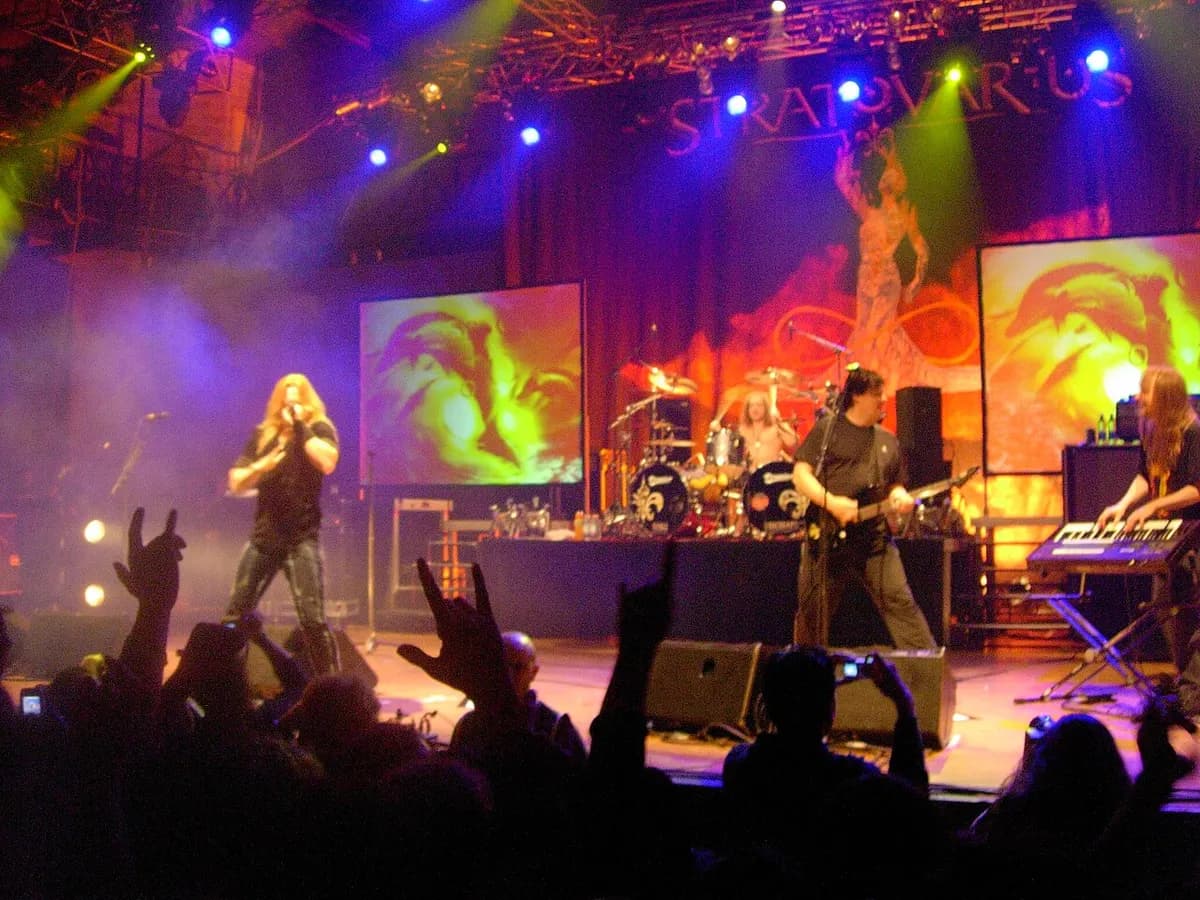
The 1990s revival was continental. In Italy, Rhapsody (renamed Rhapsody of Fire in 2006 over a trademark issue) made Legendary Tales (1997) and Symphony of Enchanted Lands (1998), whose "Emerald Sword" became a reference point for orchestral, film-score metal; from Symphony of Enchanted Lands II (2004) Christopher Lee narrated parts of their storylines. In Finland, Stratovarius hired drummer Jörg Michael and keyboardist Jens Johansson after 1995 and released Episode (1996) and Visions (1997), and Sonata Arctica debuted with Ecliptica (1999). Nightwish, formed in Kitee in 1996, put a classically trained soprano, Tarja Turunen, at the front and became one of the best-known symphonic metal bands, alongside the Swedish band Therion. In Sweden, HammerFall, a Gothenburg band formed in 1993 by former Ceremonial Oath guitarist Oscar Dronjak, released Glory to the Brave (1997) in the city best known at the time for melodic death metal.
The two later landmarks are opposites. DragonForce, formed in London in 1999, pushed the speed further on Inhuman Rampage (2006). "Through the Fire and Flames", written at 200 BPM, was included in Guitar Hero III: Legends of Rock in 2007, became known for its difficulty there, and in 2008 reached number 86 on the Billboard Hot 100, the band's only single to chart. Sabaton, from Falun in Sweden, dropped fantasy for military history on Primo Victoria (2005), Carolus Rex (2012) and The Last Stand (2016), and grew into a festival headliner that runs its own festival, Sabaton Open Air.
Key Characteristics & Sound
What identifies a power metal record:
- Tempo: roughly 160–200 BPM for the fast songs that define the style, with DragonForce at the top (200 BPM on "Through the Fire and Flames"); Sabaton and much mid-paced material sit lower.
- Gallop rhythm: the eighth-note plus two sixteenths figure, inherited from Iron Maiden.
- Double bass drumming sustained through entire verses; continuous sixteenths at 180 BPM means twelve kick hits per second.
- Vocals: high clean tenor, often pushed into head voice at the top, and multi-tracked into a choir on the chorus.
- Harmony: diatonic minor with a strong pull to the relative major, ♭VI–♭VII–i cadences, and choruses that resolve upward; harmonic minor and Phrygian dominant appear in neoclassical lead work.
- Keyboards: from a simple pad to full orchestral and choir samples, often trading solos with the guitar.
- Guitars: standard or D standard tuning, mid-forward distortion, harmonised twin leads and long, technically demanding solos.
- Lyrics: fantasy, mythology and battle; in Sabaton's case, documented military history.
Where it sits among its neighbours:
| Trait | Power Metal | Thrash Metal | Traditional Metal | Symphonic Metal |
|---|---|---|---|---|
| Peak period | 1987–present | 1983–1991 | 1980–1985 | 1996–present |
| Typical BPM | 160–200 | 180–220 | 120–160 | 100–160 |
| Vocals | High clean tenor | Shouted, rough | Mid-range clean | Soprano or clean |
| Rhythm | Gallop, double bass | Downpicked riffs | Mid-paced riffs | Orchestral pulse |
| Mood | Uplifting, major lift | Aggressive, minor | Hard, bluesy | Grand, cinematic |
| Reference track | I Want Out | Master of Puppets | The Trooper | Nemo |
Instruments & Production
Power metal is arrangement-heavy, and much of the production work goes into layering:
- Guitars in standard or D standard tuning, which keeps chord voicings bright and defined; the genre mostly stayed out of the low tunings of death metal.
- Twin harmonised leads, usually in thirds or sixths, doubled and panned hard left and right.
- Double kick pedals or two kick drums, in modern recordings edited to the grid and often triggered so that every hit reads clearly at speed.
- Keyboards and orchestral libraries: strings, brass, harpsichord and sampled choirs. Rhapsody of Fire and Nightwish later recorded with real orchestras and choirs.
- Stacked vocal production: lead, octave double, harmony parts and a wide gang chorus, usually with generous plate or hall reverb.
- Bright, loud mixes with the vocal well forward, unlike the scooped, guitar-first balance of extreme metal.
Much of the work was done in Germany. Sascha Paeth, often producing with Michael "Miro" Rodenberg, worked from his Gate Studio in Wolfsburg on records by Rhapsody of Fire, Edguy, Kamelot, Avantasia and Brazil's Angra. The labels are concentrated too: Noise Records in the 1980s, then Nuclear Blast, Century Media, Frontiers, Napalm and AFM.
Subgenres & Related Styles
The family around it:
- European / melodic power metal: the Helloween line: Gamma Ray, Freedom Call, Sonata Arctica, Stratovarius.
- US power metal: heavier and darker, with thrash rhythm guitar: Jag Panzer, Savatage, Iced Earth, Vicious Rumors.
- Symphonic power metal: orchestra and choir as core instruments: Rhapsody of Fire, Twilight Force, Gloryhammer.
- Extreme power metal: the speed wing associated with DragonForce, near 200 BPM with dense lead playing.
- Progressive power metal: odd metres and long forms shared with progressive rock: Symphony X, Kamelot, Angra.
- Speed metal: the faster, rougher 1980s style power metal grew directly out of; the boundary is the vocal and the harmony, not the tempo.
- Symphonic metal: the Nightwish branch, where the orchestra leads and tempos drop; adjacent to classical crossover and film score writing.
- Metal opera: Tobias Sammet's Avantasia, beginning with The Metal Opera (2001), a rotating cast of guest singers over power metal arrangements.
Key Bands & Tracks
Where to start:
- Helloween: Keeper of the Seven Keys Part I (1987) and Part II (1988); "I Want Out", "Eagle Fly Free".
- Blind Guardian: Nightfall in Middle-Earth (1998); "The Bard's Song" (1992) for the acoustic side.
- Gamma Ray: Land of the Free (1995).
- Running Wild: Port Royal (1988).
- Manowar: Kings of Metal (1988).
- Iced Earth: Something Wicked This Way Comes (1998), for the US school.
- Rhapsody: "Emerald Sword", from Symphony of Enchanted Lands (1998).
- Stratovarius: Visions (1997).
- Sonata Arctica: Ecliptica (1999); "FullMoon".
- HammerFall: Glory to the Brave (1997), Legacy of Kings (1998).
- Kamelot: The Black Halo (2005), for the progressive end.
- DragonForce: "Through the Fire and Flames", from Inhuman Rampage (2006).
- Sabaton: Carolus Rex (2012), issued in Swedish and English versions.
How AI Detects Power Metal
A classifier has a lot to work with here. The onset stream is extremely dense and regular from the double kick, the low band carries continuous kick energy, and the guitar spectrum keeps its mid-range instead of the scooped notch that marks thrash metal. Above that sits a sustained, pitched vocal with clear harmonics, very different from the noise-like spectrum of a growl or the flat shout of hardcore.
The hard part is that these cues also describe several neighbours. Fast hard rock and traditional metal share the clean vocal and the harmony; the difference is drum density, and a mid-paced power metal song loses that advantage. Symphonic intros and ballads drop the distortion entirely and may read as orchestral music instead. Genre AI has no power metal label, so the answer you can expect is a broader metal or rock one. Test a track in the Genre AI music genre detector and compare a fast chorus with an orchestral intro.
Genre AI's production taxonomy has no separate power metal label, and the phrase is not among the text prompts of any other label. A typical galloping, double-kick track is most likely to land in the Metal family, whose fine labels are Heavy Metal, Death Metal, Black Metal, Doom Metal, Metalcore and Nu Metal; Heavy Metal is the natural fit for a clean-sung, melodic chorus, and any alternatives will be other Metal labels. Material in the Helloween and HammerFall mould, with its consonant harmony and high tenor, may instead put the Rock family on top, where the likely answer is Hard Rock, the heavier end of Rock. Orchestral overtures and choir passages from Rhapsody of Fire or Nightwish can leave both families and land under Classical, which has its own period labels. Ballads, which most power metal albums include, are the case most likely to come back as Rock › Soft / Pop Rock.