Klezmer is the instrumental music of the Ashkenazi Jews of Eastern Europe: dance tunes and free, sobbing improvisations played at weddings by professional bands, led by a violin or a clarinet that sounds uncannily like a human voice. The Holocaust nearly wiped it out in Europe. It survived on 78 rpm records made by immigrants in New York, and from the 1970s musicians rebuilt it from those records; today bands play it on several continents.
Below: where the word and the music come from, the modes and dances, the instruments and ornaments, the main musicians, and how klezmer relates to swing and jazz. Curious how a classifier hears it? Try a clip in our free AI music genre detector and compare the result with the note below.
What Is Klezmer?
The word comes from the Hebrew kley zemer, "vessels of song". In Yiddish a klezmer (plural klezmorim) was originally the musician, not the music. Using "klezmer" as the name of a genre is relatively recent: it was popularised as a label by revival musicians in the late 1970s, and the musicologist Walter Zev Feldman, whose 1979 album with Andy Statman used the term, has claimed credit for that shift.
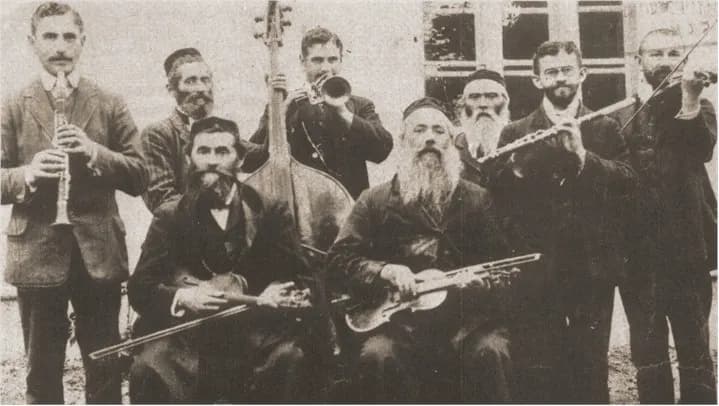
Historically, klezmorim were professional musicians who played for the Jewish community's celebrations, above all weddings, which could last for days and had a fixed sequence of ceremonial and dance music. They also played for non-Jewish patrons, and their repertoire absorbed Romanian, Ukrainian, Moldavian, Greek, Ottoman and Romani influences. At the centre, though, the music drew on the sound of Jewish prayer: the modes of the synagogue and the ornamented voice of the cantor.
Klezmer is mostly instrumental dance music, which separates it from Yiddish song and from Yiddish theatre music, although the three overlap heavily in practice. It is built on modes, not Western chord progressions. Its dances have their own rhythms, and its ornaments imitate laughter and weeping. Those features set it apart from jazz, even though the two shared the clarinet and the dance halls of early 20th-century New York.
History & Origins
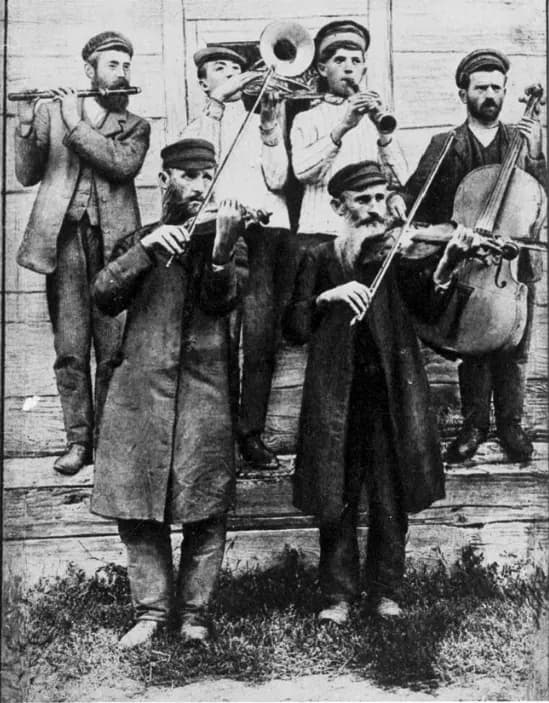
Jewish professional musicians are documented in Central and Eastern Europe from the late Middle Ages; guilds of klezmorim existed in Prague by the 16th and 17th centuries. The classic klezmer repertoire took shape in the 18th and 19th centuries in the Pale of Settlement and neighbouring regions (today's Ukraine, Moldova, Belarus, Lithuania, Poland and Romania), where small family bands, known as kapelye, played weddings alongside the badkhn, the wedding jester and master of ceremonies.
The violin was the original lead instrument. Over the 19th century the clarinet rose to share and then often take that role.
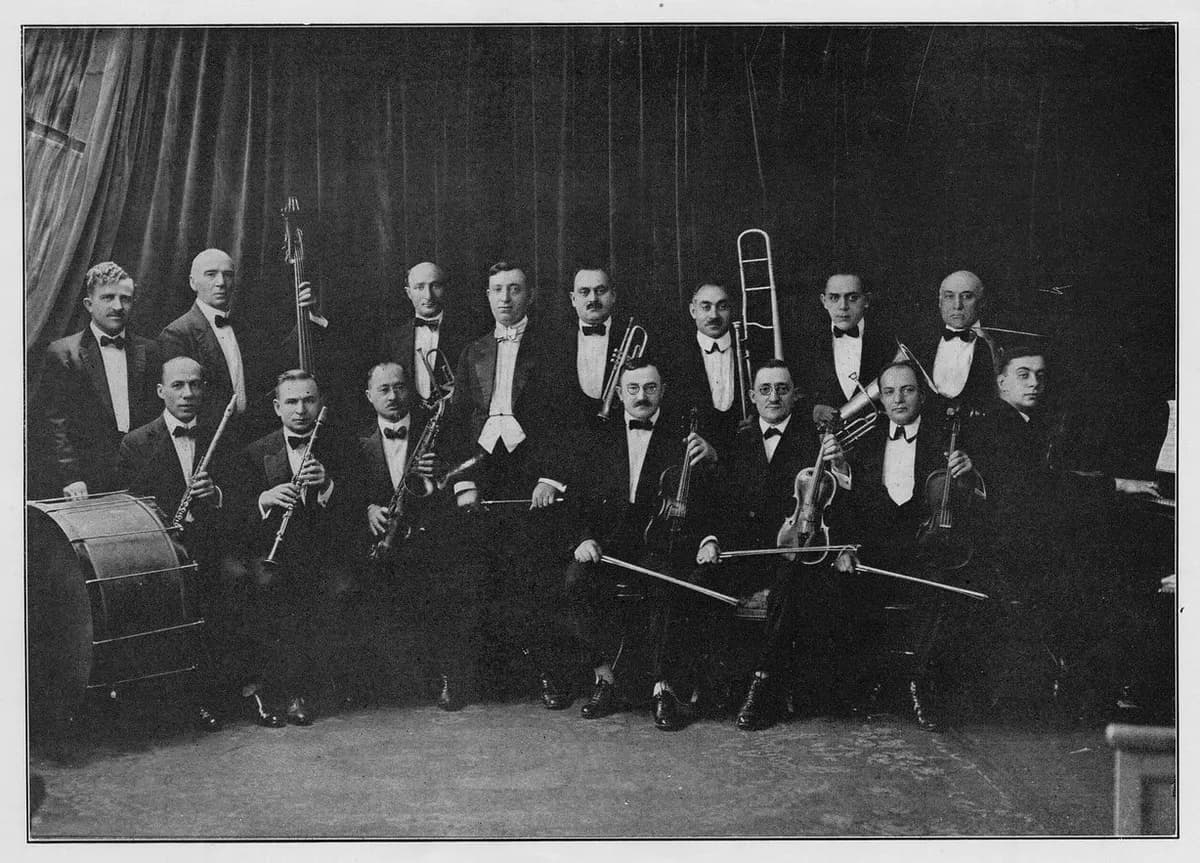
The great wave of Jewish emigration from Eastern Europe between the 1880s and 1920s carried klezmer to the United States. In New York, immigrant musicians played weddings, dance halls, union rallies and restaurants, and recorded extensively for record labels' ethnic catalogues. The clarinettists Naftule Brandwein, from Galicia, and Dave Tarras (c. 1895–1989), from Ukraine, were the best-known players of the period, alongside bandleaders such as Abe Schwartz and Harry Kandel. Most of what we know about the style comes from their 78s of the 1910s to the 1930s.
The Holocaust destroyed the communities in which klezmer had lived in Europe. In America, the music faded from mainstream Jewish life after the Second World War as younger generations assimilated and Israeli music took its place at celebrations. Klezmer phrases turned up in swing and in comedy records. Trumpeter Ziggy Elman's "And the Angels Sing" (1939), a hit for Benny Goodman, grew out of his klezmer-inflected "Fralich in Swing". The tradition itself narrowed.
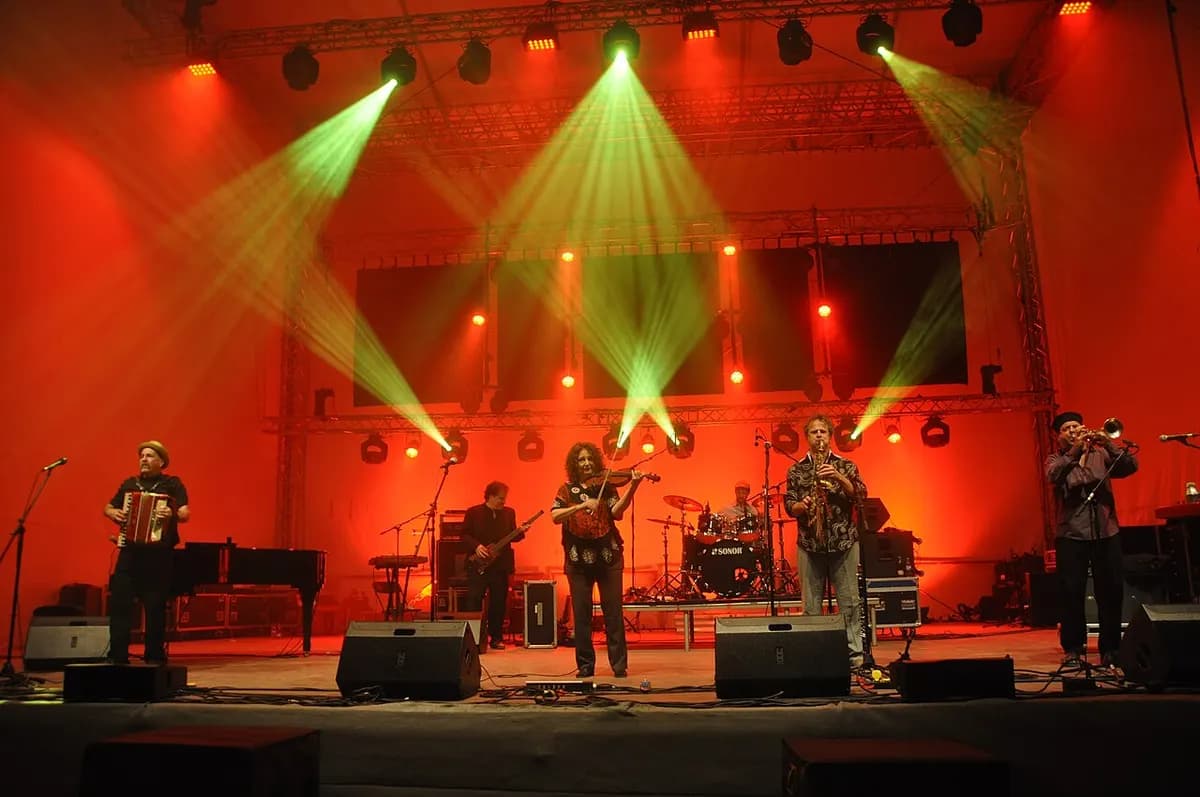
The klezmer revival began in the mid-1970s, when young American musicians started learning from the old 78s and from surviving players such as Dave Tarras. The Klezmorim (formed in Berkeley), the Klezmer Conservatory Band, Kapelye, Andy Statman, and later Brave Old World and The Klezmatics rebuilt the music, while clarinettist Giora Feidman carried it in Israel and Europe. Violinist Itzhak Perlman's project In the Fiddler's House (1995) brought it to classical audiences, and from the 1990s composer John Zorn's Radical Jewish Culture series on his Tzadik label pushed it into avant-garde jazz.
Modes, Ornaments & Sound
Klezmer's harmonic character comes from a small family of modes, many related to the prayer modes of the synagogue:
- Freygish (also called Ahava Rabboh) is the Phrygian dominant scale: a flattened second and a raised third, producing the sound most listeners think of as "Jewish". The ethnomusicologist Moshe Beregovski found that roughly a quarter of the melodies he collected were in freygish.
- Mi sheberakh (altered or "Ukrainian" Dorian) is a minor mode with a raised fourth, closely related to freygish.
- Adonoy molokh and mogen ovos resemble the Mixolydian and natural minor, with their own characteristic turns.
Ornaments make klezmer sound like speech or weeping. Players use the krekhts (a sob or catch in the note), kvetsh (a squeezed, bent pitch), trills, slides and grace notes, all taken from the cantor's vocal style. Players are judged on these inflections at least as much as on speed.
Klezmer does not run at a single tempo. Each dance has its own rhythm and feel:
| Form | Metre and rhythm | Character |
|---|---|---|
| Freylekhs | 2/4, fast and even | Joyful circle dance; the core of the wedding repertoire |
| Bulgar (bulgarish) | 2/4 or 4/4 with a syncopated 3+3+2 accent | Driving dance from Moldavia; dominant in American klezmer |
| Sher | 2/4, moderate | Set dance for couples in square formation |
| Khosidl | 2/4, moderate and stately | Dignified dance associated with Hasidic style |
| Terkish | 4/4 with a habanera-like lilt | Dance with Ottoman and Greek colour |
| Hora / zhok | Slow 3/8 or 3/4 with a limping accent | Swaying, melancholy dance |
| Doina (doyne) | Free, unmetred | Improvised lament borrowed from the Romanian doina, often leading into a dance |
Instruments
Klezmer bands vary in size from three players to large brass-heavy ensembles:
- Violin: the original lead of the European kapelye, with a second violin or sekund playing rhythmic chords.
- Clarinet: the lead in much American klezmer, often in C or E-flat. It can laugh, cry and slide, which suits the ornaments.
- Tsimbl: the Jewish hammered dulcimer, important in older European bands and revived by modern players.
- Bass: double bass or cello in the older string bands, later tuba in brass-driven bands.
- Accordion: common in 20th-century bands, where it plays harmony and rhythm.
- Brass: trumpet, trombone and baritone horn, heard in American recordings and in larger dance bands.
- Drums: a bass drum topped with a cymbal (poyk), later a full drum kit.
- Piano: common in American recording studios from the 1920s.
Early recordings sound thin and bright by modern standards, but revival musicians learned the style from them note by note.
Styles & Related Music
- Old-world klezmer: the European string-band style, reconstructed by groups such as Budowitz, using violin, tsimbl and period instruments.
- American klezmer: the clarinet-led, brass-inflected dance-band style of 1910s–1930s New York, dominated by the bulgar.
- Revival klezmer: the 1970s–80s rebuilding of the repertoire from records and surviving players.
- New Jewish music: from the 1990s, bands such as The Klezmatics added original songs, political lyrics and influences from rock, jazz and world music.
- Radical Jewish Culture: John Zorn's Masada project and the Tzadik catalogue, which combine Jewish modes with free jazz.
- Yiddish theatre and song: the vocal side of the same world. "Bei Mir Bistu Shein", written for the Yiddish stage, became a swing hit for the Andrews Sisters in 1937.
- Hasidic niggun: wordless devotional melodies that share modes and phrasing with klezmer.
- Neighbouring dance music: Romanian, Moldavian and Ukrainian folk dance, and the wider Central and Eastern European dance-band world of the polka, which shares its two-beat bounce.
Key Artists & Recordings
Where to start:
- Naftule Brandwein, the most flamboyant clarinettist on the New York records of the 1920s.
- Dave Tarras, a clarinettist who recorded from the 1920s and later taught revival players, Andy Statman among them.
- Abe Schwartz and Harry Kandel, bandleaders whose orchestras recorded much of the American repertoire.
- The Klezmorim, the Berkeley band that helped start the revival in the 1970s.
- Klezmer Conservatory Band, the Boston ensemble founded by Hankus Netsky.
- Andy Statman, clarinettist and mandolinist who studied with Dave Tarras.
- The Klezmatics, the New York band that added new songs and lyrics to the dance repertoire.
- Giora Feidman, the clarinettist who popularised klezmer in Israel and Europe.
- Itzhak Perlman's In the Fiddler's House (1995), recorded with leading revival bands.
- John Zorn: Masada and the Radical Jewish Culture series.
Start with a Dave Tarras bulgar, then a Klezmatics album, then a revival band's doina into freylekhs, where a slow lament breaks into a fast dance.
Klezmer, Swing & Jazz
Klezmer and jazz grew up side by side in early 20th-century American cities, often among the same musicians. Jewish clarinettists and trumpeters moved between wedding bands and swing orchestras, and klezmer phrases surfaced in swing hits of the late 1930s. Both scenes put the clarinet up front, so on a quick listen they are easy to confuse.
The differences lie in structure. Jazz improvises over cycles of chord changes with a swung rhythm; klezmer moves within modes, often over a drone-like or simple harmony, plays dance rhythms such as the bulgar and freylekhs with a straight or lilting feel, and treats ornament as the main expressive device. Modern bands cross between them freely. Stage music is a third case: Yiddish theatre songs and musical theatre scores such as Fiddler on the Roof borrow the sound of klezmer while remaining composed theatre music.
How AI Detects Klezmer
An audio model can hear several of klezmer's markers: a bright clarinet or violin lead with sobbing bends and slides, accordion and brass, a bouncing oom-pah bass, and the distinctive augmented-second interval of freygish. Fast bulgars and freylekhs have a recognisable two-beat drive.
Each of these features also belongs to other genres. A clarinet lead points toward early jazz and swing, an accordion and two-beat bass toward Central European folk and polka, and the freygish interval toward Middle Eastern and Balkan music. What makes a tune klezmer is its repertoire, its ornament style and its place at a Jewish wedding, and no single sound carries all three. Try a clip in the Genre AI music genre detector, and read why songs often get more than one genre label.
An honest note on how Genre AI handles klezmer. Our classifier was trained mostly on Western popular music and has no dedicated Klezmer label. The nearest broad categories are Jazz (to the model, a clarinet-led acoustic band with improvised lines sounds like early jazz and swing) and Folk / Country, for accordion-and-fiddle dance recordings. The freygish mode with its augmented second can also pull results toward Arab / Middle Eastern. Expect a label for the instrument family, not for klezmer itself.