Indie pop is guitar pop built on the independent-label infrastructure that punk left behind in Britain: cheap pressing plants, mail order, fanzines and John Peel. It took punk's do-it-yourself economics and dropped punk's volume, keeping chiming clean guitars, a soft untrained voice and a melody that usually arrives within the first verse. Its sibling indie rock stayed loud. Indie pop decided that loudness was optional and the tune was not.
This guide covers where the style came from, what separates it from indie rock and from dream pop, which labels built it, and which records to start with. To hear how a jangling three-chord single reads to a classifier, run a few seconds through our free AI music genre detector.
What Is Indie Pop?
Indie pop puts melody first, arrangement second and volume last. The guitars are clean or lightly overdriven, played as ringing open chords and arpeggios more often than riffs. The rhythm section keeps a plain backbeat and stays out of the way. The vocal sits close to the microphone and is usually delivered by someone with no formal training and no interest in acquiring any. Tracks are short, two to three and a half minutes, and structurally conservative, because the point of the form is the tune.
The word "indie" describes how the records were released, but by the mid-1980s it also described an aesthetic. Many bands chose amateurism deliberately and treated simple playing as a position. Lyrics are small in scale and specific (a bus stop, a bedsit, a friend's party, someone who did not write back) and delivered without ironic distance, which is why the style attracts both devotion and mockery.
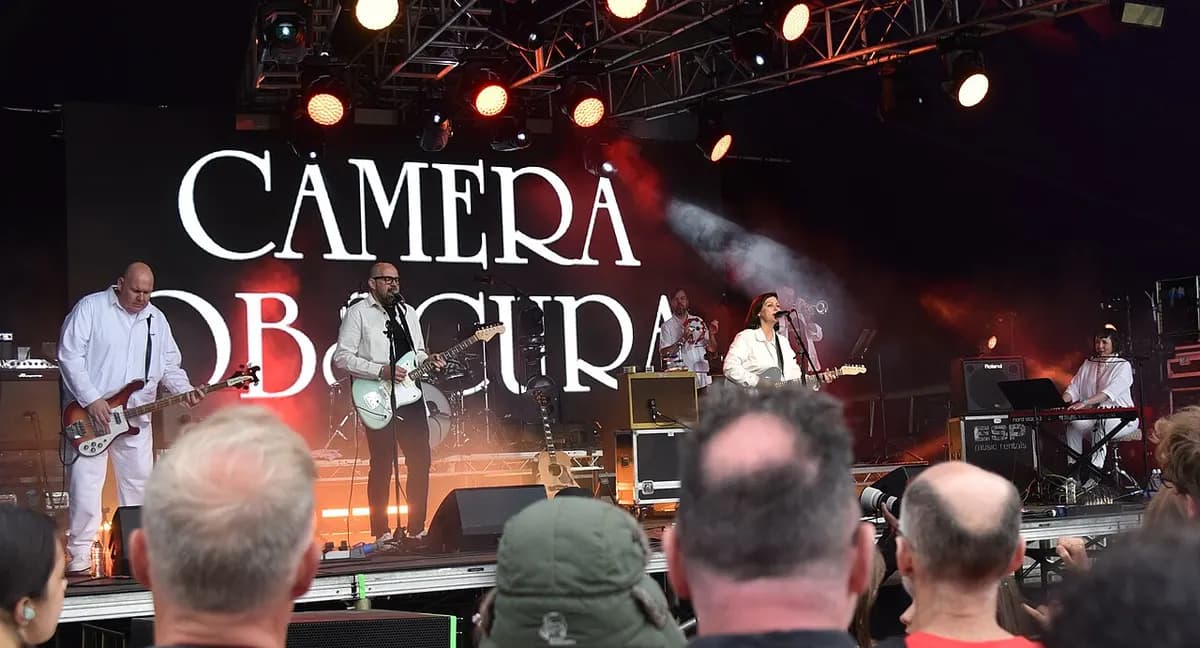
Indie rock grew from the same labels and often shared bills, and the difference is one of weight. Indie rock keeps distortion, drive and a rock band's dynamic range; indie pop trades them for jangle and sweetness. Pavement and The Strokes are indie rock; Heavenly and Camera Obscura are indie pop. The full comparison is in our indie rock guide.
In dream pop and shoegaze the guitar is a texture: a wash of reverb, delay and pitch modulation with the voice mixed into it as another layer. In indie pop the guitar plays chords you could write down, and the voice is dry and out in front. Shoegaze hides the song inside the sound; indie pop puts the song on the table.
History & Origins
The immediate precursor is post-punk's label economy. By 1979 an unknown band could press a seven-inch, sell it by mail through a fanzine advert and get it played on national radio without a contract, and indie pop was built on that possibility.
Postcard Records, founded in Glasgow in 1979 by Alan Horne, set the template. Its slogan was "The Sound of Young Scotland", a nod to Motown's "The Sound of Young America", and its flagship band was Orange Juice, whose first single "Falling and Laughing" (1980) put Velvet Underground chords, Chic-style guitar picking and Edwyn Collins's deadpan croon into three minutes of nervous, unmacho pop. Josef K and Aztec Camera also released records on the label. Postcard wound down in 1981, shortly after Orange Juice signed to Polydor, but in two years it had fixed both the sound and the posture.
The scene's founding document is C86, a cassette compiled by the NME in 1986 and sold by mail order: twenty-two tracks licensed from British independent labels, opening with Primal Scream's "Velocity Girl" and taking in The Pastels, The Wedding Present, The Shop Assistants, McCarthy and The Soup Dragons. The tape was not intended as a manifesto and its contents are stylistically mixed, but the name stuck to one strand of it, jangling, fast, thin-sounding guitar pop. "C86" became a genre label, then a term of abuse for weediness, then a badge worn on purpose.
The wing that took the abuse most directly was twee pop, also called anorak pop after the cagoules its audience wore. Talulah Gosh, formed in Oxford in 1986 around Amelia Fletcher, played two-minute songs about crushes at punk tempo. Fletcher went on to Heavenly, whose later records moved from sweetness to open feminist anger. In Glasgow, The Pastels had been working similar territory since 1981.
Sarah Records gave the scene a headquarters. Clare Wadd and Matt Haynes founded it in Bristol in 1987; both had been making fanzines, and early releases came as flexidiscs and seven-inch singles with fanzine inserts. The roster included The Field Mice, The Orchids, Heavenly, Blueboy and East River Pipe. In August 1995 the label shut itself down on principle with SARAH 100, There and Back Again Lane, a booklet with a CD of representative tracks, and a farewell party on the Thekla, a boat moored in Bristol's Floating Harbour. Its press advert announcing the end said, "We don't do encores."
America built a parallel scene in the Pacific Northwest. K Records was founded in Olympia, Washington in 1982 by Calvin Johnson, whose own band Beat Happening played three chords with no bass player. In August 1991 Johnson and Candice Pedersen organised K's International Pop Underground Convention, six days and about fifty bands in Olympia. The first night, billed "Love Rock Revolution Girl Style Now" and remembered as Girl Night, featured women performers and fed directly into riot grrrl. Slumberland Records, founded in 1989, carried the American strand onward.
The mid-1990s produced the genre's most durable act. Belle and Sebastian recorded Tigermilk in Glasgow in 1996 as a project on a Stow College music-business course; it was pressed in an edition of a thousand LPs on the college label Electric Honey. If You're Feeling Sinister followed on Jeepster in November 1996, adding strings, trumpet and Stuart Murdoch's novelistic character sketches to the jangle, and it is the record many listeners mean when they say indie pop.
From there the style reached the mainstream in bursts. The Shins' Oh, Inverted World (Sub Pop, 2001) found a wider audience after two of its songs were used in the 2004 film Garden State. Camera Obscura's Let's Get Out of This Country (2006) rebuilt Glasgow jangle as widescreen 1960s pop. Vampire Weekend's debut (XL, 2008) crossed the form with West African guitar figures. Alvvays from Toronto released "Archie, Marry Me" in 2014, now a common modern reference point.
Key Characteristics & Sound
What identifies an indie pop record:
- Tempo: typically 100–150 BPM, straight eighths, brisk but never heavy. The twee wing often runs faster than it sounds because the guitars are so light.
- Guitars: clean, treble-forward and chiming, with chorus or compression in place of distortion; open chords, arpeggios and single-note figures instead of power chords.
- Vocals: soft, close-miked, conversational, often flat-toned. Boy-girl unison singing is a scene signature.
- Harmony: diatonic and mostly major-key, drawing on 1960s girl-group and Byrds vocabulary; the melancholy usually comes from the lyric.
- Rhythm section: plain backbeat, tambourine, few fills, with a bass that often plays a countermelody instead of sitting on the root.
- Track length: two to three and a half minutes, verse-chorus form, rarely a solo.
- Production: modest budgets and small studios, so a bright top end, thin bass, audible room and no attempt to sound expensive.
- Lyrics: first-person, domestic and specific, with embarrassment treated as legitimate subject matter.
Where it sits among its neighbours:
| Trait | Indie Pop | Indie Rock | Dream Pop | Britpop |
|---|---|---|---|---|
| Peak period | 1986–1996 | 1990s–2000s | 1988–1995 | 1994–1997 |
| Typical BPM | 100–150 | 100–160 | 70–120 | 110–150 |
| Guitar sound | Clean jangle | Fuzz and drive | Reverb wash | Loud and layered |
| Vocals | Soft, close, dry | Melodic, pushed | Buried, breathy | Front, accented |
| Production | Cheap, bright | Room and grit | Dense effects | Studio polish |
| Reference track | Archie, Marry Me | Last Nite | Cherry-coloured Funk | Common People |
Instruments & Production
The equipment list is short and cheap, and it accounts for most of the sound:
- Jangle guitars: Rickenbacker six- and twelve-strings for the classic chime, but just as often a Fender Jaguar or Jazzmaster, a Burns, or a second-hand semi-acoustic bought because it was affordable.
- Small combo amplifiers at low volume, with a chorus pedal and a compressor doing the work a distortion pedal does elsewhere.
- Cheap keyboards and toy instruments (Casio home keyboards, glockenspiel, recorder, melodica) used as colour on the chorus.
- Acoustic instruments as decoration: trumpet, cello, flute and brushed drums, especially in the Belle and Sebastian and Camera Obscura lineage.
- Drum machines where a drummer was unavailable. The Field Mice used programmed rhythms on their early records.
- Cheap and home recording, with sessions booked in single days. Beat Happening's records were cut with minimal equipment, and the rough sound is part of the point.
Distribution was part of the craft. The seven-inch single was the standard unit, sold by mail order and through a handful of shops, packaged with a fanzine or a hand-made sleeve, and often promoted by little more than a John Peel session on BBC Radio 1. A record could reach its whole audience without a distributor, a plugger or a press campaign, so the music never had to bend toward radio formats.
Subgenres & Related Styles
The family around it:
- Twee pop / anorak pop: the sweetest and most defiantly amateur strand, with Talulah Gosh, Heavenly, Tiger Trap and much of the Sarah Records roster.
- Jangle pop: the guitar-tone strand shared with 1980s American college radio, and the hinge between indie pop and indie rock.
- Chamber pop: strings, horns and arranged detail on top of the same songwriting, as on Belle and Sebastian and Camera Obscura records.
- Bedroom pop: the home-recorded descendant, overlapping heavily with lo-fi production values.
- Dream pop: similar melodies played for texture instead of clarity.
- Shoegaze: indie pop songwriting buried under volume and effects; several bands from the C86 orbit moved in that direction.
- Britpop: British guitar pop that stopped apologising and aimed at arenas.
Key Bands & Tracks
Where to start:
- Orange Juice: "Falling and Laughing" (1980), the Postcard blueprint.
- The Pastels: Up for a Bit with The Pastels (1987).
- Talulah Gosh: Oxford, 1986–1988; singles collected on Backwash.
- Beat Happening: Jamboree (1988) and "Indian Summer", the American foundation stone.
- The Field Mice: "Emma's House" (1988), the Sarah Records sound in one single.
- Heavenly: Le Jardin de Heavenly (1992).
- Belle and Sebastian: If You're Feeling Sinister (1996), the genre's central album.
- The Shins: Oh, Inverted World (2001).
- Camera Obscura: Let's Get Out of This Country (2006).
- Vampire Weekend: Vampire Weekend (2008).
- Alvvays: "Archie, Marry Me" (2014).
How AI Detects Indie Pop
Indie pop gives a classifier a fairly clear acoustic profile and an unclear label. The likely cues are little distortion in the guitars, a bright, treble-weighted spectrum with little sub-bass, a steady mid-tempo backbeat with few fills, a short repetitive structure, and a quiet, close, unprocessed lead vocal. Read together, those features describe a rock line-up recorded gently, which is what most indie pop is.
Genre AI's production taxonomy has no separate indie pop class. Rock is split into eight fine labels, and the closest is Indie / Alternative. Sweeter, softer records may land on Soft / Pop Rock or leave the rock family for the coarse Pop label. Acoustic-led twee tracks with brushed drums and a trumpet could read as Folk / Country (fine label Folk) or Singer / Songwriter, which describes the audio fairly even if it misses the scene. Feed a track to the Genre AI music genre detector and look at the second and third labels as well as the first.
Indie pop has no label of its own in Genre AI, so the useful question is which way a record leans. Jangling band records from the C86 and Sarah era are most likely to come back as Rock with Indie / Alternative underneath, the same place indie rock goes, possibly with lower confidence because the distortion that marks most rock is missing. Lighter, more arranged records such as Camera Obscura's may drift to Soft / Pop Rock or to Pop, and acoustic twee songs toward Folk or Singer / Songwriter. Bands that lean on reverb instead of jangle are closer to Dream Pop, which is also absent from the taxonomy, so they face the same Indie / Alternative versus Pop split. That borderline is real in the music too.