Hard bop is the style of small-group jazz that grew out of bebop in the mid-1950s and pulled it back towards the blues and the Black church. It keeps bebop's fast lines and chord-based improvisation but adds heavier drumming, a stronger backbeat, minor-key tunes, gospel-flavoured piano and arranged horn melodies, usually played by a quintet of trumpet, tenor saxophone, piano, bass and drums. Art Blakey's Jazz Messengers, Horace Silver, Clifford Brown, Lee Morgan and the Blue Note label are its defining names.
This guide covers where hard bop came from, what makes it sound the way it does, the soul jazz and post-bop branches, the records to start with, and how it differs from bebop and cool jazz. To hear how a Blue Note-style quintet reads to a machine, drop a clip into our free AI music genre detector.
What Is Hard Bop?
Hard bop is best understood as bebop with its roots showing. The harmonic language is still the advanced, chord-by-chord vocabulary that Charlie Parker and Dizzy Gillespie built in the 1940s, and soloists still run long eighth-note lines through changing chords. What changes is the weight. The drummer plays louder and more assertively, the bass and piano lean into the blues, and melodies are often written in minor keys or borrow the call-and-response shape of gospel. The tunes are also more carefully arranged, with horn harmonies, interludes and shout choruses where bebop would play a unison head once at each end.
The result is music that is technically demanding but emotionally direct. Bebop could sound like a contest of virtuosos; hard bop sounds like a working band. Its most famous recordings, Art Blakey's "Moanin'", Horace Silver's "Song for My Father" and Lee Morgan's "The Sidewinder", are built around a memorable riff or groove that a non-specialist listener can hum.
The term is sometimes used loosely for almost any acoustic jazz of the late 1950s and 1960s, and the edges really are blurry: many musicians moved between hard bop, modal jazz and the freer "post-bop" of the mid-1960s within a few years. The core sound is easy to pick out, though: a quintet, the blues, a driving ride cymbal and a punchy written theme.
History & Origins
By the early 1950s bebop had become the language of modern jazz, while on the West Coast a lighter, more arranged cool jazz was attracting attention and record sales. Hard bop is often described as the East Coast answer, a return to rhythm, the blues and the feel of the Black neighbourhoods of New York, Philadelphia and Detroit, where many of its players grew up. That framing is a simplification, since the same musicians often played in both styles, but it captures the difference in mood.
Several recordings from 1954 and 1955 are usually cited as the starting point. Miles Davis recorded "Walkin'" for Prestige in April 1954, slowing bebop down to a heavy blues groove (the album of that name came out in 1957). On 21 February 1954 Art Blakey's quintet, with Clifford Brown on trumpet and Horace Silver on piano, recorded the two volumes of A Night at Birdland for Blue Note. Silver and Blakey then co-led the group heard on Horace Silver and the Jazz Messengers, recorded in November 1954 and February 1955, including Silver's "The Preacher" and "Doodlin'". Blue Note's Alfred Lion was reportedly reluctant to record "The Preacher", which struck him as old-fashioned, and it became a hit. At the same time the Clifford Brown–Max Roach Quintet (1954–1956) showed how brilliant, disciplined and warm the new style could be, until Brown was killed in a car accident on 26 June 1956, aged 25.
After Silver left to lead his own quintet, Blakey kept the Jazz Messengers name and turned the band into a finishing school. Over the following three decades it passed through Lee Morgan, Benny Golson, Bobby Timmons, Wayne Shorter, Freddie Hubbard, Cedar Walton, Curtis Fuller and, in the early 1980s, Wynton and Branford Marsalis. Moanin', recorded in October 1958, with Timmons's gospel-tinged title track, became the band's signature record.
The label most closely tied to the style is Blue Note Records, run by Alfred Lion and Francis Wolff. Paid rehearsals before sessions, recording engineer Rudy Van Gelder's close, punchy sound, Wolff's photographs and Reid Miles's typographic covers gave hard bop a recognisable identity. Prestige and Riverside recorded much of the same scene.
In the 1960s the style branched. One road led to soul jazz, which leaned further into groove and gospel, often with Hammond organ, and sometimes reached the pop charts. Lee Morgan's The Sidewinder (recorded December 1963, released 1964) became Blue Note's best-selling album, and its title track reached No. 81 on the Billboard Hot 100 in January 1965. Cannonball Adderley's "Mercy, Mercy, Mercy", recorded in October 1966, became a surprise hit in early 1967. The other road led to post-bop, where Wayne Shorter, Herbie Hancock and others absorbed modal harmony and looser forms. When jazz-rock and fusion took over in the 1970s, hard bop lost its commercial footing. It came back in the 1980s through the "Young Lions", Wynton Marsalis and a generation of young players who revived acoustic small-group jazz in its image.
Key Characteristics & Sound
What identifies a hard bop recording:
- Tempo: very wide, from slow, heavy blues around 90–120 BPM to burning up-tempo pieces above 250 BPM. The medium-tempo groove tune, roughly 120–180 BPM, is the most characteristic.
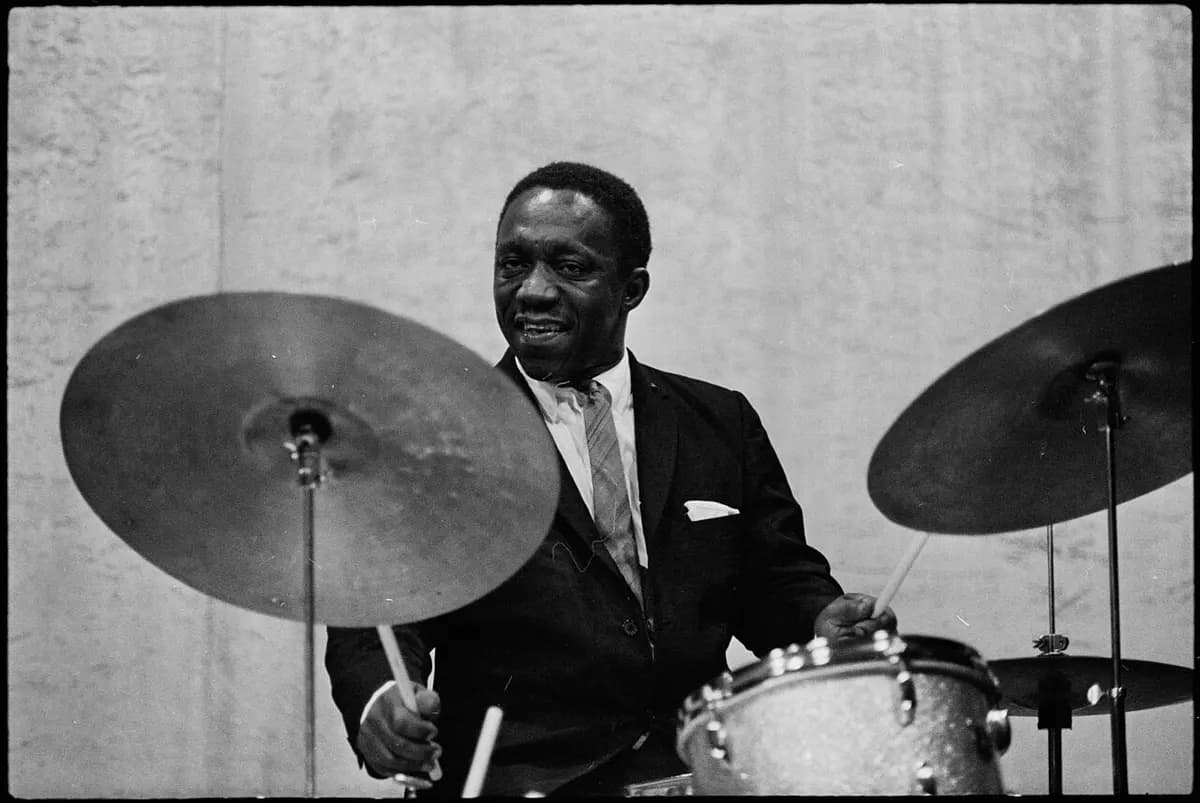
- Swing feel with weight: a ride cymbal pattern in swung eighths, a walking bass, and a drummer who marks the backbeat and fills aggressively. Art Blakey's rolling press roll into a new chorus is a trademark.
- Blues and gospel harmony: twelve-bar blues forms, minor blues, plagal "amen" cadences, call-and-response between horns and piano.
- Arranged themes: two horns in harmony instead of unison, written introductions, vamps and send-offs into solos.
- Long-form solos: each player takes several choruses over the changes, often with the other horn adding background riffs.
- Funky piano: block chords, blues licks and repeated figures in the left hand. Horace Silver and Bobby Timmons defined this approach.
- Tone: a fuller, harder saxophone sound than cool jazz; trumpets play with bite and are often open, not muted.
How it sits among the neighbouring jazz styles of its era:
| Trait | Hard Bop | Bebop | Cool Jazz | Soul Jazz |
|---|---|---|---|---|
| Peak period | 1954–1965 | 1944–1955 | 1949–1960 | 1958–1970 |
| Typical tempo | Medium to very fast | Fast to very fast | Slow to medium | Medium groove |
| Harmonic roots | Bebop plus blues and gospel | Chromatic, chord-based | Bebop plus classical counterpoint | Blues, gospel, simple vamps |
| Drumming | Loud, assertive, backbeat | Light ride, 'dropping bombs' | Soft, often brushes | Backbeat, near-funk |
| Typical lineup | Trumpet, tenor, rhythm | Alto, trumpet, rhythm | Nonet or pianoless quartet | Organ trio or quintet |
| Reference track | Moanin' | Ko-Ko | Take Five | The Sidewinder |
Instruments & the Quintet Format
The classic hard bop band is a quintet: trumpet and tenor saxophone in the front line, with piano, double bass and drums. Larger groups add a trombone (the Jazz Messengers ran as a sextet with Curtis Fuller in the early 1960s) or swap the tenor for alto, as Cannonball Adderley did.
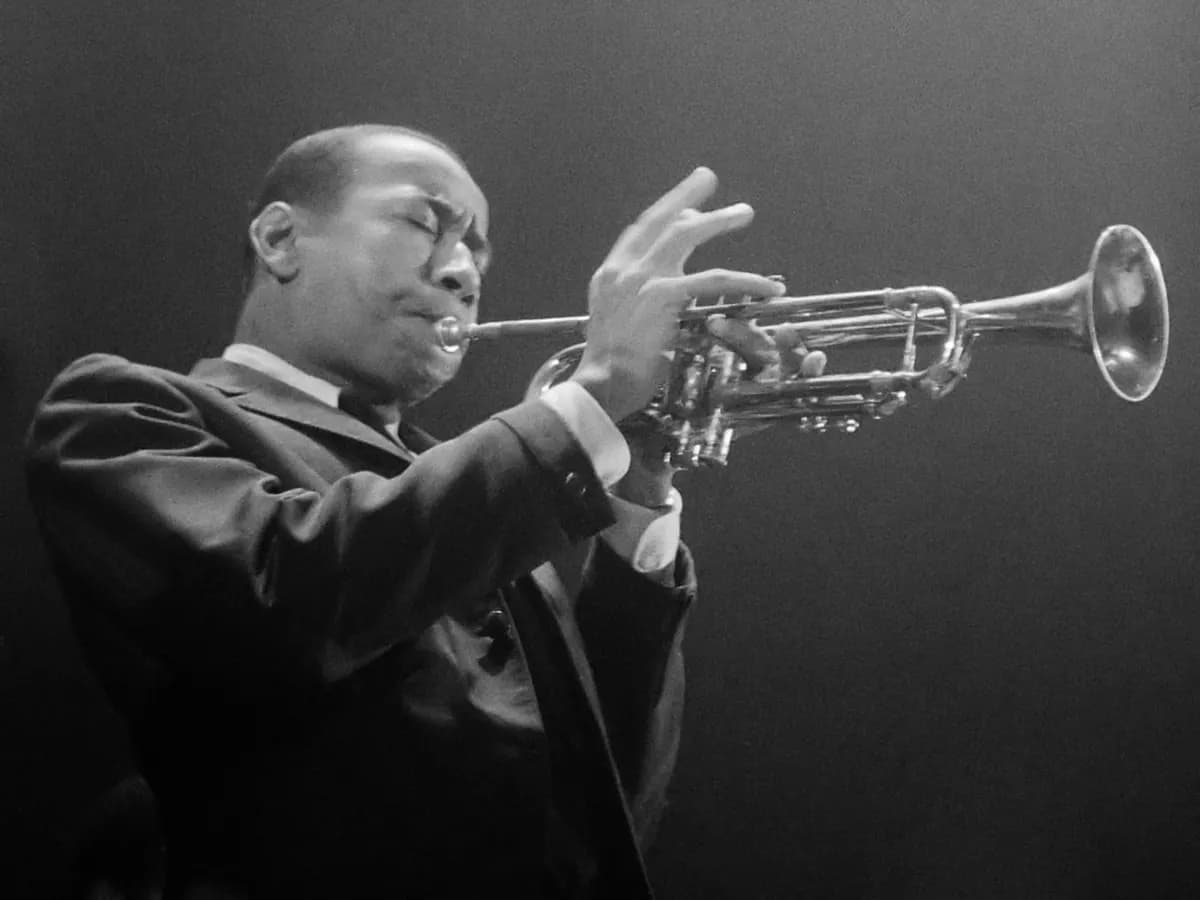
- Trumpet: Clifford Brown's warm, flawless lines set the standard; Lee Morgan, Freddie Hubbard, Kenny Dorham, Donald Byrd and Blue Mitchell followed.
- Tenor saxophone: the big-toned centre of the style, with Sonny Rollins, Hank Mobley, Johnny Griffin, Dexter Gordon, Benny Golson, and John Coltrane in his Prestige and Blue Note years.
- Piano: comping with blues voicings and strong left-hand figures, from Horace Silver, Bobby Timmons, Wynton Kelly, Red Garland and Cedar Walton.
- Double bass: walking lines that lock with the ride cymbal, from Paul Chambers, Doug Watkins and Sam Jones.
- Drums: the engine of the music, in the hands of Art Blakey, Max Roach, Philly Joe Jones and Louis Hayes.
- Hammond organ: central to the soul jazz branch through Jimmy Smith, Larry Young and others, often with guitar and drums instead of bass.
The Van Gelder sound matters to how hard bop is heard today. Close-miked horns, a present piano and a compact, punchy drum kit put the band in the room with the listener, and that intimacy is part of what a listener, or an audio model, recognises as "Blue Note".
Branches & Related Styles
- Soul jazz: the groove-first, gospel-heavy branch of Jimmy Smith, Cannonball Adderley, Horace Silver's later records and Lou Donaldson. It feeds directly into funk and soul and, decades later, into acid jazz and sample-based hip-hop.
- Post-bop: hard bop players absorbing modal harmony and open forms in the 1960s, as on Wayne Shorter's Speak No Evil and Herbie Hancock's Maiden Voyage. See modal jazz.
- Neo-bop / Young Lions: the acoustic revival of the 1980s led by Wynton Marsalis, much of it trained in Blakey's band.
- Latin-tinged hard bop: Horace Silver's "Señor Blues" and "Song for My Father" borrow Latin rhythms. Song for My Father was inspired by a trip Silver made to Brazil, and its title tune is dedicated to his Cape Verdean-born father. The fuller fusion of the two is Latin jazz.
- Jazz rap and sampling: Blue Note hard bop and soul jazz became raw material for jazz rap and boom bap producers in the late 1980s and 1990s.
Key Musicians & Essential Albums
A starter shelf, roughly in chronological order:
| Album | Leader | Year | Why it matters |
|---|---|---|---|
| Walkin' | Miles Davis | 1954 (recorded) | Bebop slowed into a heavy blues groove; an early hard bop marker |
| Horace Silver and the Jazz Messengers | Horace Silver / Art Blakey | 1954–55 (recorded) | 'The Preacher' and 'Doodlin'' bring gospel and blues to the front |
| Clifford Brown & Max Roach | Clifford Brown & Max Roach | 1955 | The model of a disciplined, brilliant hard bop quintet |
| Saxophone Colossus | Sonny Rollins | 1956 | 'St. Thomas' and thematic improvisation at its peak |
| Blue Train | John Coltrane | 1957 | Coltrane's Blue Note statement as a leader |
| Moanin' | Art Blakey and the Jazz Messengers | 1958 | Bobby Timmons's gospel riff; the style's signature record |
| Soul Station | Hank Mobley | 1960 | The relaxed, round-toned side of the tenor tradition |
| Go | Dexter Gordon | 1962 | A returning bebop elder in a hard bop setting |
| The Sidewinder | Lee Morgan | 1964 | Hard bop's biggest commercial hit, a boogaloo-flavoured groove |
| Song for My Father | Horace Silver | 1965 | The bass vamp later borrowed far beyond jazz |
Hard Bop vs Bebop vs Cool Jazz
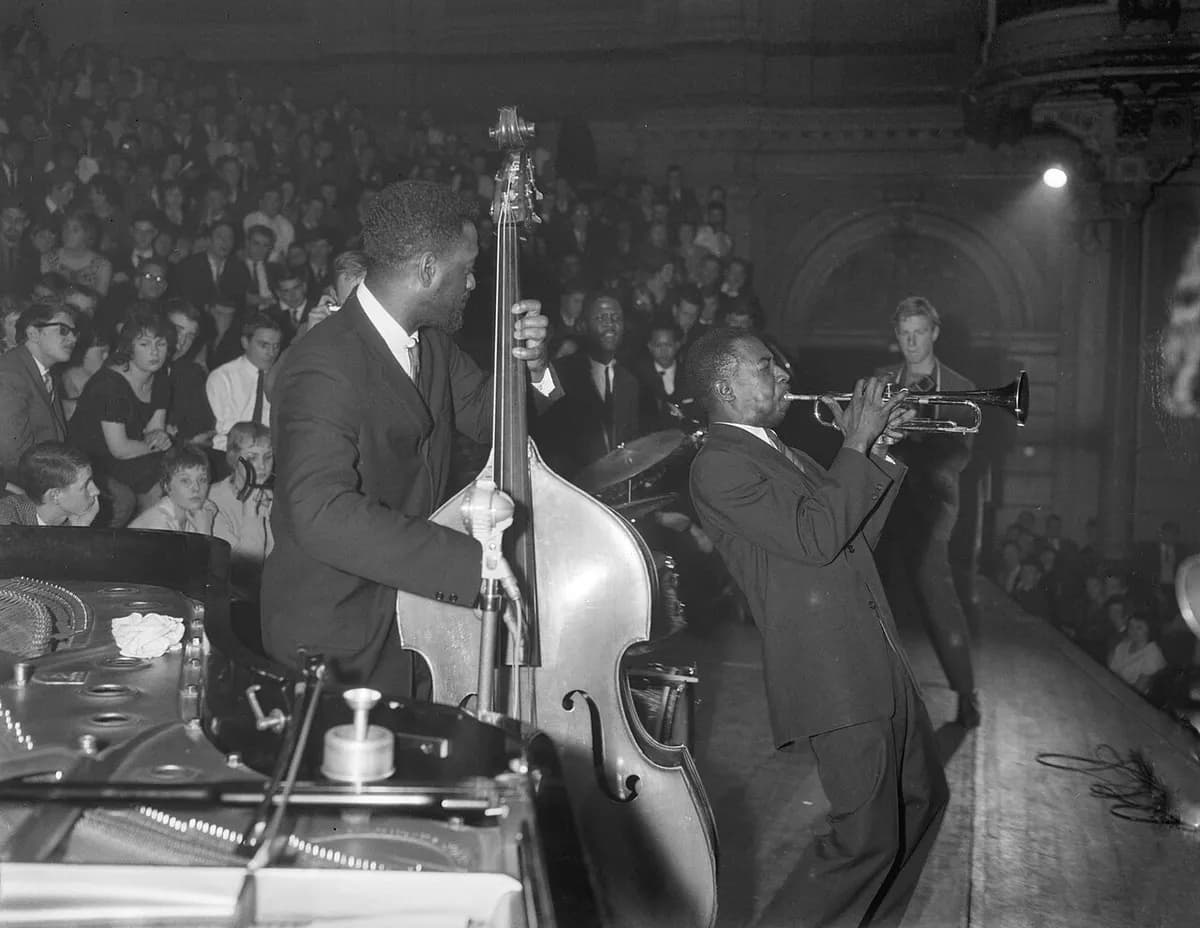
The three are separated less by vocabulary than by attitude. Bebop is a soloist's music: short unison heads, then a relay of virtuoso choruses at high speed, with the drummer keeping time on the ride cymbal and dropping accents. Hard bop keeps the soloing but treats the band as a unit, with arranged material, a heavier rhythm section and the blues in the foreground.
Cool jazz goes the other way, with softer dynamics, lighter tone, more counterpoint and classical influence, and frequent brushes on the snare. Put "Take Five" next to "Moanin'" and the difference is obvious within a bar: Paul Desmond's dry, airy alto against Lee Morgan's bright trumpet and Blakey's pounding backbeat.
Against modal jazz, the test is harmonic rhythm. Hard bop moves through chord changes every bar or two; modal tunes sit on one scale for eight or sixteen bars. And against swing, the difference is scale and function: swing is big-band dance music with short solos, hard bop is small-band listening music with long ones. For the deeper roots that hard bop draws on, our jazz vs blues comparison covers the shared ground.
How AI Detects Hard Bop
An audio model has strong, stable cues for acoustic jazz in general: the continuous ride-cymbal pattern in the high frequencies, a walking double bass with a clear pitched attack on every beat, saxophone and trumpet timbres with their characteristic harmonic profiles, and piano comping that never settles into a repeating pop-style accompaniment. Hard bop adds louder snare and kick activity, a more pronounced backbeat and, in soul jazz, organ and a near-funk groove.
What a model cannot easily hear is history. "Hard bop" is partly a period and a label, and it differs from bebop in emphasis while using the same instruments. Try a track in the Genre AI music genre detector and compare the top label with the alternatives. For a short clip, see also whether AI can identify a genre from a few seconds.
Genre AI's production taxonomy has no hard bop label, so the answer it can give is a neighbour, most likely inside the coarse Jazz family, since the walking bass, ride cymbal and two horns in front are strong jazz signals. Fast quintet material with long eighth-note solos will probably read as the fine label Bebop, which is historically close and not a bad answer. Other Jazz subgenres may appear as alternatives below it. One of those is Latin Jazz, which is a plausible runner-up on Horace Silver's Latin-tinged tunes and also on modal post-bop, because "modal jazz" is one of that label's text prompts. Organ-led soul jazz and boogaloo grooves like "The Sidewinder" may instead be won by the Funk / Soul family, with Funk or Soul as the answer, because the backbeat and the repeating bass figure carry more weight than the jazz harmony. In that case no Jazz labels are listed, since alternatives only come from the winning family. A quirk of the label prompts: the phrase "hard bop" sits among the text prompts of Hard Rock, not of any jazz label, but an acoustic quintet sounds nothing like a rock band, so that match is unlikely to decide the result. Treat the answer as "which corner of jazz", and use the era, the label and the lineup to decide whether it is hard bop.