G-funk, short for "gangsta funk", is the West Coast hip-hop production style that dominated rap in the first half of the 1990s. Its recipe is easy to spot: slow, rolling tempos, deep basslines lifted or replayed from Parliament-Funkadelic, a high, sliding synthesizer lead, and sung hooks. Dr. Dre's The Chronic (1992) made it a national sound and turned Los Angeles into the commercial centre of rap.
This guide covers where G-funk came from, what its records are made of, the producers and musicians behind them, and why it is a sound and not a subject, which is the key difference from gangsta rap. To check whether a beat leans G-funk, funk or boom bap, play a few seconds into our free AI music genre detector.
What Is G-Funk?
G-funk is defined by production, not lyrics. Most G-funk records were gangsta rap in content, but the term describes how the music sounds: late-1970s funk re-engineered for hip-hop. Where New York producers chopped short drum breaks, G-funk producers took whole grooves (a P-Funk bassline, a Zapp keyboard figure, a soul record's chord sequence) and either looped them or had musicians replay them in the studio, then set them over slow drum-machine patterns.
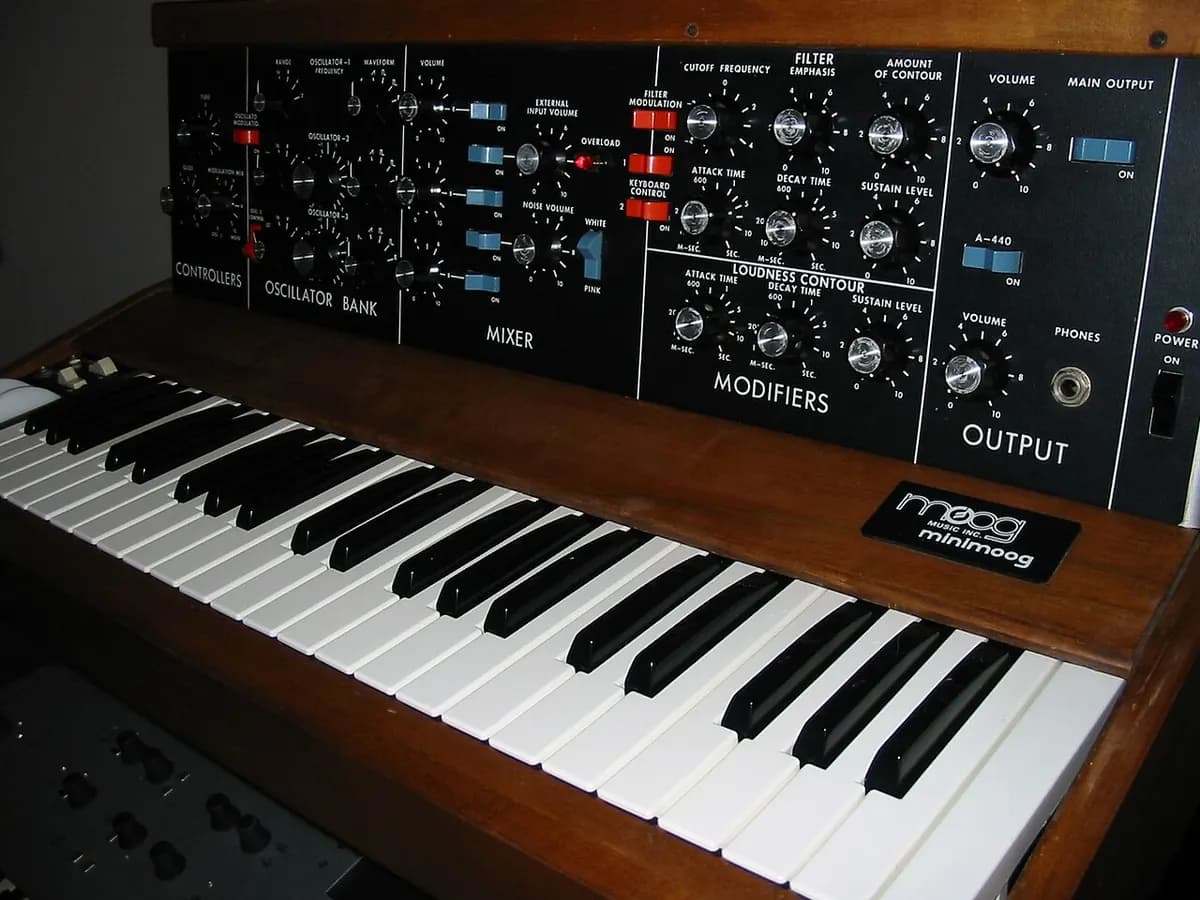
On top sits the element everyone recognises: a portamento synth lead, usually from a Minimoog or a similar monophonic synthesizer, gliding between high notes with a thin, whistling tone. Add a sung chorus, often by Nate Dogg, and a relaxed, conversational rap delivery, and you have the sound of Los Angeles radio between 1992 and 1996.
The combination sold enormously: lyrics as hard as anything in rap, set to music that sounded like a summer afternoon. G-funk got gangsta rap played at parties, in cars and on pop radio.
History & Origins
G-funk's raw material is funk from the 1970s and early 1980s: Parliament-Funkadelic under George Clinton, with Bernie Worrell's Minimoog lines and Bootsy Collins's bass; Zapp and Roger Troutman, whose talk-box vocals became a West Coast signature; and smooth soul and quiet-storm records.
Several producers were moving toward the sound at the start of the 1990s. DJ Quik's Quik Is the Name (1991) already favoured live-sounding funk over break-chopping. Above the Law recorded Black Mafia Life in 1991–1992, a slow, melodic funk record whose release slipped to February 1993, two months after The Chronic. The group's Cold 187um has long claimed that he came up with both the name and the sound, and Wikipedia notes that the claim is disputed. The record that defined the style is Dr. Dre's The Chronic, released by Death Row Records in December 1992 after Dre left N.W.A.
The Chronic introduced Snoop Doggy Dogg as Dre's main collaborator and built most of its tracks on interpolated funk. "Nuthin' but a 'G' Thang" rides Leon Haywood's "I Want'a Do Something Freaky to You", and "Let Me Ride" draws on Parliament's "Mothership Connection (Star Child)". Bassist and keyboardist Colin Wolfe and other studio musicians replayed parts live, which gave the album a warmth that loops alone would not have. Snoop's debut Doggystyle (1993) followed with the same team and confirmed the formula.
The years 1993–1996 were the style's peak. Warren G and Nate Dogg's "Regulate" (1994), built on Michael McDonald's "I Keep Forgettin' (Every Time You're Near)", became one of the defining singles of the era. Tha Dogg Pound, MC Eiht, Mista Grimm and Bay Area acts all worked inside the palette, and 2Pac's "California Love" (1995), produced by Dr. Dre with Roger Troutman on talk box, became its anthem.
Dre left Death Row in 1996, 2Pac was killed that September, and East Coast and Southern styles took over the charts. When Dre returned with 2001 (1999), he had moved to a sparser sound of piano riffs, strings and hard drums, and by the early 2000s G-funk had largely left the mainstream. It survives as a reference point, picked up by later West Coast artists such as Kendrick Lamar and YG and sampled widely.
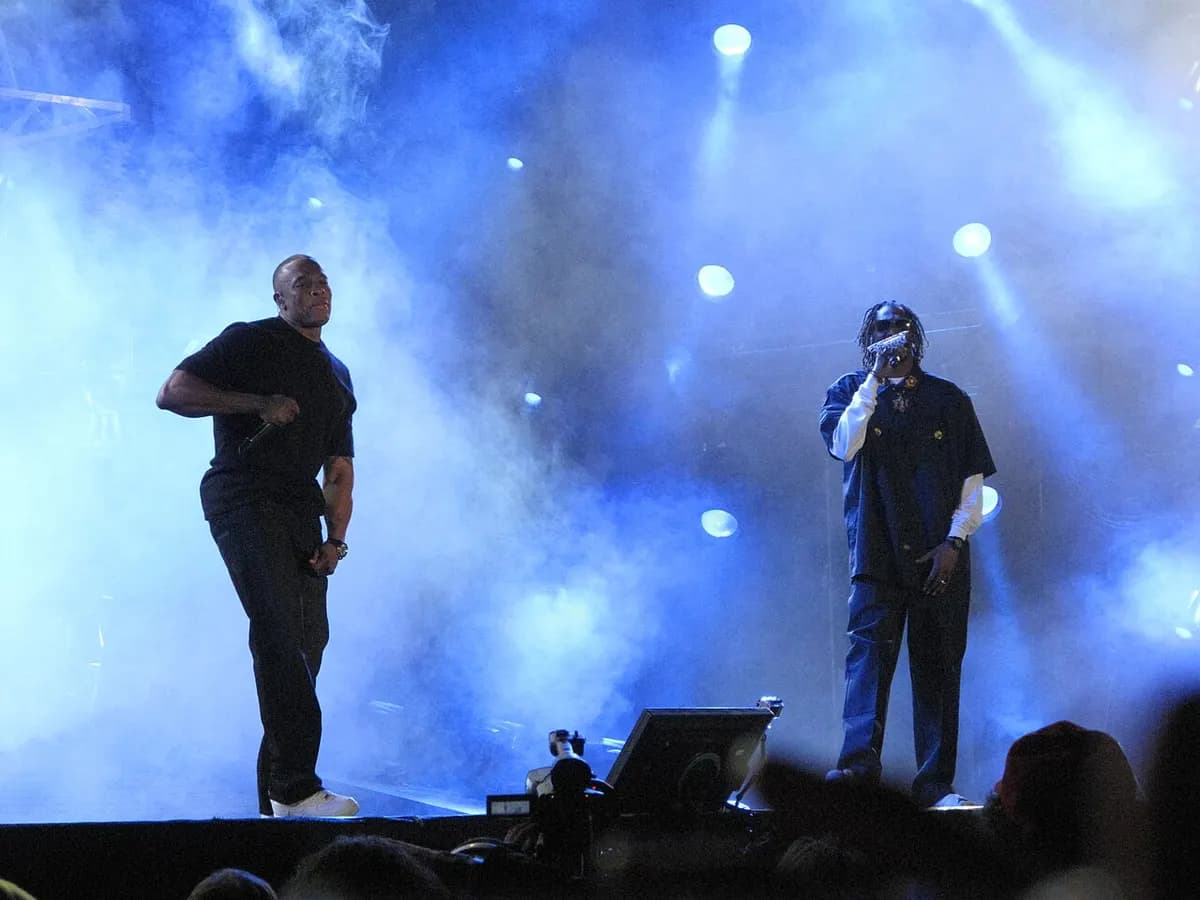
Key Characteristics & Sound
How to recognise G-funk by ear:
- Tempo: Wikipedia gives 90–100 BPM, with many classics in the low-to-mid 90s; slow enough to feel like a cruise.
- Bass: deep and melodic, a moving funk bassline, often played on a Minimoog or replayed by a bassist, instead of a static sub-bass hit.
- The whine: a high-register monophonic synth lead with heavy portamento, sitting above everything else in the mix.
- Drums: Roland TR-808 kicks and claps layered with laid-back snares; swung, relaxed timing.
- Keys: Rhodes and synth pads providing lush chord beds borrowed from soul and quiet storm.
- Talk box and vocoder lines in the Roger Troutman tradition.
- Sung hooks by R&B singers, with Nate Dogg the defining voice; female backing vocals are common.
- Delivery: unhurried, melodic, often drawled. Snoop Dogg's flow is the textbook example.
Comparing G-funk with its source and its successor makes the recipe clear:
| Trait | P-Funk (1970s) | G-Funk (1992–1996) | Late West Coast (1999+) |
|---|---|---|---|
| Typical tempo | 100–115 BPM | 90–100 BPM | 90–100 BPM |
| Rhythm source | Live band | Drum machine + replayed funk | Programmed drums |
| Lead sound | Minimoog, horns | Portamento synth whine | Piano riff, strings |
| Bass | Live bass guitar, synth bass | Melodic synth or replayed bass | Simpler, heavier sub |
| Vocals | Group chants, sung | Rapped verses, sung hooks | Rapped, fewer sung hooks |
| Reference record | Mothership Connection (1975) | The Chronic (1992) | 2001 (1999) |
Instruments & Production
G-funk is a studio style, and its tools are specific:
- Interpolation over sampling. Producers often had session players re-perform a part instead of looping the original recording, which could reduce sample-clearance costs and gave engineers control over every sound.
- Minimoog and similar analogue monosynths for both bass and lead. The lead's slow glide between notes produces the "whine".
- Roland TR-808 for kicks and claps, often combined with sampled snares and percussion.
- Talk box: a tube carries a synth's sound into the performer's mouth, where it is shaped into words. Roger Troutman is the reference player.
- Sustained chord beds from Rhodes piano and string pads, giving the tracks a warm, wide middle.
- A clean, expensive mix. Dr. Dre's productions were known for separation and low-end weight that suited car stereos, in clear contrast with the gritty, dusty sound of East Coast boom bap.
Scenes & Related Styles
G-funk sat inside a wider West Coast ecosystem and influenced styles far beyond it:
- Death Row Records: Dr. Dre, Snoop Dogg, Tha Dogg Pound, Nate Dogg and, from 1995, 2Pac; the commercial core of the style.
- Long Beach: the shared hometown of Snoop Dogg, Warren G and Nate Dogg, and the source of much of the style's melodic side.
- Compton and South Central: DJ Quik, MC Eiht and Compton's Most Wanted, with their own funk-heavy variants.
- Bay Area: E-40 and others developed a parallel funk-based sound that later fed into hyphy.
- Gangsta rap: the lyrical tradition G-funk usually carried, and G-funk is the best-known sound it ever had.
- New jack swing and R&B: the same era's R&B shared singers and polished production values.
- Later revivals: modern West Coast artists, retro-minded producers and parts of phonk and synthwave borrow the whine and the bass.
Key Artists & Albums
The essential G-funk records:
- Dr. Dre: The Chronic (1992), "Nuthin' but a 'G' Thang", "Let Me Ride".
- Snoop Doggy Dogg: Doggystyle (1993), "Gin and Juice", "Who Am I? (What's My Name?)".
- Warren G: Regulate... G Funk Era (1994), "Regulate" with Nate Dogg.
- Nate Dogg: the era's defining hook singer across dozens of features.
- Tha Dogg Pound: Dogg Food (1995).
- 2Pac: "California Love" (1995) and All Eyez on Me (1996).
- DJ Quik: Quik Is the Name (1991), Safe + Sound (1995).
- Above the Law: Black Mafia Life (1993).
- MC Eiht: "Streiht Up Menace" (1993), from the Menace II Society soundtrack.
Start with The Chronic, "Regulate" and "California Love": the blueprint, the biggest single and the anthem.
G-Funk vs Gangsta Rap, Funk & Boom Bap
G-funk is easiest to define against its neighbours. It is a production style. Gangsta rap is a lyrical category, funk is the band music G-funk was built from, and boom bap is the East Coast alternative it was set against.
| Trait | G-Funk | Gangsta Rap | Funk | Boom Bap |
|---|---|---|---|---|
| Defined by | Sound | Subject matter | Groove and band playing | Sound |
| Region | West Coast | Nationwide | US, from the mid-1960s | East Coast |
| Tempo | 90–100 BPM | Varies; mostly 85–100 BPM | 90–120 BPM | 85–95 BPM |
| Core sound | Replayed P-Funk, synth whine | Any production | Live bass, guitar, horns | Chopped breaks, dusty samples |
| Hooks | Sung, melodic | Varies | Sung, chanted | Scratched or rapped |
| Reference | The Chronic | Straight Outta Compton | Mothership Connection | Illmatic |
How AI Detects G-Funk
G-funk is one of the more acoustically distinctive rap styles, because its signature elements are sounds, not lyrical choices. A classifier can pick up the slow tempo, the melodic bass moving across several notes per bar, the swung drum-machine pattern and, most tellingly, a high, sustained synthesizer tone gliding between pitches. Those features overlap with what models learn from funk and soul, so a split reading between rap and funk is a likely outcome.
A model cannot tell from the audio whether the lyrics are gangsta rap, party rap or something else, because that distinction lives in the words. Try a track in the Genre AI music genre detector, and read how AI music genre detection works for the limits of audio-only classification.
Genre AI's production taxonomy has no dedicated G-funk label, but the style maps onto it better than most rap styles. The coarse Rap Hip-Hop family has a fine label called Gangsta, and the separate Funk / Soul family includes Funk, whose list of aliases even contains the phrase "g funk". A G-funk record is literally both: rapped vocals over replayed funk. The likeliest reading is Hip-Hop (often with Gangsta underneath) with Funk as a close alternative, and the balance may tilt toward Funk on tracks with long instrumental passages or a sung hook carrying most of the song. Given what G-funk is made of, that split describes the music accurately.