Gypsy jazz, known in French as jazz manouche, is the string-band style of swing created in 1930s Paris by the Belgian-born Manouche guitarist Django Reinhardt and the violinist Stéphane Grappelli. It replaces the horns and drums of American jazz with acoustic guitars, violin and double bass: one guitar takes blazing, arpeggio-rich solos while the others drive a percussive chop called la pompe. Its standards, such as "Minor Swing", "Nuages" and "Djangology", are still played at jam sessions and festivals across Europe and beyond.
This guide covers the Quintette du Hot Club de France, Django's life and technique, the sound and instruments of the style, the Sinti family traditions that carried it on, the players to know and how gypsy jazz differs from American jazz, flamenco and klezmer. To hear how a string-only swing band reads to an algorithm, try a clip in our free AI music genre detector.
What Is Gypsy Jazz?
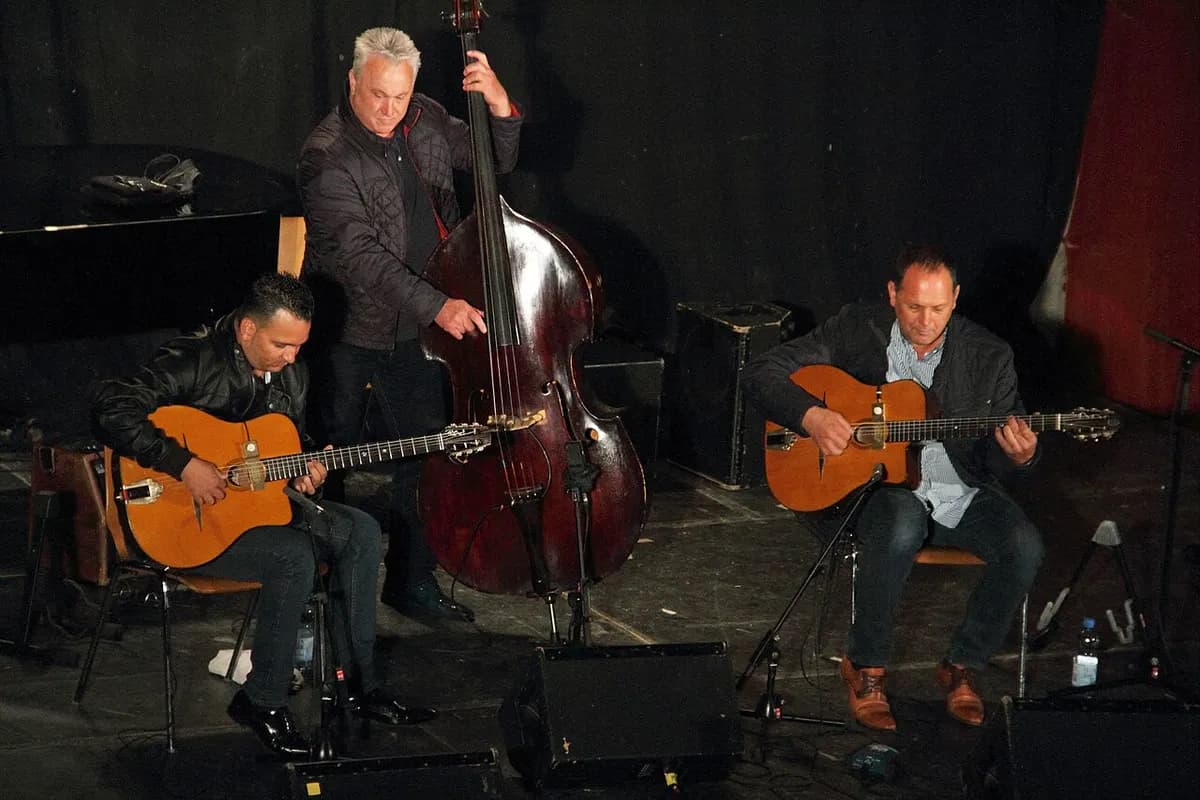
Gypsy jazz is swing-era jazz played by a string ensemble, with a set of techniques and a repertoire that grew out of one band and one guitarist. The classic lineup is a lead guitar, one or two rhythm guitars, a violin or clarinet, and a double bass. There are no drums and no piano. The rhythm guitars supply the drive a drummer would otherwise provide, and the lead guitar plays with a loud, bright, cutting tone that carries without amplification.
Reinhardt's own influences are well documented. After the fire that injured his hand, an acquaintance, Émile Savitry, played him records by Louis Armstrong, Duke Ellington, the violinist Joe Venuti and the guitarist Eddie Lang. Before that he had worked as a teenager in the French bal musette dance halls, accompanying accordionists. And he was born into the Manouche, the French name for the Sinti, a Romani people, whose family bands kept the style going after his death.
A note on the name: "Gypsy" is an outsider's word for Romani people, and some consider it offensive. Many musicians and writers prefer jazz manouche or "Django-style jazz". "Gypsy jazz" remains the most widely used English term, and this guide uses both.
History & Origins
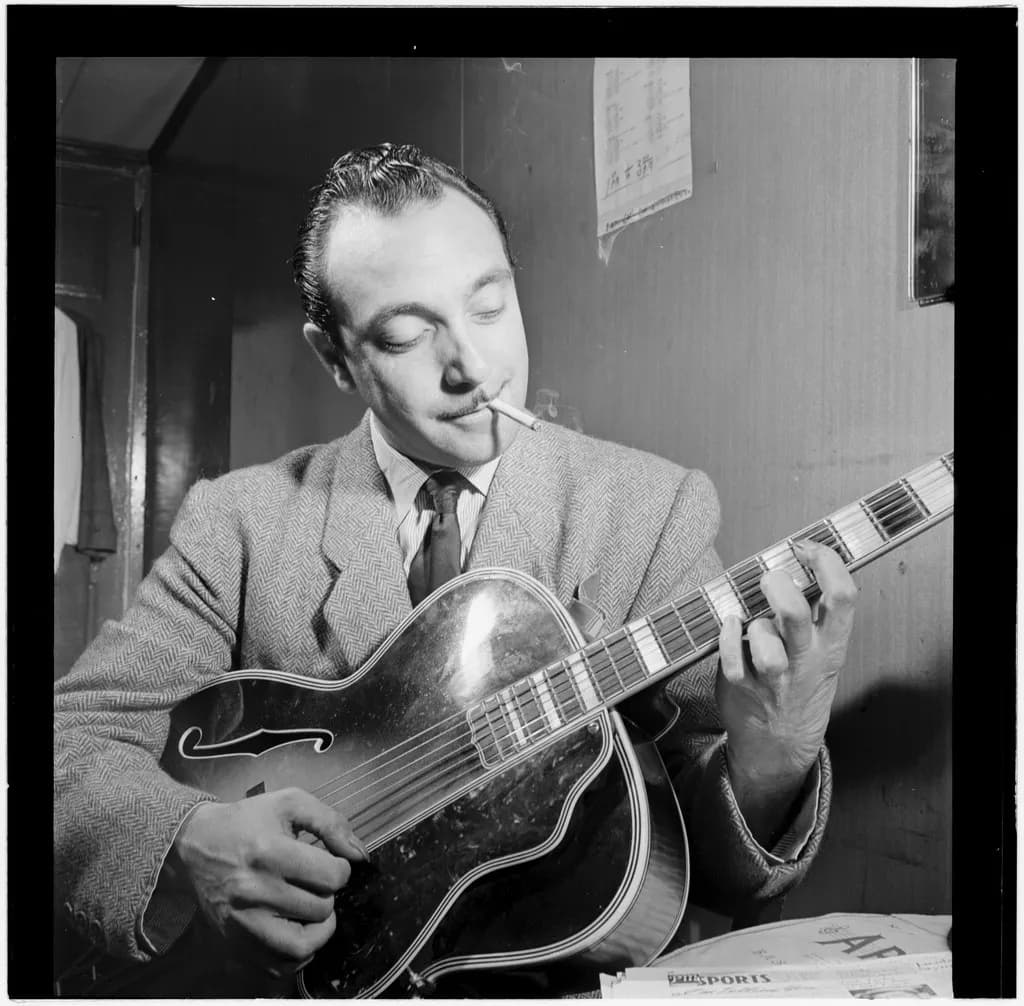
Django Reinhardt was born on 23 January 1910 in Liberchies, Belgium, into a travelling Manouche family, and grew up in the caravan settlements on the edge of Paris. He made his first recordings in 1928, on banjo-guitar behind musette accordionists. On the night of 2 November 1928 a candle set fire to the celluloid his wife used to make artificial flowers, and the blaze in their caravan badly burned his left hand. His ring and little fingers were left largely unusable, so he relearned the guitar playing single-note lines mainly with his index and middle fingers and using the damaged fingers in some chords. That constraint shaped his fast, arpeggio-based, sliding style.
In the summer of 1934 Reinhardt and the violinist Stéphane Grappelli were both playing in a band led by the bassist Louis Vola at the Hôtel Claridge on the Champs-Élysées, and their backstage jams turned into a group. The promoters Pierre Nourry and Charles Delaunay of the Hot Club de France jazz society backed it as the Quintette du Hot Club de France. The original quintet was all strings: Django and Grappelli as soloists, Django's brother Joseph Reinhardt and Roger Chaput on rhythm guitar, and Vola on bass. It first recorded in November and December 1934, and by 1948 it had cut more than 130 studio titles, among them Django's "Minor Swing" (1937) and "Djangology".
When the Second World War broke out in 1939, the quintet was in London. Grappelli stayed in Britain for the duration and Django went straight back to Paris, where he re-formed the group with Hubert Rostaing's clarinet in place of the violin. His wistful ballad "Nuages", released in 1940, became a huge success in occupied France. After the war he toured the United States with Duke Ellington's orchestra in 1946, took up the amplified guitar and absorbed bebop into his late recordings. In 1951 he settled in Samois-sur-Seine, and he died of a brain haemorrhage on 16 May 1953 in nearby Fontainebleau, aged 43.
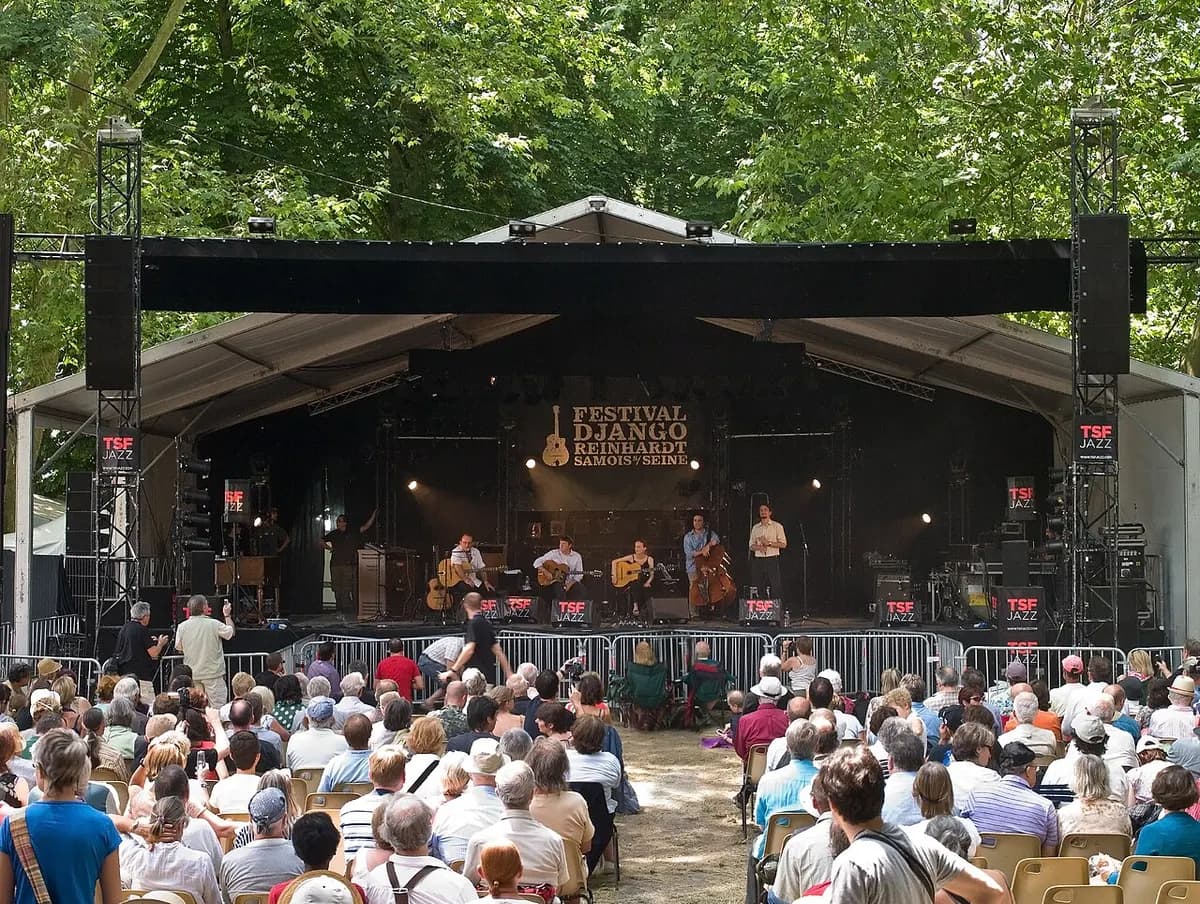
The style survived him in the Sinti and Manouche communities of France, Belgium, the Netherlands and Germany, where it was passed down within families by ear. The Ferré, Schmitt and Rosenberg families and many others kept the repertoire alive. Samois has held a festival in his memory since 1968; it became an annual week-long event in 1983 and moved to the grounds of the Château de Fontainebleau in 2017. From the 1970s on a wider revival took shape: Fapy Lafertin, Häns'che Weiss and Boulou Ferré became known, Biréli Lagrène emerged as a teenage prodigy, the Dutch Rosenberg Trio with Stochelo Rosenberg reached a large audience, and jazz manouche spread into a worldwide circuit of festivals, schools, luthiers and online lessons. Woody Allen's film Sweet and Lowdown (1999), about a fictional American guitarist obsessed with Django, introduced many new listeners.
Key Characteristics & Sound
- La pompe: the rhythm guitar "pump", a crisp downstroke on every beat, with the chords on beats two and four accented and quickly damped, producing a snare-like "boom-chick" in 4/4.
- Tempo: from ballads and slow swing around 80–120 BPM to medium swing at 160–200 BPM, and showpiece tempos well above 250 BPM. Waltzes in 3/4 (valses manouches) are part of the repertoire.
- Harmony: swing-era progressions with a strong taste for minor keys. Minor sixth chords, diminished chords and the harmonic minor scale are everywhere, as in "Minor Swing" (Am, Dm, E7).
- Lead guitar language: rapid arpeggios, chromatic runs, diminished patterns, octave melodies, tremolo and dramatic glissandos.
- Picking technique: the "rest stroke", in which the pick passes through the string and comes to rest on the next one. Downstrokes dominate, which gives the attack its volume and punch.
- No drums: all of the time-keeping comes from guitars and bass, which gives the style its light, acoustic, driving feel.
| Trait | Gypsy Jazz | American Swing | Flamenco |
|---|---|---|---|
| Origin | Paris, 1930s | USA, 1930s | Andalusia, 18th–19th century |
| Core ensemble | Guitars, violin, double bass | Big band: brass, reeds, rhythm section | Guitar, voice, palmas, dance |
| Time-keeping | La pompe rhythm guitar, bass | Drums, bass, piano, guitar | Guitar rasgueado, hand claps |
| Metre | 4/4 swing, some 3/4 waltzes | 4/4 swing | Compás cycles of 12, 4 and 3 |
| Harmony | Swing changes, minor 6ths, diminished | Swing changes | Phrygian / Andalusian cadence |
| Reference piece | Minor Swing | Sing, Sing, Sing | Entre dos aguas |
Instruments
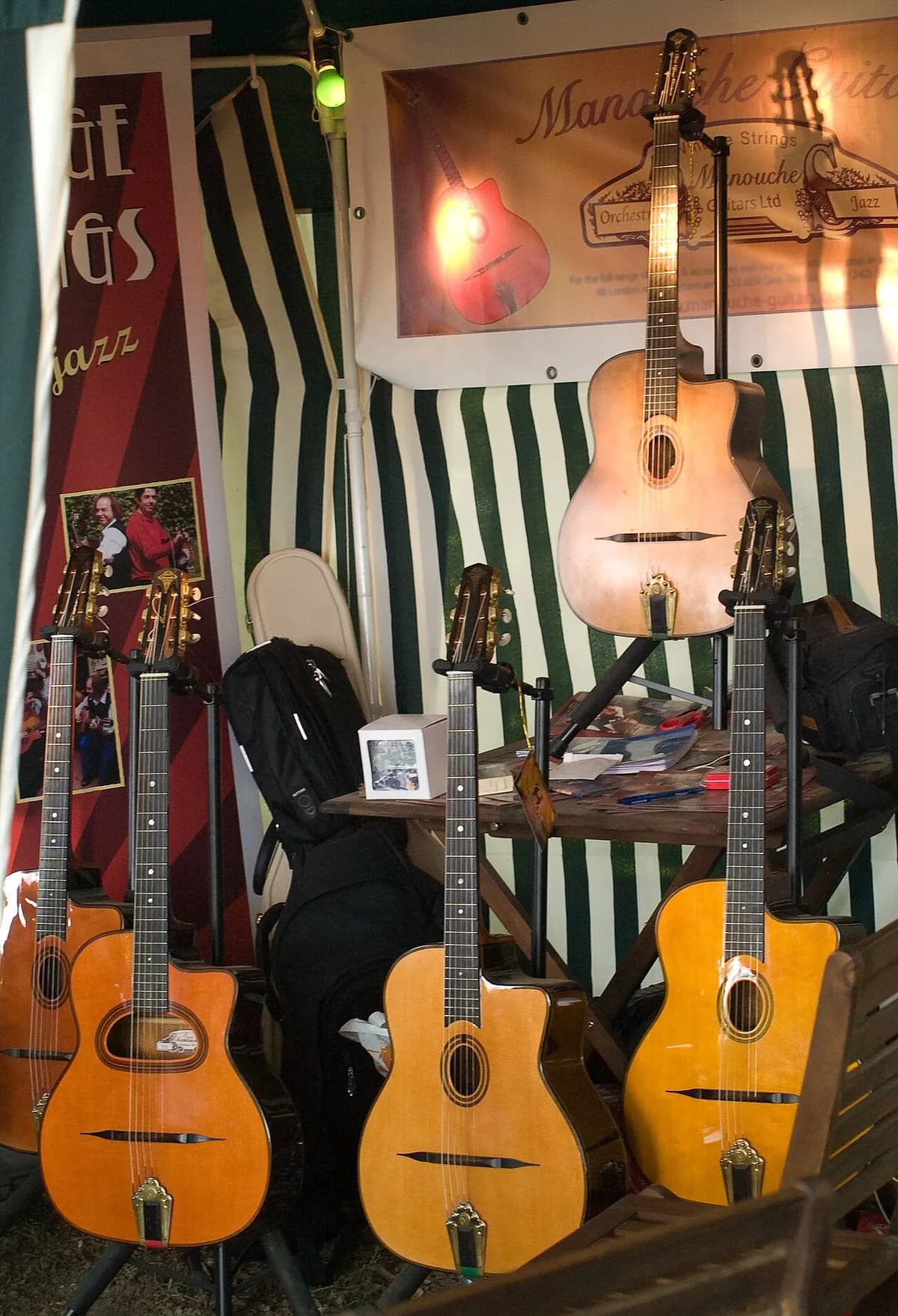
- Selmer-Maccaferri guitar: in 1932 the Paris firm Selmer began building steel-string guitars to a design by the Italian guitarist and luthier Mario Maccaferri, and kept making them until about 1952. The early models had a large D-shaped soundhole (the "grande bouche"). The later "petite bouche" models, with a small oval soundhole and 14 frets clear of the body instead of 12, became Django's guitar and the template for the style. Modern makers build copies in large numbers.
- Rhythm guitar: usually the same type of guitar, played with la pompe.
- Violin: Grappelli's elegant, swinging lines defined the role. Later violinists include Schnuckenack Reinhardt and Florin Niculescu.
- Clarinet: Hubert Rostaing replaced the violin in Django's wartime quintet.
- Double bass: played with a strong two-feel or a walking line, often slapped or plucked hard to cut through the guitars.
- Accordion: the musette tradition sits next door, and swing-musette accordionists such as Gus Viseur and Tony Murena played the same repertoire.
The sound of gypsy jazz depends on these instruments. Steel strings, a light top and a large body give the lead guitar a loud, dry, mid-heavy tone with a sharp attack and fast decay, quite different from the warm, sustained sound of an archtop jazz guitar.
Standards & Repertoire
The core repertoire mixes Django's compositions with American and French standards. Tunes nearly every player learns:
- Django Reinhardt compositions: "Minor Swing", "Nuages", "Djangology", "Swing 42", "Belleville", "Douce Ambiance", "Manoir de mes rêves", "Daphné", "Troublant Boléro".
- American standards: "Dinah", "Sweet Georgia Brown", "All of Me", "Limehouse Blues", "Honeysuckle Rose", "After You've Gone".
- European tunes: "Les Yeux Noirs" (the Russian romance "Dark Eyes"), "J'attendrai", valse musette waltzes.
Jam sessions, often around a campfire or in a festival tent, work much like a jazz session: someone calls a tune, the rhythm guitars set the tempo with la pompe and soloists take turns.
Key Musicians & Recordings
- Django Reinhardt, the founder: start with the Quintette du Hot Club de France recordings of 1934–1939 and "Nuages" (1940).
- Stéphane Grappelli, the co-founder, who had a long later career and recorded widely, including duets with Yehudi Menuhin.
- The Ferré family: Matelo, Baro and Sarane Ferré, Django's contemporaries, and later Boulou and Elios Ferré.
- Biréli Lagrène, the prodigy of the 1980s, who moved between manouche, fusion and modern jazz.
- The Rosenberg Trio: Stochelo, Nous'che and Nonnie Rosenberg from the Netherlands.
- Fapy Lafertin, Angelo Debarre, Tchavolo Schmitt and Dorado Schmitt, leading voices of the traditional style.
- Häns'che Weiss and Schnuckenack Reinhardt, central figures of the German Sinti jazz scene.
- Joscho Stephan, Gonzalo Bergara and John Jorgenson, among the many players who carried the style to an international audience.
Gypsy Jazz vs Swing, Flamenco & Klezmer
Against American swing, the repertoire and harmony overlap heavily, but the sound is different: no drums, no brass, and guitars carrying both lead and rhythm. Flamenco is the other great guitar tradition associated with Romani musicians, and there the differences outweigh the similarities. Flamenco has its own compás rhythmic cycles, Phrygian harmony, cante vocals and dance, and it is played on nylon strings with rasgueado strumming. Gypsy jazz swings in 4/4 on steel strings with a pick.
Klezmer also features violin or clarinet and minor keys, and it too is a European tradition with roots in itinerant communities. But klezmer comes from Jewish wedding and dance music, uses its own modes and dance forms, and is not built on swing. Modern jazz moved on through bebop and beyond, while gypsy jazz players today still improvise in a 1930s–1940s vocabulary, much as bluegrass players keep a mid-century acoustic sound.
How AI Detects Gypsy Jazz
For an audio model, gypsy jazz has distinctive textures: the bright, percussive attack of a steel-string acoustic guitar, the snare-like click of la pompe on beats two and four in place of a drum kit, a walking or two-feel double bass and, often, a violin. The swing rhythm and the chord changes point toward jazz. The absence of drums and the dominance of acoustic guitars point toward folk and acoustic music. The balance between those two signals decides where a classifier places a track.
Try a recording in the Genre AI music genre detector, and compare a fast swing tune with a slow ballad or waltz from the same artist.
Genre AI's production taxonomy has no gypsy jazz label, so the answer will be a neighbour. The most likely result is the coarse Jazz label with the fine label Big Band / Swing, which is the closest fit: its text prompts include "swing", "string band" and even "romani swing", and the harmony and 4/4 swing feel are shared even though the instruments are not. Other Jazz subgenres such as Bebop or Easy Listening may show up beside it as alternatives. The likely confusion runs toward Folk / Country, whose fine label Folk may win on slower pieces, waltzes and ballads like "Nuages": with no drum kit, no brass and acoustic guitars filling the spectrum, they can sound to a model more like an acoustic string-band recording than a jazz one. When that happens, Jazz labels will not be listed underneath, because alternatives only come from the same family. Minor-key pieces with flamenco-like guitar runs are unlikely to come back as Latin: that label has no subgenres and is shown only when no family with subgenres, such as Jazz or Folk / Country, is among the model's top five guesses.