Industrial rock is rock song-writing welded to the machinery of industrial music: distorted guitars over drum machines and sequencers, samples and noise in place of a clean band sound, and vocals that are shouted, whispered or run through distortion. It took shape in the 1980s and broke into the mainstream in the 1990s, above all through Nine Inch Nails and Ministry.
It is not the same thing as industrial music itself. Industrial, in the original sense, was the 1970s avant-garde of Throbbing Gristle (tape loops, noise and found sound, with little interest in songs or guitars), and our industrial guide covers that whole lineage. Industrial rock is one late branch of it, where the machine aesthetic met verse–chorus songs. To hear how a track like that reads to a classifier, run a few seconds through our free AI music genre detector.
What Is Industrial Rock?
Industrial rock keeps the forms of rock (songs, choruses, a singer at the centre, electric guitars) and replaces its methods. The drums are programmed or heavily sampled; the guitars are often recorded, cut up and looped instead of being played straight through; synthesisers, samples and noise fill the space a rhythm guitarist and keyboardist would occupy. The result sounds mechanical and abrasive even when the song underneath is a ballad.
Industrial music began as an anti-music project: Throbbing Gristle's Industrial Records label (1976) existed to make sound that fell outside pop and rock entirely. The beat-driven forms that followed, electronic body music in Belgium and Germany and electro-industrial in Canada, were still primarily electronic club music. Industrial rock brought that palette back into a rock band format, largely in North America, which is why NIN and Ministry could play rock festivals and get on rock radio while Throbbing Gristle never could.
A second boundary runs on the heavy side. Industrial metal (Godflesh, Fear Factory, later Ministry, Rammstein) puts the weight on riffs, down-tuned guitars and metal drumming. Industrial rock puts it on songs and atmosphere. Many bands cross the line within a single album, and the labels are often used interchangeably.
History & Origins
The groundwork came from British and American post-punk. Killing Joke, formed in London in 1978, combined repetitive, tribal drumming and grinding guitar on their 1980 debut. In Chicago, Steve Albini's Big Black used a Roland TR-606 drum machine in place of a drummer (credited on the sleeves simply as "Roland") and built abrasive, metallic guitar records around it; Atomizer (1986) is the usual reference. From the German scene, Einstürzende Neubauten and, later, KMFDM (Sascha Konietzko's group, founded in Paris in 1984 and soon based in Hamburg) mixed machine rhythm with guitars from the industrial side.
Chicago became the centre. Wax Trax! Records, a shop-turned-label run by Jim Nash and Dannie Flesher, released Front 242, KMFDM, Revolting Cocks and much of the North American industrial scene through the 1980s. Al Jourgensen's Ministry, which had begun as a synth-pop act, turned hard on Twitch (1986) and then fused samples, drum machines and thrash-speed guitar on The Land of Rape and Honey (1988) and The Mind Is a Terrible Thing to Taste (1989). Psalm 69 (1992), with "Jesus Built My Hotrod" featuring the Butthole Surfers' Gibby Haynes, took them into the mainstream.
The decisive record came from Cleveland. Trent Reznor wrote, played and programmed most of Nine Inch Nails' debut, Pretty Hate Machine (1989, TVT Records), working with producers Flood, Adrian Sherwood, Keith LeBlanc and John Fryer. "Head Like a Hole" and "Down in It" put industrial textures inside tight, hook-driven pop songs. NIN played the first Lollapalooza tour in 1991; from the harsher Broken EP (1992), "Wish" won the Grammy for Best Metal Performance in 1993; and The Downward Spiral (1994), recorded in the Los Angeles house where the Manson family murders had taken place, became the genre's landmark. "Closer" was a radio hit, and "Hurt", later covered by Johnny Cash on American IV (2002), showed the style could carry a ballad.
Reznor's Nothing Records launched Marilyn Manson, whose Antichrist Superstar (1996), co-produced by Reznor, took industrial rock to arena scale. The mid-1990s brought radio-friendly bands with similar sounds: Filter ("Hey Man, Nice Shot", 1995, from Reznor's former touring guitarist Richard Patrick), Stabbing Westward and Gravity Kills. In autumn 1995 David Bowie and NIN co-headlined a North American tour while Bowie promoted Outside. In Europe, Rammstein's Sehnsucht (1997) and "Du hast" opened a heavier, German-language strand, usually filed as industrial metal or Neue Deutsche Härte.
By the end of the decade, industrial rock's textures had been absorbed into nu metal and mainstream alternative production, and the style stopped being a separate commercial category. NIN continued with The Fragile (1999) and Year Zero (2007), and Reznor's later film-score work with Atticus Ross carried the same sound palette into cinema.
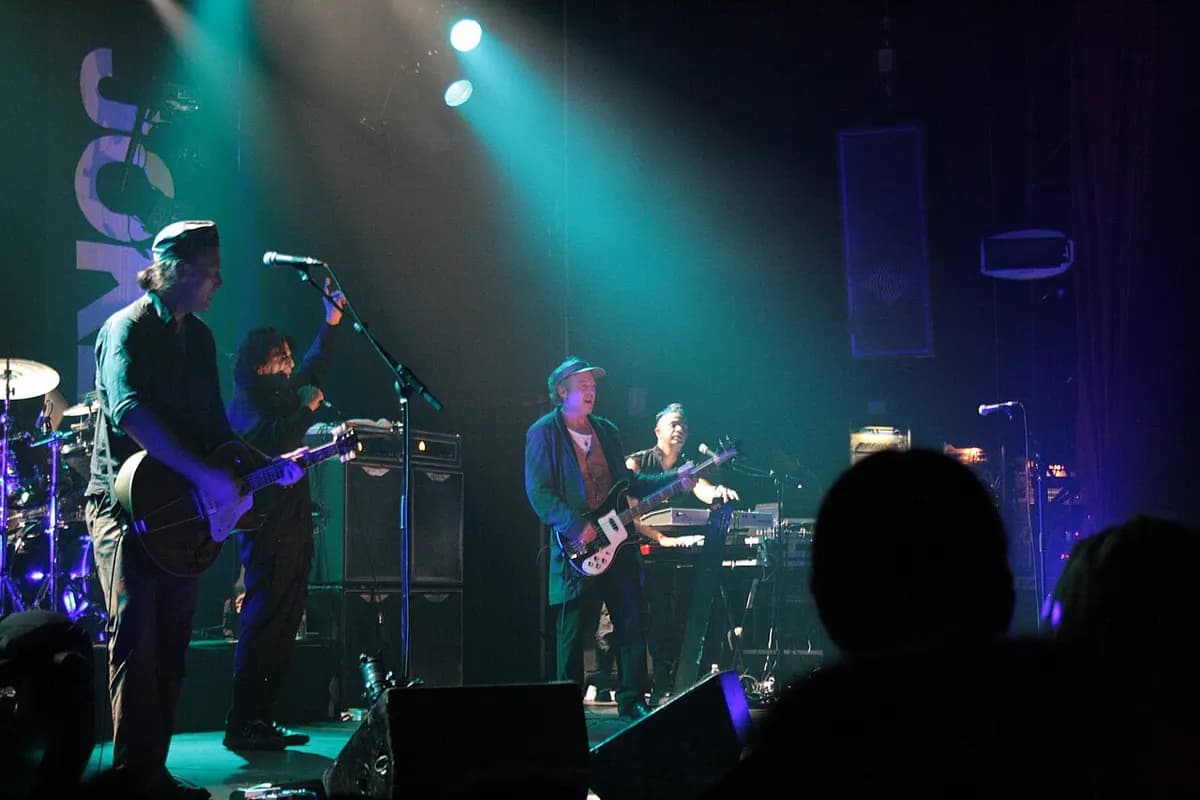
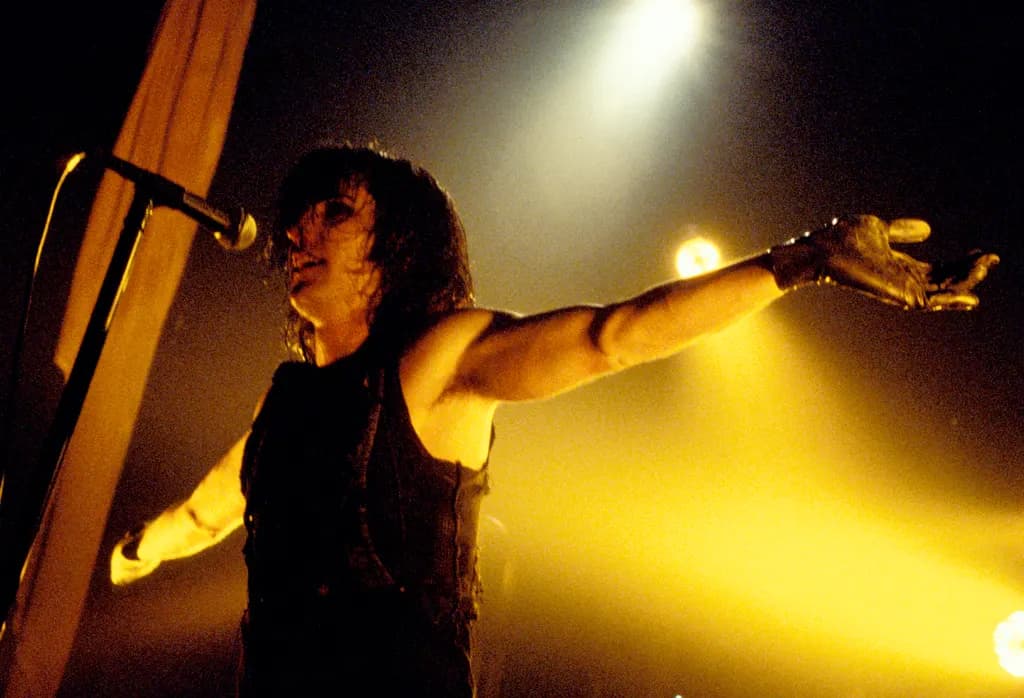
Key Characteristics & Sound
What identifies an industrial rock record:
- Tempo: mostly 90–140 BPM, with mid-tempo grinding tracks common and Ministry's thrash-influenced material running faster.
- Programmed or sampled drums: drum machines and sequenced loops, often distorted, quantised and mechanical; live drummers, when used, are usually edited to match.
- Distorted guitars as texture: heavily processed, sometimes sampled and looped, frequently treated as one noise layer among several, seldom as a lead instrument.
- Synthesisers and samples: sequenced bass lines, synth stabs, film and television dialogue, metallic percussion and noise.
- Processed vocals: shouted, whispered or distorted through amplifiers and effects; dynamic swings from near-silence to screaming.
- Song form: verse–chorus structures, often with a pop-style hook. The hook is what separates the style from its experimental parent.
- Lyrics: control, addiction, religion, self-loathing, technology and power.
- Dynamics: sudden shifts between quiet, sparse sections and walls of noise.
Where it sits among its neighbours:
| Trait | Industrial Rock | Industrial (original) | EBM | Industrial Metal |
|---|---|---|---|---|
| Peak period | 1988–1999 | 1976–1983 | 1981–1990 | 1989–present |
| Typical BPM | 90–140 | No fixed pulse | 110–130 | 100–160 |
| Guitars | Central but processed | Rare | Absent | Down-tuned riffs |
| Drums | Programmed, sampled | Tape loops, found sound | Sequenced, dance | Machine or metal kit |
| Song form | Verse–chorus | None | Repetitive club tracks | Riff-driven |
| Reference record | The Downward Spiral | 20 Jazz Funk Greats | No Comment | Streetcleaner |
Instruments & Production
Industrial rock was among the first rock styles made primarily in the computer, and its production is inseparable from its sound:
- Samplers: E-mu Emulator and Akai units in the late 1980s, used to sample guitars, voices, film dialogue and metal percussion.
- Drum machines and sequencers: from Roland units to computer sequencing, which allowed one person to build a full band arrangement.
- Analogue synthesisers: for bass lines, stabs and noise; Reznor's records made heavy use of them alongside guitars.
- Distortion on everything: on drums, vocals and synths as well as guitars, often through guitar amplifiers or overdriven mixing desks.
- Digital editing: hard-disk recording let producers assemble parts from fragments instead of capturing a band playing straight through, and NIN's 1990s records made extensive use of it.
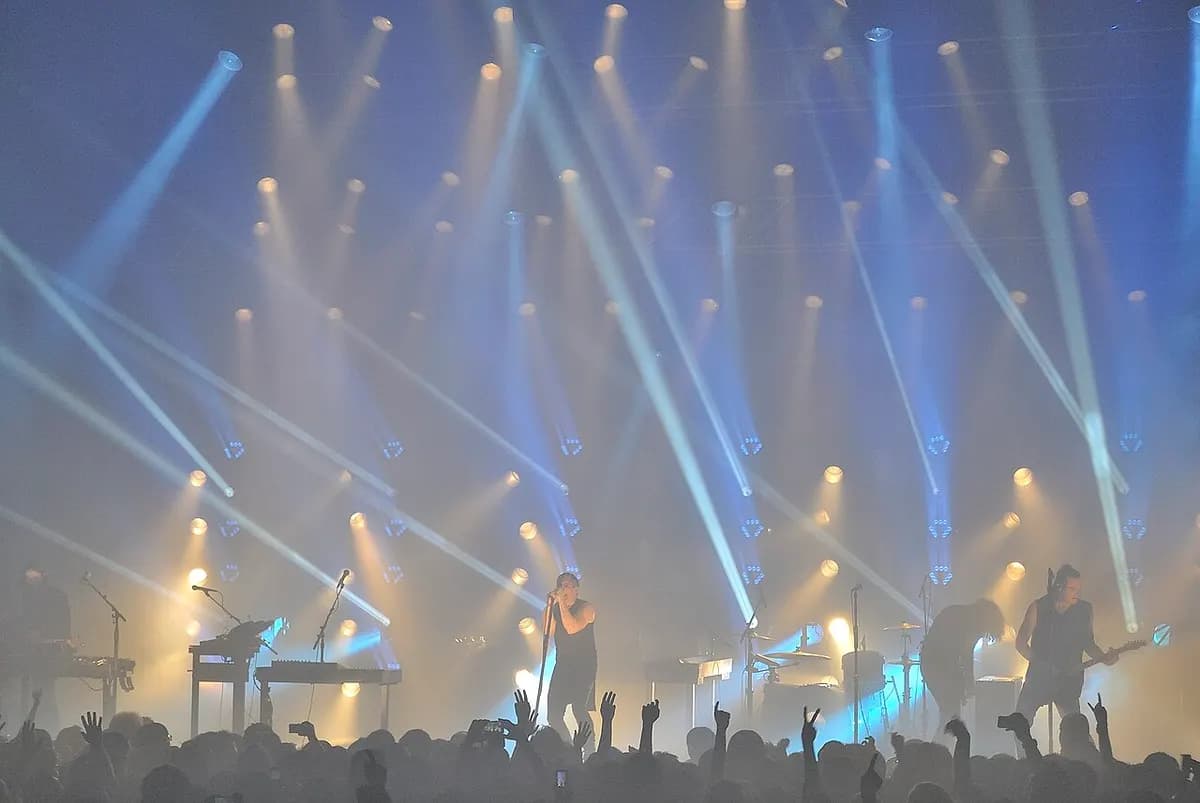
- Live band on tour: the studio records were often one person's work, while concerts used full, loud bands, which is how NIN and Ministry built their reputations.
Related Styles & Scenes
The family around it:
- Industrial, the parent: Throbbing Gristle, Cabaret Voltaire, SPK, Einstürzende Neubauten.
- EBM (electronic body music): Front 242, DAF, Nitzer Ebb; the dance-floor branch with no guitars.
- Electro-industrial: Skinny Puppy and Front Line Assembly; darker, more electronic.
- Industrial metal: Godflesh, Fear Factory, later Ministry, Rammstein.
- Neue Deutsche Härte: the German-language heavy strand around Rammstein.
- Nu metal, which absorbed industrial rock's textures and dynamics in the late 1990s.
- Gothic rock and darkwave, which shared clubs, labels and audiences.
- Post-punk, the source of Killing Joke and the early abrasive guitar sound.
Key Artists & Albums
Where to start:
- Killing Joke: Killing Joke (1980); "Wardance".
- Big Black: Atomizer (1986).
- Ministry: The Land of Rape and Honey (1988), Psalm 69 (1992).
- Nine Inch Nails: Pretty Hate Machine (1989), The Downward Spiral (1994); "Head Like a Hole", "Closer", "Hurt".
- KMFDM: Naive (1990), Nihil (1995).
- Revolting Cocks: Al Jourgensen's Wax Trax! side project.
- Marilyn Manson: Antichrist Superstar (1996).
- Filter: "Hey Man, Nice Shot" (1995).
- Stabbing Westward: "Shame" (1996).
- Rammstein: Sehnsucht (1997), for the industrial metal edge.
Three records for the arc: The Land of Rape and Honey for the Chicago sound, Pretty Hate Machine for the songs, The Downward Spiral for the peak.
Industrial Rock vs Industrial Music
The names overlap, so the two are easy to mix up. The short version:
- Industrial is the umbrella and the origin: a 1976 avant-garde movement, its beat-driven descendants (EBM, electro-industrial, industrial techno), and its rock and metal offshoots. Its original form has no fixed pulse, no songs and few conventional instruments.
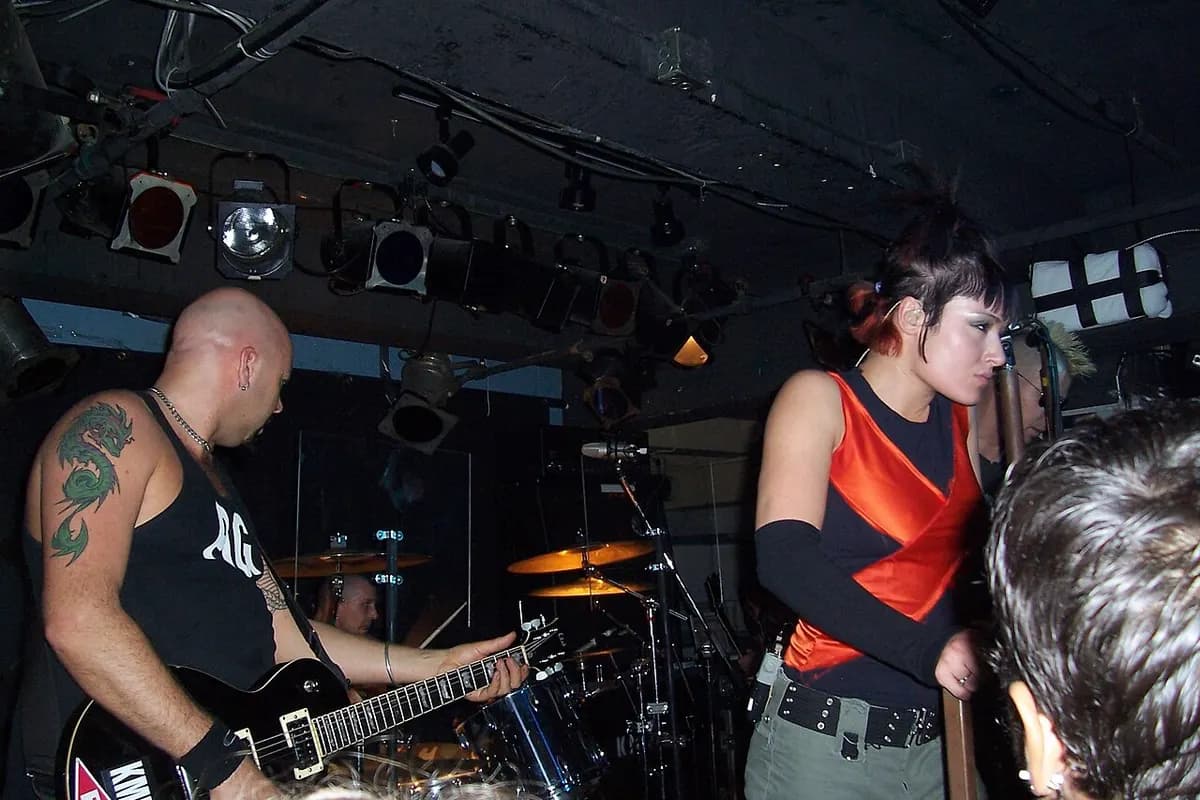
- Industrial rock is one specific offshoot: rock bands, mostly North American and mostly from 1988 onward, using industrial methods (machines, samples, noise) to make songs with guitars and choruses.
A Throbbing Gristle record and a Nine Inch Nails single share sounds; their formats differ. If a track has a singer, a hook and a guitar, and its drums sound like a machine, it is industrial rock. If it has no song at all, it is industrial in the original sense. If it is a dance track built entirely from synthesisers, it belongs to EBM or electro-industrial.
How AI Detects Industrial Rock
An audio classifier hears industrial rock as rock with an electronic skeleton. Distorted guitars and an aggressive vocal point toward metal, hard rock and alternative, while the rigid, quantised drums, synth bass and sampled textures point toward electronic music. The genre lives in the overlap, and which side wins depends on the section of the track.
Full-band choruses with heavy guitars read as metal or alternative rock. Verses built from a drum loop, a synth line and a whispered vocal can read as electronic. Ballads such as "Hurt" behave like quiet alternative rock. Try a chorus and a verse of the same track in the Genre AI music genre detector; they may come back in different families.
Genre AI has no industrial rock label, and none of its labels lists "industrial" among its prompts. The style's defining trait, rock songs built with machines, splits across three coarse families of the taxonomy. The guitars, distortion and vocal point to Rock (where Indie / Alternative and Hard Rock are the likely fine labels) and Metal (Nu Metal or Heavy Metal); the sequenced drums and synthesisers point to Electronic Dance, where Electro, whose prompts include "electro rock" and "electro metal", is a plausible pick. The model returns one family per clip, and the alternatives it lists come only from inside that family, so a Rock answer will offer other Rock labels, never an electronic one. On a heavy, guitar-led track like Ministry's "Thieves" or NIN's "Wish", a Rock or Metal answer is the likelier outcome; on a sparse, synth-led verse Electronic Dance may come first. Our Industrial page describes the parent genre splitting the same way: the model hears the instruments, and the lineage is invisible to it.