
Dubstep is a style of electronic dance music built around a tempo of roughly 140 BPM with a half-time feel, a lot of sub-bass, and a heavy emphasis on the "drop." It started in South London in the early 2000s, grew out of UK garage and 2-step, borrowed from Jamaican dub and reggae sound-system culture, and by the early 2010s had turned into the wobbling bass music headlining American festivals.
This guide covers what dubstep is, where it came from, how to recognise it by ear, the sound-design tricks behind the wobble, its main subgenres, how it differs from drum and bass and trap, and the artists worth knowing. Not sure whether a bass-heavy track is dubstep, trap, or drum and bass? Drop a clip into our free AI music genre detector and it will read the low end and the half-time groove in a few seconds.
What Is Dubstep?
Dubstep is a genre of bass-led electronic music defined by a sparse, syncopated rhythm at around 140 BPM that feels like half that tempo, plus a huge, often modulated sub-bass. The classic pattern puts a kick on the first beat and a snare on the third beat of each bar (the "half-time" pattern), which leaves plenty of room for the low frequencies. It is written for big sound systems, where the bass is felt in the chest as much as heard.
Dubstep tracks are usually built around a tense build, a sudden drop where the bass comes in at full force, and long intros and outros that DJs can mix. The drop is the hallmark: everything else thins out and a wobbling or growling bassline takes over. Early dubstep was dark, sparse, and close to dub; later styles made the drop the main event. What stays constant is the empty space in the arrangement, the sub-bass, and the 140 BPM half-time groove.
History & Origins
Dubstep took shape in South London around 1999–2003, centred on the borough of Croydon. It began as a darker, sparser offshoot of UK garage and 2-step, drawing on the sub-bass and "version" culture of Jamaican dub and reggae sound systems. The name was in print by 2002: it appeared on the July 2002 cover of XLR8R magazine, and Tempa co-founder Neil Jolliffe is often credited with coining it, though Kode9 and others are also named and the spaced form "dub step" was around earlier.
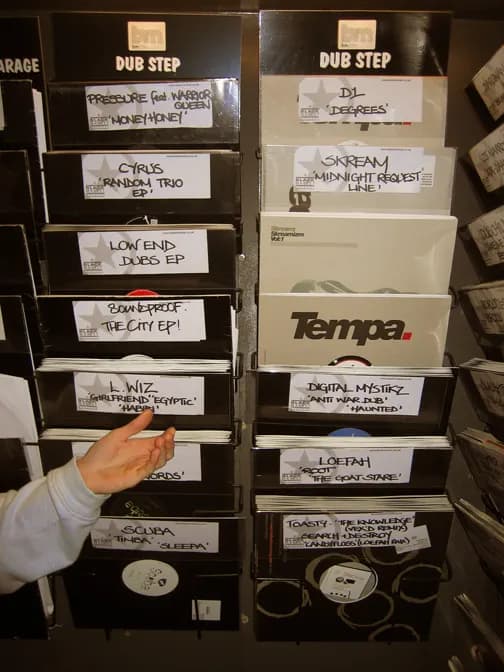
An early meeting point was Big Apple Records, a small Croydon record shop where DJ Hatcha and a teenage Skream worked behind the counter, and where Benga, Digital Mystikz (Mala and Coki) and Loefah came to hear and trade dubplates. The club night FWD>> and the pirate station Rinse FM gave the sound a home, and Digital Mystikz and Loefah started their own night and label, DMZ, in Brixton. BBC Radio 1's Mary Anne Hobbs brought it to a national audience; her "Dubstep Warz" show in January 2006 is often cited as the point where the genre reached listeners outside London. Skream's "Midnight Request Line" (Tempa, 2005) became Tempa's best-selling 12-inch and was picked up by house and techno DJs such as Ricardo Villalobos. Benga & Coki's "Night" (Tempa, 2008) topped the UK dance singles chart.
From there dubstep split in several directions. Burial's self-titled album (2006) and Untrue (2007), both on Hyperdub, made it ghostly and atmospheric, while the Leeds-born producer Rusko made it louder and more aggressive. In the US, producers led by Skrillex pushed the distorted mid-range bass into a harder, metallic festival sound nicknamed brostep. By 2011–2012 dubstep was part of the American EDM mainstream, while the UK originators kept the deeper, dubbier strain going in clubs.
Key Characteristics & Sound
You can usually identify dubstep by these traits:
- Tempo: almost always around 140 BPM, but with a half-time feel that reads as ~70 BPM.
- Rhythm: a sparse, syncopated pattern with the kick on beat 1 and the snare on beat 3, leaving room for the bass.
- Sub-bass: the deep low end is the centre of the mix; on a club system you feel it as much as hear it.
- The wobble: a bass note modulated by an LFO so its tone or volume oscillates, producing the signature "wob-wob" or grinding growl.
- The drop: a tension-and-release structure where the track breaks down, then the bass slams back in.
- Vibe: dark and spacious in the original UK strain; aggressive and high-impact in brostep.
If a track sits in a half-time, head-nod groove with deep sub-bass and a modulated, wobbling lead bass that drops hard after a build, you're almost certainly hearing dubstep. Tempo and feel are useful tells, and they vary by sub-style:
| Subgenre | Typical BPM | Feel |
|---|---|---|
| Deep / Dub-influenced | 138–142 | Dark, spacious, meditative |
| Brostep | 140 (half-time) | Aggressive, metallic, drop-heavy |
| Riddim | 140 (half-time) | Minimal, repetitive, triplet bounce |
| Melodic Dubstep | 140 (half-time) | Euphoric, emotional leads |
| Future Garage | 130–140 | Atmospheric, swung, vocal-led |
Sound Design & Production
Dubstep is a producer's genre: its "instruments" are almost entirely synthesised and shaped in a DAW. The core tools and techniques:
- Sub-bass: a clean sine or triangle wave in the lowest octaves, the foundation of every track.
- LFO modulation: a low-frequency oscillator routed to a filter, amplitude, or wavetable position. This is what creates the rhythmic wobble.
- Reese bass: a detuned, phasing sawtooth stack that growls in the mid-range, named after Kevin Saunderson's alias Reese and his 1988 Detroit track "Just Want Another Chance"; common in heavier dubstep.
- Soft synths: Native Instruments Massive (2007) and later Xfer Serum (2014) became the usual tools for designing screaming, "talking" bass patches.
- Drums: punchy kicks and a sharp, often heavily processed snare or clap on the backbeat, with sparse percussion.
- Effects: dub-style reverb and delay, pitch automation, distortion, and resampling to make basses "talk."
Most of the craft is bass sound design: producers automate filter cutoff, formants, and wavetable position in time with the beat, so a single bass note moves like a melody or a voice. Side-chaining, careful low-end mixing, and the build-up-to-drop arrangement do the rest.
Subgenres of Dubstep
Dubstep splits into a deeper, dubbier original strain and a louder, drop-focused one, plus several offshoots. The main ones:
- Deep / Dub-influenced Dubstep: the original UK sound, dark, sparse and sub-heavy, associated with Digital Mystikz, Loefah and the DMZ nights.
- Brostep: the harder, drop-driven style with screaming mid-range bass that broke in the US around 2010–2012, led by Skrillex, Excision and Datsik; Rusko's album O.M.G.! (2010) is often cited as an early example.
- Riddim: minimal and repetitive, built on simple triplet-bounce basslines and stripped percussion; it grew into a large scene of its own during the 2010s.
- Melodic Dubstep: emotional, euphoric leads layered over the half-time drop (Seven Lions, Illenium).
- Future Garage: atmospheric, swung music with chopped vocals that mixes dubstep's space with UK garage rhythms; Burial is its main reference point.
Many of these sit close to neighbouring genres: future garage borders house and garage, melodic dubstep edges toward trance, and the half-time, bass-forward drops share DNA with trap.
Dubstep vs Drum and Bass vs Trap
Dubstep is easy to confuse with other bass-heavy genres. All three lean on big low end, but tempo, rhythm, and roots differ:
| Trait | Dubstep | Drum and Bass | Trap |
|---|---|---|---|
| Origin | South London, early 2000s | London/UK, early 1990s | US South (Atlanta), 2000s |
| Tempo | ~140 BPM (half-time feel) | 170–180 BPM | 130–170 BPM (half-time feel) |
| Rhythm | Sparse half-time, snare on 3 | Fast breakbeats | Rolling hi-hats, 808 kicks |
| Core sound | Wobble / LFO sub-bass, the drop | Rolling breaks + heavy bass | 808 bass, snappy snares, hats |
| Roots | UK garage + dub/reggae | Jungle + breakbeat | Hip-hop + Southern rap |
Notable Artists & Tracks
Foundational and influential dubstep acts include:
- Skream: "Midnight Request Line," an early crossover hit from the Croydon scene.
- Benga: "Night" (with Coki), a UK dance chart number one in 2008.
- Digital Mystikz (Mala & Coki) & Loefah: founders of DMZ and its deep, dub-influenced sound.
- Burial: Untrue (2007), the ghostly, atmospheric album that was shortlisted for the 2008 Mercury Prize.
- Rusko: made dubstep louder and more aggressive, a bridge toward brostep.
- Skrillex: "Scary Monsters and Nice Sprites" (2010), which won the Grammy for Best Dance Recording in 2012.
- Excision & Datsik: Canadian producers who led the heavy, drop-driven North American strain.
Start with "Midnight Request Line," "Night," "Untrue," and "Scary Monsters and Nice Sprites" to hear the genre's arc from Croydon underground to global stages.

Dubstep Around the World & Today
What began in a Croydon record shop is now played worldwide. The UK keeps the deeper, dubbier strain going in clubs and on small labels, while North America turned brostep into a festival headline act. Riddim built its own following, and melodic dubstep found a place in streaming-era EDM.
In the 2020s dubstep is heard less on pop radio than around 2012, but there is more variety: an active riddim scene, renewed interest in the original deep sound, and plenty of crossover with trap, drum and bass and hybrid "bass music." The 140 BPM half-time drop that Skream and Benga worked out in South London two decades ago is still the template for a large part of electronic music.
How AI Detects Dubstep
For dubstep, an AI model leans heavily on the low end. It measures where the rhythmic weight sits (the ~140 BPM pulse that resolves to a half-time, kick-on-1, snare-on-3 feel), then looks for the dominant sub-bass energy and the periodic LFO modulation that gives the wobble its growl. Those features are weighed against hundreds of other genre profiles, and because dubstep shades into trap, drum and bass, and future garage at the edges, the result comes back as ranked probabilities with a sub-style breakdown.
To hear this in action, head to the Genre AI music genre detector, hold a few seconds of a track up to the mic, and see whether it calls it brostep or a deeper, dub-influenced cut. Curious what the model is listening for? Our explainer on how AI music genre detection works breaks down the pipeline.
When we feed tracks through Genre AI ourselves, the strongest Dubstep readings come from the ~140 BPM half-time skeleton (kick on 1, snare on 3) wrapped around heavy sub-bass and a wobble that pulses in time with the beat. Push the mid-range into a distorted, screaming drop and the model tips toward Brostep; keep the low-end clean, roomy, and dub-flavoured and it favours the original deep dubstep. Because of that spread, we show the runner-up styles next to the top guess.