Gothic rock is the branch of post-punk that slowed down, turned up the reverb and stayed. Built on chorused lead bass, sparse reverberant guitar, drum machines and baritone vocals, it took shape in Britain between 1979 and 1983. It also grew a visual style, a club circuit and festivals of its own, and the scene has run without a break for more than forty years.
This guide covers where goth came from, what defines the sound, how it differs from post-punk and darkwave, and which records to start with. To hear how a track reads to a classifier, run a few seconds through our free AI music genre detector.
What Is Gothic Rock?
Gothic rock takes post-punk's inverted band, with the bass leading and the guitar used as texture, and makes atmosphere the main goal. Tempos drop, reverb becomes part of the arrangement, minor keys and modal melodies dominate, and vocals sit low and theatrical.
Three elements make a track recognisably goth. The bass carries the song, usually through a chorus pedal and high on the neck. The guitar plays space: single notes, tremolo, long delays, chords left to ring. And the drums are frequently a machine. The Sisters of Mercy's Doktor Avalanche is the best-known example, a deliberately inhuman pulse that the band credits as a member and that plays on all three of its studio albums.
Lyrically it deals in mortality, romanticism, religion and ruin, and it borrows its imagery from nineteenth-century Gothic literature and horror cinema. Bauhaus made their debut with a single named after Bela Lugosi, the actor who played Dracula, and most of these bands knew exactly how theatrical they were being.
History & Origins
The founding record is Bauhaus' "Bela Lugosi's Dead", released in August 1979: more than nine minutes of dub-spaced bass, scraped guitar and vampire imagery, recorded live in the studio in one take at Beck Studios in Wellingborough. Most of the genre's vocabulary is already there.
The scene formed around it quickly. Siouxsie and the Banshees moved from punk toward tribal drums and modal guitar on Juju (1981); The Cure recorded Faith (1981) and Pornography (1982), the bleakest of the three; Joy Division's Closer (1980) hangs over all of it, though the band belongs to post-punk proper.
London's Batcave club, opened in July 1982, gave the scene a physical centre and a dress code. The music press tried labels such as "positive punk" before settling on "goth" for both the music and the people. In Leeds, The Sisters of Mercy, formed in 1980, built the genre's most durable sound around Andrew Eldritch's baritone and a drum machine. The Mission, started by two former Sisters, Wayne Hussey and Craig Adams, followed, as did The March Violets from Leeds and Fields of the Nephilim, formed in Stevenage in 1984.
America ran a parallel and rawer version, deathrock, in Southern California: Christian Death, 45 Grave and Kommunity FK, closer to punk and fond of horror-movie theatrics. Continental Europe produced coldwave and, later, the electronic branches that became darkwave and EBM.
By the late 1980s the original wave had fragmented. Goth's ideas moved outward: into gothic metal and symphonic metal in the 1990s, into industrial rock, into the 4AD label's ethereal wing (Cocteau Twins, Dead Can Dance), and into synth-based darkwave. The scene itself never disappeared. Wave-Gotik-Treffen in Leipzig has been held since 1992 and draws around 20,000 visitors a year.
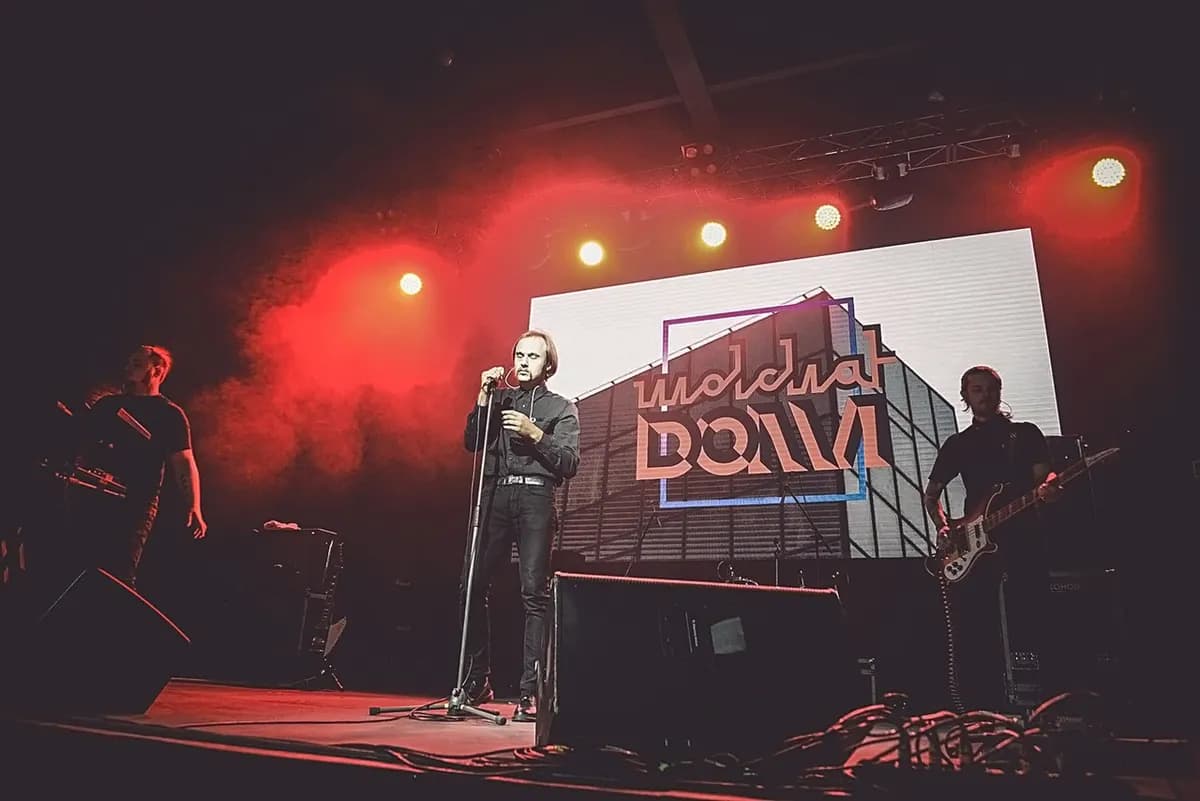
The streaming era brought listeners who had no link to the original scene. In 2020 Molchat Doma, a band formed in Minsk in 2017, spread on TikTok with "Sudno (Boris Ryzhy)" from their 2018 album Etazhi, and acts such as Lebanon Hanover found audiences far from the old club circuit.
Key Characteristics & Sound
What identifies a gothic rock track:
- Lead bass: melodic, chorused, played high; in most goth songs it is the main hook.
- Guitar as atmosphere: tremolo, flange and long delay, single notes and sustained chords in place of riffs.
- Drum machines or tom-heavy patterns: a mechanical pulse, or the tribal floor-tom rhythms of Siouxsie and the Banshees.
- Tempo: commonly 90–140 BPM, with an unhurried, marching feel.
- Vocals: deep baritone or dramatic soprano, drenched in reverb, often closer to declamation than to singing.
- Harmony: minor keys, modal melodies, drones and unresolved suspensions.
- Reverb as structure: the space around the instruments is written into the arrangement.
- Lyrics: death, faith, decay, romance and ruin, written in a literary voice; confession is rare.
Where it sits among its relatives:
| Trait | Gothic Rock | Post-Punk | Deathrock | Darkwave |
|---|---|---|---|---|
| Tempo | 90–140 BPM | 120–160 BPM | 140–180 BPM | 80–130 BPM |
| Drums | Machine or tribal toms | Live, dub-spaced | Live, punk-derived | Programmed |
| Guitar | Reverberant, sparse | Scratchy, angular | Raw, surf-tinged | Minimal or absent |
| Vocals | Baritone, theatrical | Declaimed | Shrieked, campy | Whispered, processed |
| Mood | Romantic, funereal | Cold, analytical | Horror-movie | Melancholy, synthetic |
| Reference album | Pornography (1982) | Unknown Pleasures (1979) | Only Theatre of Pain (1982) | Medusa (1986) |
Instruments & Production
In goth, the studio sound defines the genre as much as the songs do:
- Chorus and flanger on bass, the most identifiable sound in the genre.
- Analogue and digital reverb used at extremes, often across the whole mix.
- Drum machines: the Doktor Avalanche of The Sisters of Mercy, which started as a Boss DR-55 and later ran on Roland, Yamaha and Akai units.
- Guitar effects over amplification: tremolo, phaser, e-bow and long tape or digital delay.
- Cold, wide mixes with a hollow midrange and hard-panned guitars.
- Synth pads and strings that thicken the sound without leading it, especially after 1983.
- Vocal treatment: heavy plate reverb and doubling, with the voice placed at the back of the room on purpose.
Subgenres & Related Styles
The family around it:
- Deathrock: the American, punk-rooted branch; Christian Death, 45 Grave.
- Darkwave: the electronic, synth-led descendant; Clan of Xymox, Lebanon Hanover, Molchat Doma.
- Ethereal wave: the 4AD strand built on wordless female vocals and reverb; Cocteau Twins, Dead Can Dance.
- Coldwave: the French and Belgian version, colder and more minimal.
- Gothic metal: the 1990s hybrid with doom metal; Type O Negative, Paradise Lost.
- Industrial and EBM: the harder electronic neighbours that share the clubs.
- Post-Punk: the parent genre; goth is its slow, romantic branch.
Notable Artists & Albums
Where to start:
- Bauhaus: In the Flat Field (1980), the single "Bela Lugosi's Dead" (1979).
- The Cure: Faith (1981), Pornography (1982), Disintegration (1989).
- Siouxsie and the Banshees: Juju (1981).
- The Sisters of Mercy: First and Last and Always (1985), Floodland (1987).
- Fields of the Nephilim: The Nephilim (1988).
- The Mission: God's Own Medicine (1986).
- Christian Death: Only Theatre of Pain (1982).
- Dead Can Dance: Within the Realm of a Dying Sun (1987).
- Clan of Xymox: Medusa (1986).
- Molchat Doma: Etazhi (2018), the record many new listeners found first.
Three records for the arc: "Bela Lugosi's Dead" for the invention, Pornography for the depth, Floodland for the sound that still fills goth clubs.
How AI Detects Gothic Rock
Much of what makes goth recognisable is in the spectrum. Long reverb tails smear note onsets and raise the share of sustained energy over transients; the bass plays in the melodic register where guitars usually sit; and a low male voice under heavy reverb has a distinctive formant profile.
Genre AI's production taxonomy has no gothic rock label. A guitar-and-bass goth track most likely lands in the Rock family, as Punk (whose text prompts include "post punk") or Indie / Alternative, which is close to the truth, since the line between goth and post-punk is one of degree. When the drum machine and synth pads dominate, the Electronic Dance family may win instead, usually as Synth Pop. Slow, heavy goth with distorted guitar can tip into Metal and come back as Doom Metal. Try a track in the Genre AI music genre detector.
Genre AI has no Gothic Rock label, so expect the answer to name the nearest family. For a classic guitar-led track the likely result is Rock with Punk or Indie / Alternative on top, the two labels that sit closest to Post-Punk; the alternatives shown come only from the same Rock family. Material built on a drum machine and synth pads may be read as Electronic Dance and returned as Synth Pop, which is also where much darkwave is likely to end up. Slow tracks with distorted guitar may cross into Metal as Doom Metal, a fair hint at where gothic metal came from. Reverb and the low, sustained vocal are what the model hears most, so a dry studio take of a goth song may read as plain rock.