Math rock is guitar music that puts rhythm first. Instead of a steady beat under a melody, it builds songs from interlocking patterns in odd and shifting time signatures (7/8, 5/4, 11/8), played on clean, bright guitars in unusual tunings. It came out of the American underground in the early 1990s, and today one of its most active scenes is in Japan.
This guide covers where math rock came from, how the guitar playing works, how it differs from progressive rock and post-rock, and which records to start with. To hear how a track reads to a classifier, run a few seconds through our free AI music genre detector.
What Is Math Rock?
Math rock is complex rhythm played without grandeur. A typical track runs on a repeating figure whose bar is not four beats long, with guitar and drums locked into patterns that shift against each other and line up again after several bars. The playing is precise, the tone is clean, and the line-up is usually a trio or quartet with no keyboards and often no vocals.
The name started as a semi-joke in the 1990s, and many of the bands it describes have rejected it, but it stuck because it matches the listening experience: the pleasure is in following a pattern that will not sit still. Prog rock uses complexity to build long, dramatic pieces with orchestral keyboards; math rock keeps to indie-rock scale, with three-to-five-minute songs, small amps and no concept albums.
Its second signature is texture: bright, undistorted, often tapped guitar with many open strings ringing. That comes from alternate tunings, and it makes a math rock guitar part easy to recognise within a few bars.
History & Origins
Two lines of ancestry meet here. One runs through progressive rock, especially the interlocking guitars of King Crimson's early-1980s records such as Discipline (1981); the other through hardcore punk and the American noise-rock underground, where bands were already breaking rhythm apart with no interest in virtuoso display.
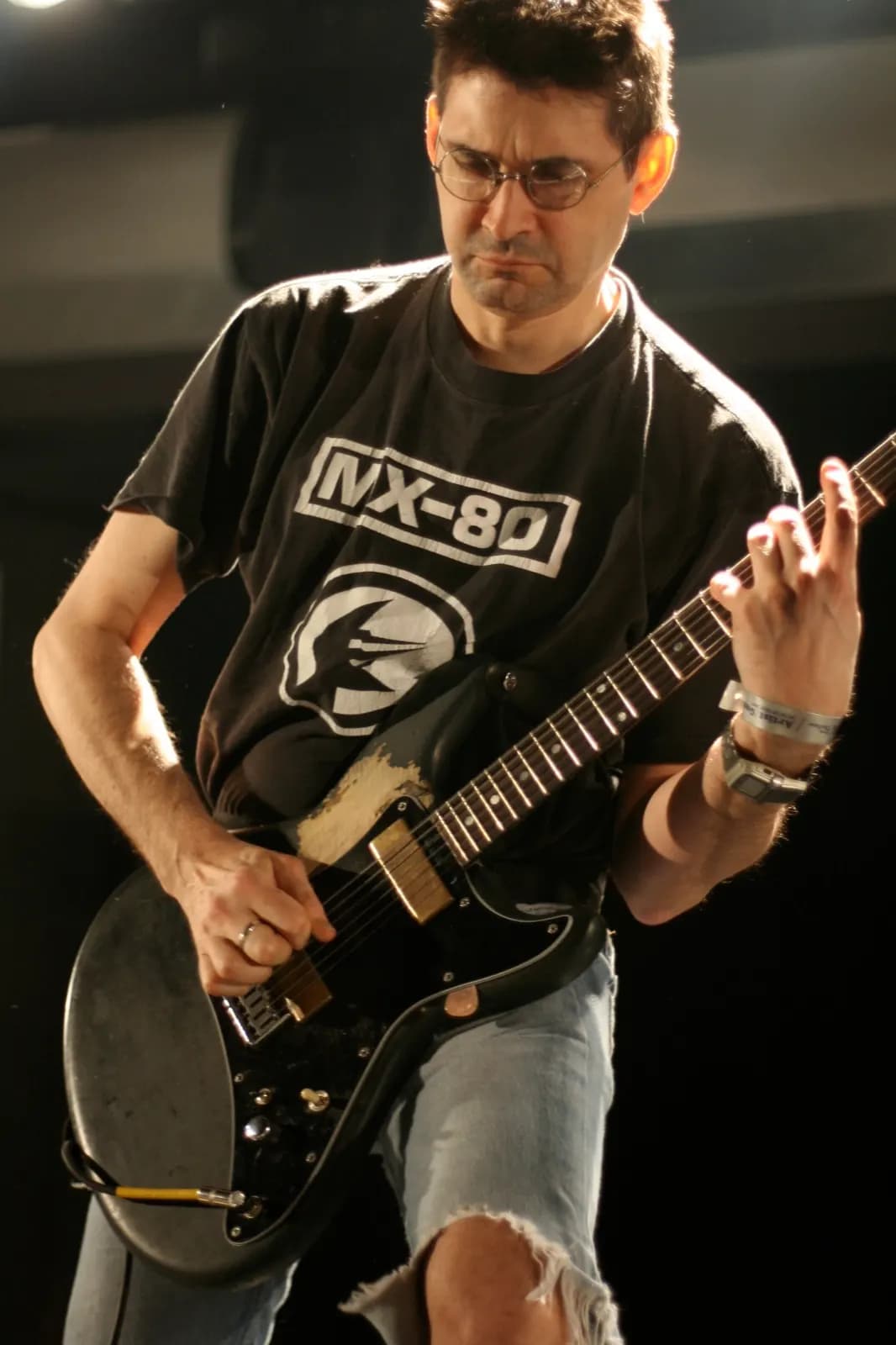
A key early record is Slint's Spiderland (1991) from Louisville, with its quiet-loud dynamics, spoken vocals and unstable metre; it also helped start post-rock. In Pittsburgh, Don Caballero made some of the genre's best-known instrumental records, driven by Damon Che's drumming. In Chicago, Shellac and engineer Steve Albini gave the scene its dry, unprocessed sound. In North Carolina, Polvo built songs from detuned, slightly off-kilter guitars.
By the late 1990s a second, warmer branch had grown out of Midwest emo, following Chicago's Cap'n Jazz (1989–1995). American Football's self-titled 1999 album, with clean interlocking guitars in open tunings, shifting metres and Steve Lamos's trumpet, became a touchstone for that branch and found a much larger audience online in the 2010s. Maps & Atlases and Hella carried the American style through the 2000s.
Japan then became one of its main centres, where the style met an existing taste for technical instrumental music. Ruins, active since the 1980s, came first; toe, LITE, tricot and mouse on the keys followed and built a scene that tours internationally. For many new listeners, Japanese math rock is the first version they hear.
Britain added another wave in the 2000s: TTNG (formerly This Town Needs Guns) from Oxford, Colour from Kingston, and the early records of Foals, whose Antidotes (2008) brought the interlocking guitar style to indie clubs. Since the 2010s much of the genre's audience has gathered online, around tablature sites, YouTube playthroughs and streaming recommendations.
Key Characteristics & Sound
What identifies a math rock track:
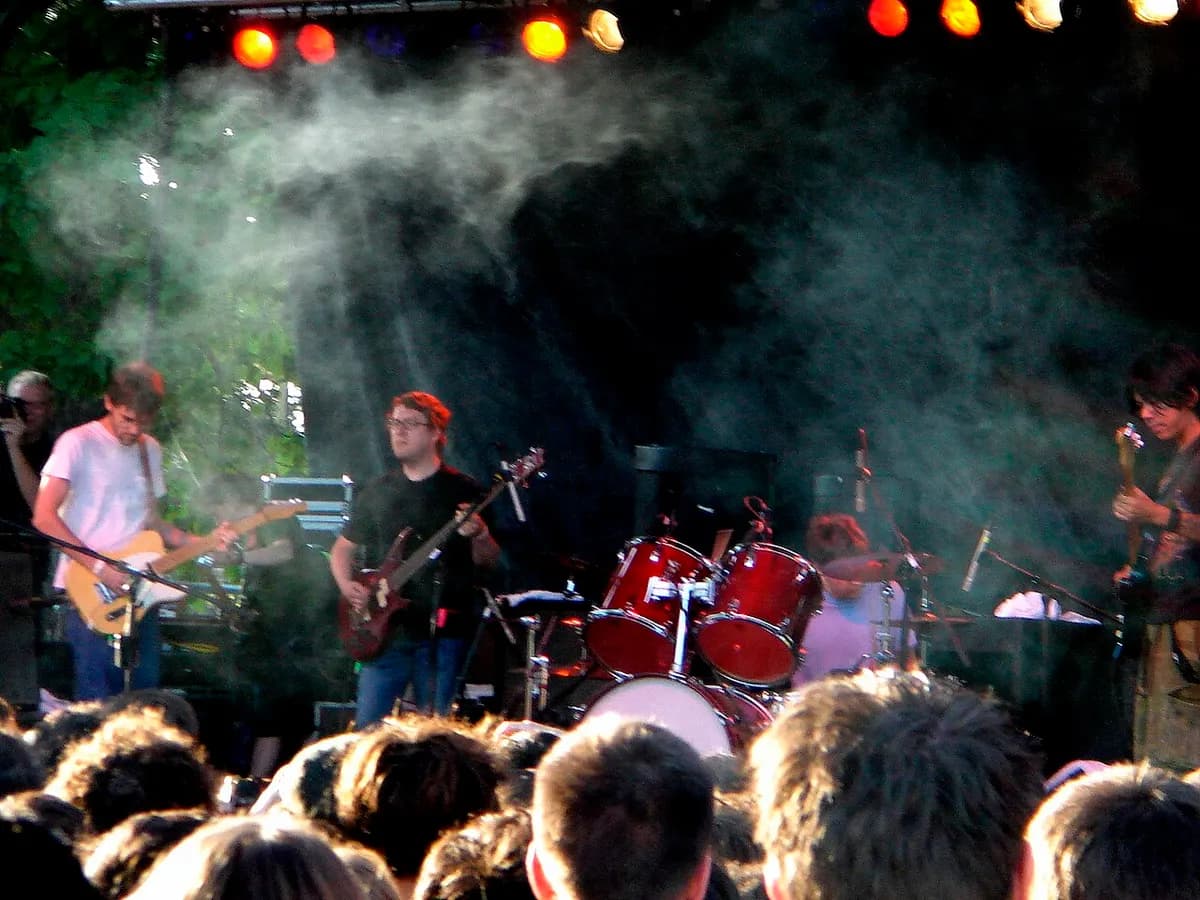
- Odd and shifting metres: 5/4, 7/8, 11/8, and bar-to-bar changes; a phrase may resolve only every three or five bars.
- Polymetre: guitar and drums running patterns of different lengths that line up again periodically.
- Clean tone: little or no distortion, so the attack of each note stays audible and the rhythm reads.
- Tapping and open strings: two-handed tapping and arpeggios that let open strings ring against fretted notes.
- Alternate tunings: heavily modified, often a new one for each song, which is why the chords are hard to name.
- Tempo: usually 120–170 BPM, though the tempo says little here; the metre is what defines the music.
- Instrumental or understated vocals: when present, sung softly and mixed as another layer.
- Dynamics: abrupt stops, quiet-loud contrast, and arrangements that avoid choruses.
How it sits among its neighbours:
| Trait | Math Rock | Progressive Rock | Post-Rock | Midwest Emo |
|---|---|---|---|---|
| Core idea | Rhythmic puzzle | Long composed forms | Slow build, texture | Confessional melody |
| Guitar tone | Clean, bright | Varied, often distorted | Reverberant, delayed | Clean, arpeggiated |
| Time signatures | Odd, shifting | Odd, shifting | Mostly 4/4 | Mixed, some odd |
| Keyboards | Rare | Central | Occasional | Rare |
| Track length | 3–5 min | 7–25 min | 6–12 min | 3–5 min |
| Reference album | What Burns Never Returns (1998) | Close to the Edge (1972) | Spiderland (1991) | American Football (1999) |
Instruments & Technique
Math rock is built on technique, and the technique is unusually specific:
- Alternate tunings: open and modal tunings chosen per song so that ringing open strings supply the harmony while the fretting hand plays patterns. American Football's FACGCE tuning on "Never Meant" is a well-known example.
- Two-handed tapping: used partly for speed but mostly for texture, since it lets one guitarist sustain a moving line and a drone at once.
- Clean amps with light compression, so the start of every note survives; heavy gain is avoided.
- Delay used as a rhythmic device, often set to a subdivision of the odd metre.
- Drums as a melodic partner: kits played across the barline, with ride and toms carrying the pattern instead of a plain backbeat.
- Bass as glue, usually locked to the guitar's pattern more than to the kick, which makes the metre audible.
- Dry production in the Albini manner: room mics, no gloss, little editing, so the listener can hear that people played it.
Subgenres & Related Styles
The family around it:
- Midwest emo: the melodic, "twinkly" branch; American Football, Algernon Cadwallader.
- Noise rock: the abrasive ancestor; Shellac, The Jesus Lizard.
- Post-rock: the slower, more atmospheric cousin, with Slint as a shared origin.
- Japanese math rock: toe, LITE, tricot; warmer and more melodic, often with jazz-fusion phrasing.
- Mathcore: the violent hybrid with metalcore; The Dillinger Escape Plan, Converge.
- Progressive metal: the heavy relative that shares the metres and adds distortion and length.
- Jazz Fusion: the older tradition math rock borrows harmony and technique from.
Notable Artists & Albums
Where to start:
- Slint: Spiderland (1991).
- Don Caballero: What Burns Never Returns (1998).
- American Football: American Football (1999).
- toe: The Book About My Idle Plot on a Vague Anxiety (2005).
- Hella: Hold Your Horse Is (2002).
- TTNG: Animals (2008).
- Foals: Antidotes (2008).
- tricot: T H E (2013).
- LITE: Phantasia (2008).
- Polvo: Today's Active Lifestyles (1993).
Three records for the arc: Spiderland for the origin, American Football for the melodic turn that brought in a wider audience, and The Book About My Idle Plot... for the Japanese scene.
How AI Detects Math Rock
Math rock is a hard case for automatic classification, and especially for the beat-tracking stage most systems run first. Tempo and downbeat estimation assume a repeating four-beat grid; when the bar length changes every few measures, the estimate becomes unstable, and every feature computed relative to the beat inherits that instability.
What does read reliably is timbre: clean electric guitar with strong note attacks, wide dynamic contrast, no vocal for long stretches, and a high rate of distinct pitch events. Those cues push results toward indie rock, alternative, rock or occasionally jazz fusion when the harmony gets extended. Test it in the Genre AI music genre detector, and see our full explainer on math rock for more on the scene.
Testing this style in Genre AI ourselves, Math Rock shows a limitation worth knowing about: a model reports a single tempo, and for a piece that alternates 7/8 and 4/4 that number means little. What comes back is a family answer, usually Indie Rock or Alternative, with an unusually flat alternatives list, because none of the standard genre profiles fit a clean, busy, vocal-free guitar texture. The clearest tell is what confidence does over a longer sample: on most guitar music it rises as more of the track is heard, and on math rock it stays low, because each new section changes the evidence.