
New jack swing, also called swingbeat, is the sound of R&B and hip-hop being welded together for the first time at chart scale. Producer Teddy Riley put smooth vocal-group singing over hard, swung drum-machine programming, and from the late 1980s into the early 1990s that combination was all over American radio, MTV and the pop charts.
This guide covers how the style was built, what makes the groove swing, why it faded so quickly, and what it left behind. To hear how a track reads to a classifier, run a few seconds through our free AI music genre detector.
What Is New Jack Swing?
New jack swing puts hip-hop drums under R&B vocals. The rhythm track is programmed, hard-hitting and swung: tightly quantised, but with every second sixteenth note pushed late so the groove lopes instead of marching. The melody is carried by trained singers doing gospel-derived runs and vocal-group harmony.
The style also imported hip-hop's arrangement habits: rap verses inside R&B songs, sampled breaks and horn stabs, scratching used as punctuation, and a general habit of treating the beat itself as the hook. Before it, R&B ballads and rap records were mostly made by different people for different audiences. Afterwards, rappers on R&B singles and R&B singers on rap hooks became routine.
Visually and commercially it was a package of synchronised dance routines, high-top fades and coordinated outfits, which is part of why it dated so fast. The musical idea outlasted the look: 1990s hip-hop soul and much of later R&B kept the same drums-under-voices formula.
History & Origins
The architect is Teddy Riley, a Harlem producer who was working professionally in his teens. The sound had precursors: some critics cite "Oh Louise" (1985) by the English singer Junior Giscombe, and others name Full Force's "Alice, I Want You Just for Me" from the same year as the first new jack swing song. Riley's production for Keith Sweat ("I Want Her", 1987, a No. 5 hit on the Billboard Hot 100) and his own group Guy (Guy, 1988) established the template. Journalist Barry Michael Cooper named the style in an October 1987 Village Voice profile of Riley, and the phrase stuck to the whole movement.
It went mainstream through Bobby Brown. Don't Be Cruel (1988) split its production between Riley and the team of L.A. Reid and Babyface, sold in the millions, and made the Riley-produced "My Prerogative" the genre's signature record: a former New Edition member singing about autonomy over a beat that sounded like a rap track.
The wave was broad. Bell Biv DeVoe's Poison (1990) came with the group's own summary of its sound, quoted in slightly different words from source to source as "mentally hip-hop, smoothed out on the R&B tip, with a pop appeal to it". Johnny Gill, Today, Al B. Sure! and Karyn White all worked in the style, and in Britain the music was sold under the name swingbeat.
Michael Jackson confirmed its status by bringing Riley in as co-producer on much of Dangerous (1991). Wikipedia calls it the most commercially successful new jack swing album, with more than 30 million copies sold. Jodeci's Forever My Lady (1991) pushed the style toward slower, rawer territory that pointed at what came next.
The fade came from two directions. Mary J. Blige's What's the 411? (1992), produced largely by Sean Combs, kept the hip-hop drums but replaced the polish with grit, and the result was called hip-hop soul. Dr. Dre's The Chronic (1992) moved West Coast rap toward funk samples and slower tempos. Wikipedia dates the style's popularity to 1988–1993, though hits kept arriving: Montell Jordan's "This Is How We Do It" reached No. 1 in 1995, and the genre's appeal to young listeners declined after that. Riley's next group, Blackstreet, was already moving somewhere else.
Key Characteristics & Sound
What identifies a new jack swing track:
- Swung programmed drums: a sixteenth-note shuffle applied to a drum machine, so the groove lopes while staying rigid.
- Tempo: roughly 100–120 BPM, quicker than a ballad, with room for choreography.
- Hard snare and rimshot from the SP-1200 or 808, mixed loud and dry.
- Synth bass and stabs: DX7 and Minimoog basslines with orchestral or horn hits punctuating the beat.
- Vocal-group harmony: layered background stacks, gospel runs, ad-libs in every gap.
- Rap verses inside R&B songs, usually from a guest, sometimes from a group member.
- Sampled breaks and scratching used as texture, borrowed directly from hip-hop production.
- Bright, compressed late-1980s mixing, often with gated reverb on the snare.
Where it sits among its neighbours:
| Trait | New Jack Swing | 1980s R&B | Hip-Hop Soul | Contemporary R&B |
|---|---|---|---|---|
| Period | 1987–1993 | 1980–1990 | 1992–1998 | 1996 onward |
| Drums | Swung, programmed, hard | Straight, polished | Sampled loops, harder | Programmed, spacious |
| Tempo | 100–120 BPM | 90–115 BPM | 90–105 BPM | 60–100 BPM |
| Vocals | Group harmony, runs | Lead with backing | Grittier, solo | Melismatic, layered |
| Rap | Guest verse standard | Rare | Central | Frequent |
| Reference album | Don't Be Cruel (1988) | Control (1986) | What's the 411? (1992) | The Writing's on the Wall (1999) |
Instruments & Production
The genre is a product of a specific generation of machines:
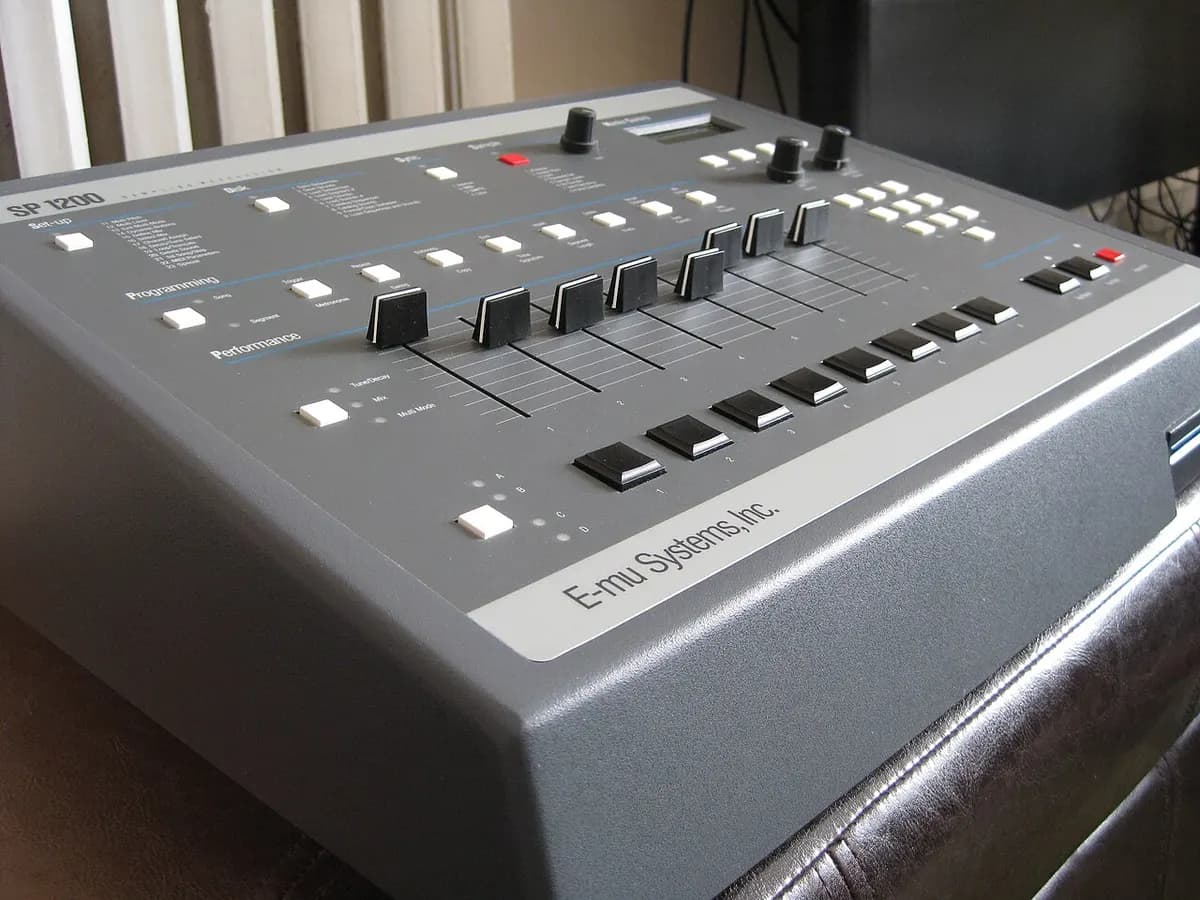
- Drum sources: the Roland TR-808, LinnDrum and Roland R-8, with the E-mu SP-1200 and Akai samplers for sampled hits. The SP-1200's short sampling time and gritty 12-bit sound are part of the era's character.
- Swing quantisation, the defining production move: every second sixteenth note is delayed by a set percentage, which turns a machine grid into a shuffle.
- Yamaha DX7 and Roland D-50 for bass and bell tones, the digital sheen that ties these records to their years.
- Orchestra hits and horn stabs from stock sample libraries, used as rhythmic accents.
- Gated reverb on snares, carried over from mid-1980s pop production.
- Multi-tracked vocal stacks, sometimes dozens of backing passes, arranged like a gospel choir.
- Producers as brands: Teddy Riley, L.A. Reid and Babyface, Jimmy Jam and Terry Lewis. In this period the producer's name on the sleeve helped sell the record.
Related Styles & Legacy
What it connects to:
- Swingbeat: the British name for the style.
- Hip-hop soul: the direct successor, with the same drums, rougher voices and less polish; Mary J. Blige, Faith Evans.
- New jack R&B ballads: the slow-jam counterpart from the same producers.
- Revivals: Bruno Mars's "Finesse" (2016), and K-pop tracks such as EXID's "Lady" (2018) and NewJeans' "Supernatural" (2024), which Wikipedia lists as modern new jack swing.
- R&B: the parent genre, permanently changed by the fusion.
- Hip-Hop: the other parent, which gained a route to pop radio through it.
- Motown: the vocal-group tradition that new jack swing updated for the drum-machine era.
Notable Artists & Tracks
Where to start:
- Bobby Brown: "My Prerogative", "Every Little Step" (1988).
- Guy: "Groove Me", "Teddy's Jam" (1988).
- Keith Sweat: "I Want Her" (1987).
- Bell Biv DeVoe: "Poison" (1990).
- Michael Jackson: "Remember the Time" (from Dangerous, 1991).
- Jodeci: "Come & Talk to Me" (1991).
- Johnny Gill: "Rub You the Right Way" (1990).
- Karyn White: "The Way You Love Me" (1988).
- Wreckx-n-Effect: "Rump Shaker" (1992).
- Blackstreet: "No Diggity" (1996), made after the era by its architect.
For a short route through it: "I Want Her" for the invention, "My Prerogative" for the peak, and "Remember the Time" for the moment the biggest star in pop adopted the sound.
How AI Detects New Jack Swing
A classifier is more likely to pick this style up through rhythm and production era than through any single instrument. The swing applied to programmed drums produces a regular but uneven spacing of hits, machine-tight yet shuffled. Combine that with a tempo around 100–120 BPM, a dry hard snare, digital synth bass and stacked vocal harmony, and the profile is fairly specific.
Genre AI's production taxonomy has no new jack swing label. The closest options are the coarse R&B label and the Contemporary RnB fine label, which sits inside the Rap Hip-Hop family; Pop and Funk / Soul are other likely answers. Whether a track leans toward R&B, pop, hip-hop or funk may depend on whether the sample contains a rap verse. Test one in the Genre AI music genre detector.
Genre AI has no dedicated new jack swing label, so the answer will be one of its neighbours. The likeliest are the coarse R&B label and Contemporary RnB, a fine label in the Rap Hip-Hop family, with Pop and Funk / Soul as plausible alternatives. Which one wins may depend on what the analysed seconds contain: a stretch with a rap verse pulls toward the Hip-Hop side, a sung chorus with stacked harmonies toward R&B or Pop. The word "swing" in the name is a false friend here. In the taxonomy it is an alias of Big Band / Swing, a jazz label, and the swung sixteenths of a drum machine have little in common with a big band, so a jazz answer would be a surprise. The useful signal is the production: a swung, dry, mechanical groove with late-1980s digital synths, which is what Bobby Brown, Guy and Michael Jackson's Dangerous material share.