Grindcore is where hardcore punk and extreme metal meet at full speed. It runs on the blast beat, drumming so fast the individual hits blur into a single texture, with songs frequently under a minute, vocals split between a low growl and a high shriek, and lyrics that are either furiously political or deliberately grotesque. It was assembled in and around Birmingham, England, in the mid-1980s, and its underground still runs festivals, labels and tours today.
This guide covers where grindcore came from, what a blast beat actually is, how it differs from death metal, and which albums to start with. To hear how a track reads to a classifier, run a few seconds through our free AI music genre detector.
What Is Grindcore?
Grindcore is defined by extreme tempo, extreme brevity and deliberate ugliness working together. The blast beat, kick and snare alternating at sixteenth-note speed (commonly 180–280 BPM, faster at the extremes), removes any sense of groove and replaces it with a wall of impacts. Songs are built as bursts: state a riff, blast, stop.
Its dual parentage is audible on every record. From hardcore punk and crust it takes the political anger, the DIY release model and the refusal of technique for its own sake; from early death metal and thrash it takes the downtuned riffing and the growl. Both sides are pushed further than either parent went.
Grindcore also made the very short song a habit. Napalm Death's "You Suffer" lasts about a second; in 2007 its video set the Guinness record for the shortest music video, at 1.3 seconds. Their debut album Scum fits twenty-eight tracks into thirty-three minutes. The point is formal: a song lasts exactly as long as its idea.
History & Origins
The ingredients existed before the genre. Discharge's D-beat gave British punk a mechanical, apocalyptic drive; Siege, from Weymouth near Boston, played hardcore at speeds few had attempted; and Michigan's Repulsion recorded Horrified in June 1986 under the title Slaughter of the Innocent, a demo that combined punk speed with death-metal riffing and circulated on tape until Necrosis Records released it in 1989.
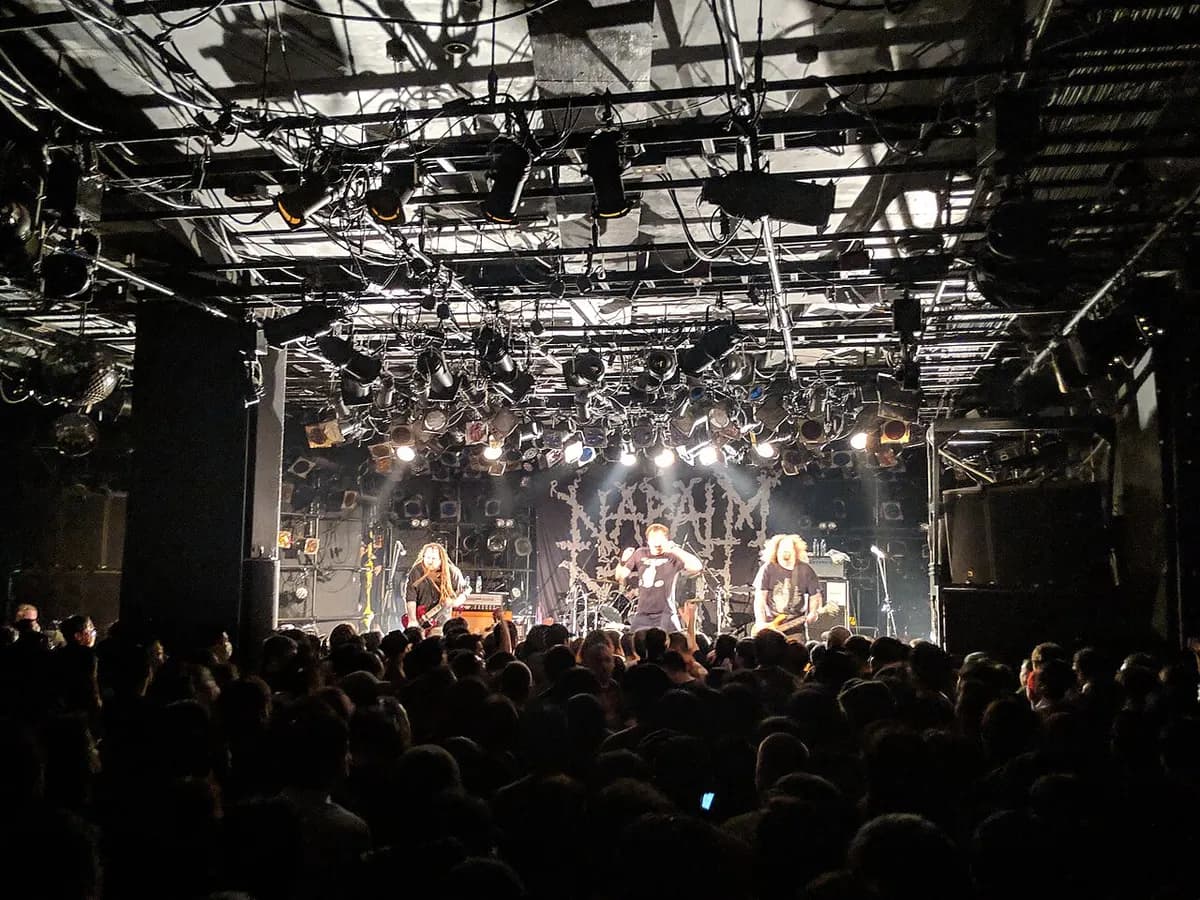
The synthesis happened in the West Midlands. Napalm Death formed in May 1981 in Meriden, near Coventry, as an anarcho-punk band inspired by Crass, and played its early gigs around Birmingham. It accelerated through successive line-ups until drummer Mick Harris, who joined in December 1985, was playing blast beats as a matter of course. Harris is generally credited with coining the term "blast beat" and, in Albert Mudrian's account, the word "grindcore" too, though Spin writer Steven Blush credits bassist Shane Embury. Scum (1987), recorded at Rich Bitch studio in Birmingham by two different line-ups with Harris the only member on both sides, is the genre's founding document. BBC Radio 1 DJ John Peel championed the band and recorded sessions with them, which is how music this extreme reached national radio.
The first wave followed immediately: Extreme Noise Terror from Ipswich; Carcass from Liverpool, whose Reek of Putrefaction (1988), with lyrics built from medical terminology, effectively created goregrind; Bolt Thrower, formed in Coventry in 1986; and, in Los Angeles, Terrorizer, whose World Downfall appeared in 1989.
Through the 1990s the style branched. Brutal Truth and Nasum refined it; Discordance Axis and later Pig Destroyer made it technical and precise. In California, Infest from Valencia, whose Slave LP came out in 1988, and Man Is the Bastard laid the groundwork for powerviolence, which added abrupt whiplash between blasts and slow crawls. Carcass themselves moved to melodic death metal with Heartwork (1993), a record that shaped a generation of metalcore bands.
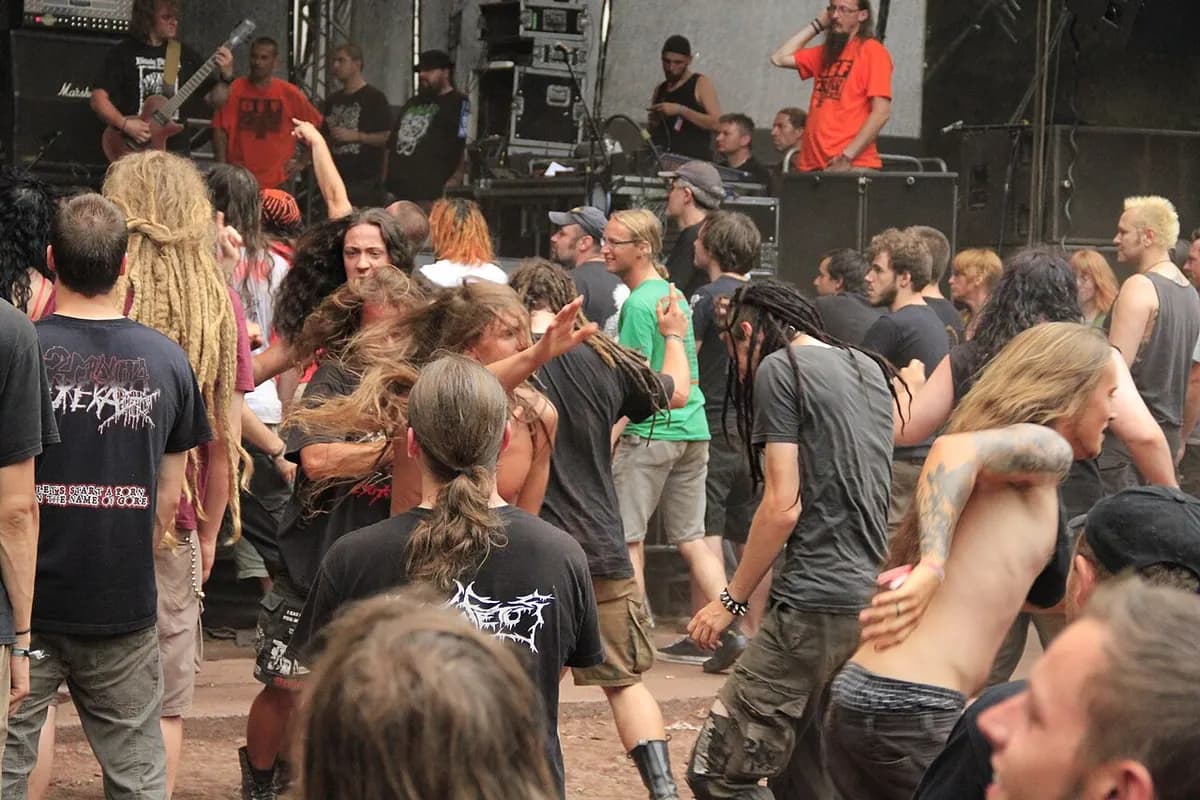
Grindcore has never been commercial. Its scene runs on split releases, seven-inches, small labels and festivals such as Obscene Extreme, held in Trutnov in the Czech Republic since 1999, and Napalm Death are still touring more than forty years after forming. Its influence shows up in metalcore breakdowns, in mathcore, and in the blast beats that are now standard across extreme metal.
Key Characteristics & Sound
What identifies a grindcore track:
- Blast beats: alternating or simultaneous kick and snare at sixteenth-note rates, commonly 180–280 BPM, with the fastest bands going beyond.
- Song length: 20 seconds to 2 minutes; albums routinely carry 20–30 tracks.
- Dual vocals: a low guttural growl alternating with or layered under a high shriek, the genre's most recognisable trait.
- Downtuned guitars with heavy distortion, riffs often reduced to a rhythmic smear.
- Abrupt structure: no development; sections change without transition and songs end without warning.
- Bass often distorted, heard as texture more than as pitch.
- Lo-fi, saturated production: clarity is not a goal, and many classics were recorded in a few days.
- Lyrics: anti-war, anti-capitalist and animal-rights politics on one side; medical and horror grotesquerie on the other.
Where it sits among the extreme styles:
| Trait | Grindcore | Death Metal | Hardcore Punk | Powerviolence |
|---|---|---|---|---|
| Tempo | Blasts at 180–280+ BPM | 180–260 BPM | 180–250 BPM | Whiplash between blasts and crawls |
| Song length | 0:20–2:00 | 3:00–6:00 | 0:45–2:00 | 0:15–1:30 |
| Drums | Blast beats | Blast plus grooves | D-beat, skank | Blast plus sudden stops |
| Vocals | Growl plus shriek | Growl | Shouted | Screamed |
| Riffs | Rhythmic smear | Structured, technical | Barre chords | Minimal |
| Reference album | Scum (1987) | Altars of Madness (1989) | Damaged (1981) | Slave (1988) |
Instruments & Production
Grindcore's technical demands sit almost entirely with the drummer:
- Blast-beat technique: single-stroke alternation between kick and snare, or a "bomb blast" with snare eighth notes over a sixteenth-note double-kick line, sustained for the length of a section.
- Double-bass pedals and tight, high-tuned snares that stay articulate at speed.
- Downtuned guitars with maximum gain, usually with the mids scooped so the blast beat cuts through. Scum's first side is tuned to E-flat, its second down to C.
- Distorted bass filling the gap left by the scooped guitars.
- Two vocalists, or one doing both parts: the growl carries weight, the shriek carries the rhythm.
- Fast, cheap sessions: Scum's two sides were recorded nine months apart, in August 1986 and May 1987, and Carcass made Reek of Putrefaction in four days.
- Modern productions are far cleaner: Nasum, Pig Destroyer and Nails made grindcore that is legible without softening it.
Subgenres & Related Styles
The family around it:
- Goregrind: pathology and horror themes with pitch-shifted vocals; Carcass, General Surgery.
- Deathgrind: the death-metal-leaning branch with more structured riffing; Cattle Decapitation, Misery Index.
- Powerviolence: American cousin built on sudden tempo whiplash; Infest, Man Is the Bastard, Weekend Nachos.
- Mincecore: the crust-punk-leaning political wing; Agathocles.
- Cybergrind: programmed drums and electronics; Agoraphobic Nosebleed.
- Mathcore: the technical, dissonant relative; The Dillinger Escape Plan, Converge.
- Death Metal and hardcore punk: the two parents, both still audible.
Notable Artists & Albums
Where to start:
- Napalm Death: Scum (1987), From Enslavement to Obliteration (1988).
- Repulsion: Horrified (recorded 1986, released 1989).
- Carcass: Reek of Putrefaction (1988), Heartwork (1993).
- Terrorizer: World Downfall (1989).
- Extreme Noise Terror: A Holocaust in Your Head (1989).
- Brutal Truth: Extreme Conditions Demand Extreme Responses (1992).
- Nasum: Human 2.0 (2000).
- Discordance Axis: The Inalienable Dreamless (2000).
- Pig Destroyer: Prowler in the Yard (2001).
- Nails: You Will Never Be One of Us (2016).
Three records for the arc: Scum for the invention, World Downfall for the genre fully formed, The Inalienable Dreamless for what happens when it becomes precise.
How AI Detects Grindcore
Grindcore breaks several assumptions that audio models rely on. Beat trackers look for a pulse in a plausible dance range, so a blast beat near 250 BPM is likely to be reported at half or a quarter of its real rate, or as no stable tempo at all. Spectrally the music is close to broadband noise: distorted guitar, cymbal wash and a growled vocal fill the spectrum with little tonal structure.
What does read is extremity itself: very dense onsets, very low harmonic clarity and little dynamic variation, which point to the Metal family. Genre AI has no grindcore label; the most likely answer is Death Metal, with Black Metal or Metalcore possible as alternatives. Test one in the Genre AI music genre detector.
Genre AI's production taxonomy has no Grindcore label, so the realistic result is a Metal answer, most likely Death Metal, with sibling labels such as Black Metal or Metalcore among the alternatives. The punkier end of the genre, with shouted vocals and D-beat sections, may instead be read as Rock and labelled Punk. Tempo is the weaker part of the reading: a blast beat is fast enough that any BPM shown is likely to be a halved or quartered guess. Song length is the other practical limit. Many grindcore tracks last under a minute, so a clip often covers most of the song, and a track of a few seconds such as "You Suffer" gives the model very little to go on.