
Glam rock is British pop-rock built on spectacle: stomping 4/4 beats, 1950s rock and roll riffs played through 1970s amplifiers, and performers in glitter, platform boots and deliberately ambiguous gender presentation. Glam acts crowded the UK singles chart between 1971 and 1975, and the style fed into punk, 1980s metal and Britpop.
This guide covers where glam came from, what makes the records sound the way they do, how it differs from the glam metal that borrowed its name, and which albums to start with. To hear how a track reads to a classifier, run a few seconds through our free AI music genre detector.
What Is Glam Rock?
Glam rock, also called glitter rock, pairs musically conservative rock and roll with flamboyant presentation. The songs are short, loud and simple, built around a chorus; the image was androgynous and theatrical, and in 1972 it genuinely provoked people.
The musical core is the stomp: a heavy, deliberately unsubtle 4/4 with handclaps and doubled or triple-tracked drums, closer to a football terrace than to a dancefloor. Over that go simple blues-derived riffs, saxophone or piano, layered backing vocals and a lead vocal delivered with camp exaggeration.
What separates glam from ordinary early-1970s rock is intent. Glam treated the performer as a character and the concert as theatre. The constructed persona, with an album built around a role, outlived the sound, and later pop stars borrowed it far more often than they borrowed the riffs.
History & Origins
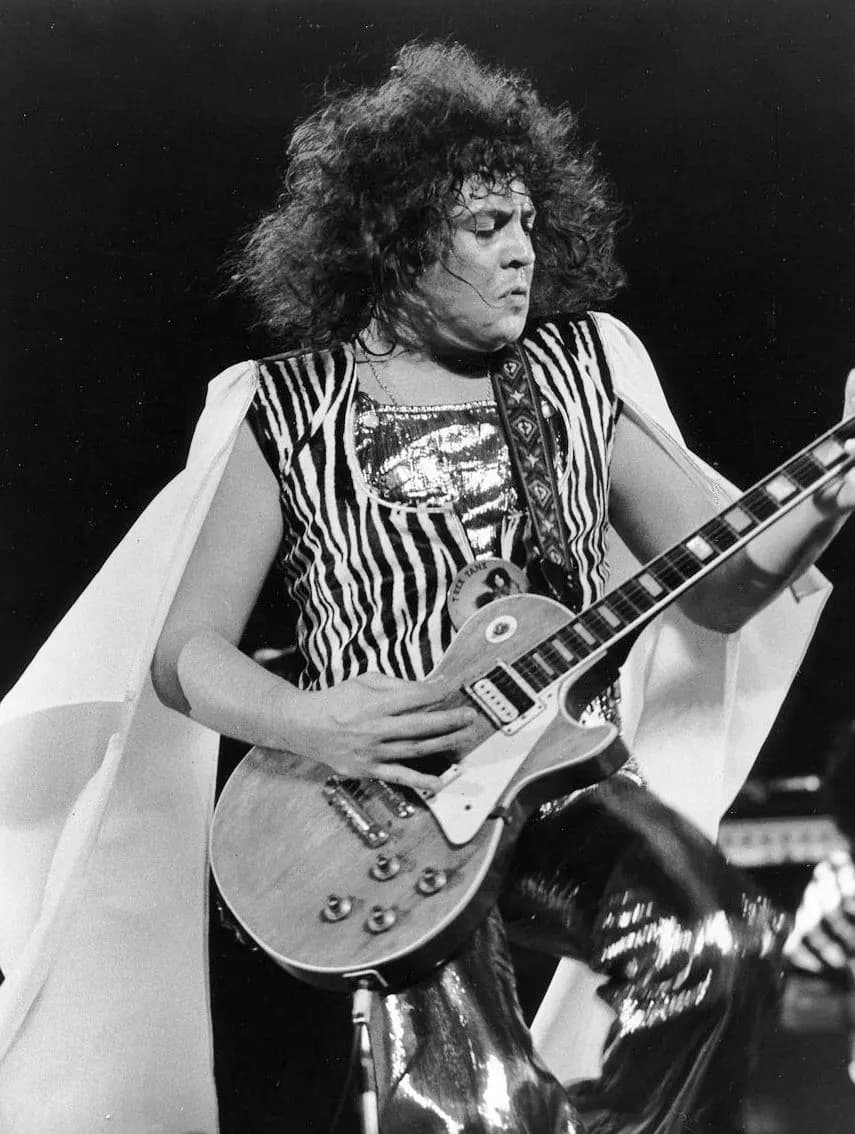
The starting point is usually dated to March 1971, when Marc Bolan of T. Rex appeared on the BBC's Top of the Pops wearing glitter and satins to perform "Hot Love". T. Rex had spent the late 1960s as an acoustic psychedelic-folk duo. The switch to electric boogie produced four UK number ones in barely more than a year: "Hot Love", "Get It On", "Telegram Sam" and "Metal Guru".
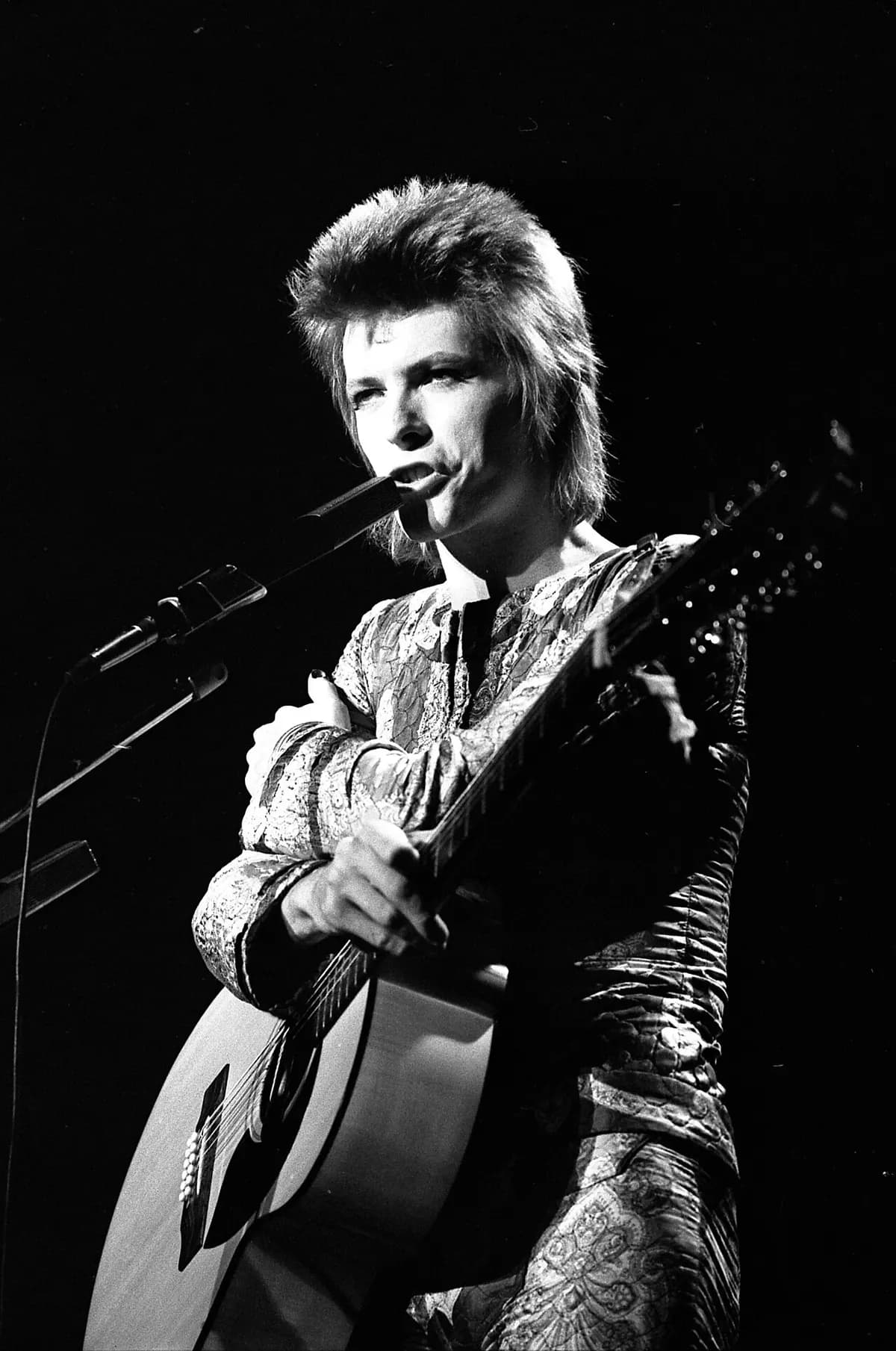
David Bowie turned the style into art. The Rise and Fall of Ziggy Stardust and the Spiders from Mars (1972) invented a character, gave him a band and a story, and Bowie retired that character from the stage of the Hammersmith Odeon on 3 July 1973. Roxy Music, formed in 1970 and releasing their first album in 1972, brought art-school conceptualism and Brian Eno's synthesiser into the same space.
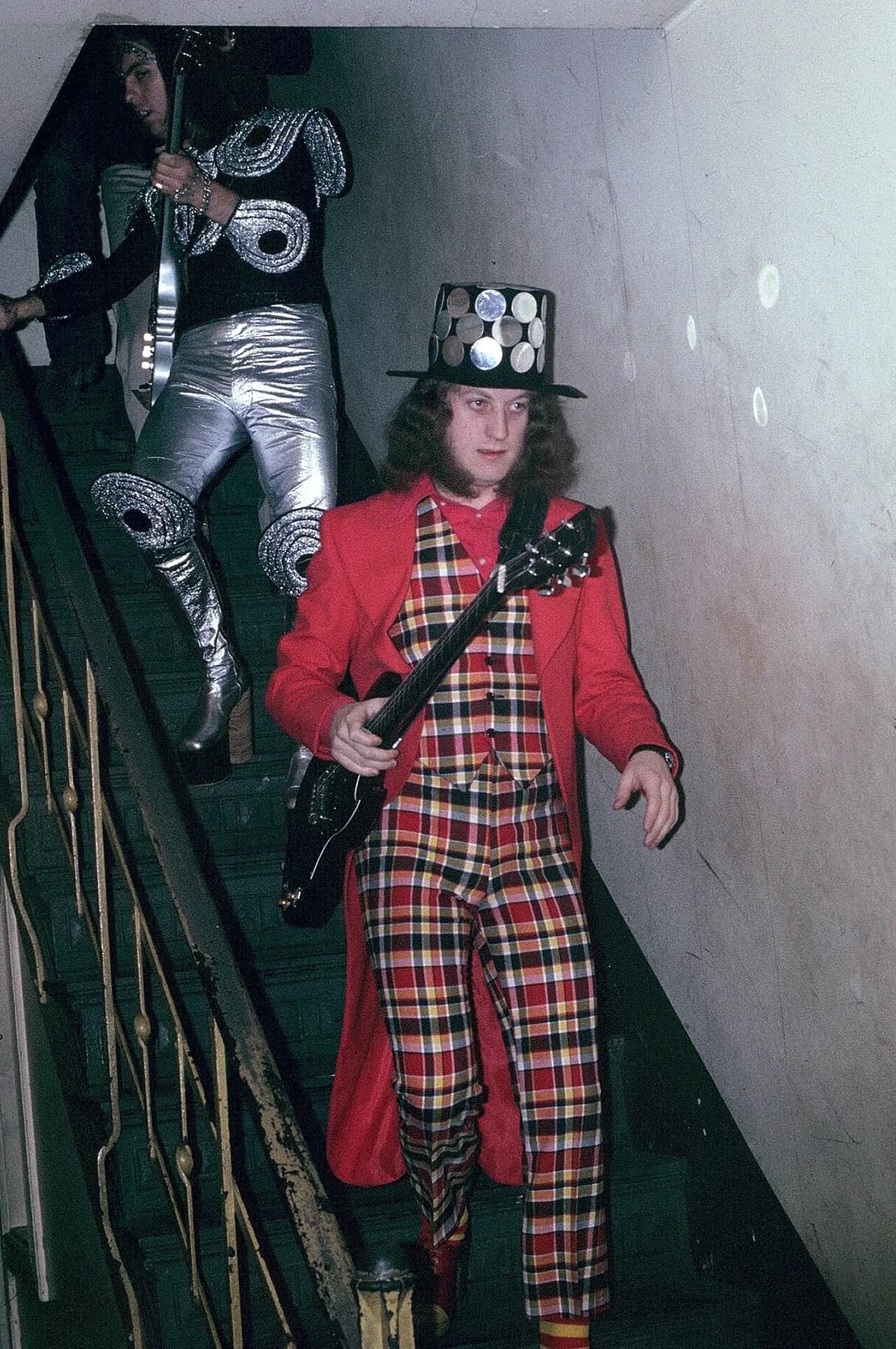
Beneath the two headline acts sat the singles machine. Slade wrote their own hits, with deliberately misspelled titles and terrace-chant choruses, and reached number one six times. Sweet and Mud worked largely with the songwriting team of Nicky Chinn and Mike Chapman. Wizzard, formed by Roy Wood after he left the Electric Light Orchestra, reached number one with "See My Baby Jive" and "Angel Fingers". Suzi Quatro, an American who broke through in Britain with the Chinn–Chapman song "Can the Can" in 1973, sang and played bass at the front of her band, and critics often describe her as a pioneer for women in rock.
America responded differently. Glam there meant the New York Dolls' shambolic drag-and-Chuck-Berry rock, Alice Cooper's horror theatre and Lou Reed's Transformer (1972), produced by Bowie. Commercially it stayed small, but it led straight into punk.
The era ended around 1975 and 1976, as the singles acts ran out of ideas and punk arrived to declare all of it obsolete while borrowing its make-up and covering its records. Later echoes are easy to find: 1980s glam metal on the Sunset Strip took the look and the volume, Suede and Placebo rebuilt the androgyny for the 1990s, and Lady Gaga's persona-driven pop works from Bowie's template.
Key Characteristics & Sound
What identifies a glam rock track:
- The stomp: heavy, simple 4/4 with the snare and handclaps hitting hard on 2 and 4, often multi-tracked.
- Tempo: mostly 110–140 BPM, mid-paced by design so that every beat lands heavily.
- 1950s roots: boogie and Chuck Berry riffs, twelve-bar structures, saxophone and honky-tonk piano.
- Layered backing vocals: gang choruses built for an audience to sing.
- Guitars: thick but not heavy; overdriven, chorused, mixed wide, rarely soloing for long.
- Vocals: theatrical and mannered, often with exaggerated vibrato or a deliberate sneer.
- Song length: about three minutes, with the chorus early. These were singles first and album tracks second.
- Production: big, bright and compressed, with strings and orchestration on the more ambitious records.
How glam relates to what came before and after:
| Trait | Glam Rock | Rock and Roll | Glam Metal | Hard Rock |
|---|---|---|---|---|
| Period | 1971–1975 | 1954–1963 | 1981–1991 | 1969 onward |
| Tempo | 110–140 BPM | 140–180 BPM | 120–160 BPM | 100–140 BPM |
| Guitar | Riffy, chorused | Clean, twangy | High-gain, shredding | Overdriven, bluesy |
| Focus | Persona and chorus | Dance and rhythm | Virtuosity and image | Riff and power |
| Vocals | Theatrical, camp | Shouted, rhythmic | High, wailing | Powerful, bluesy |
| Reference album | Ziggy Stardust (1972) | Elvis Presley (1956) | Appetite for Destruction (1987) | Led Zeppelin II (1969) |
Instruments & Production
Glam's production is where the apparent simplicity turns out to be constructed:
- Multi-tracked drums and handclaps: the stomp is usually several performances stacked, which is why it sounds larger than one kit in one room.
- Layered electric guitars with chorus and short slapback echo, giving width more than weight.
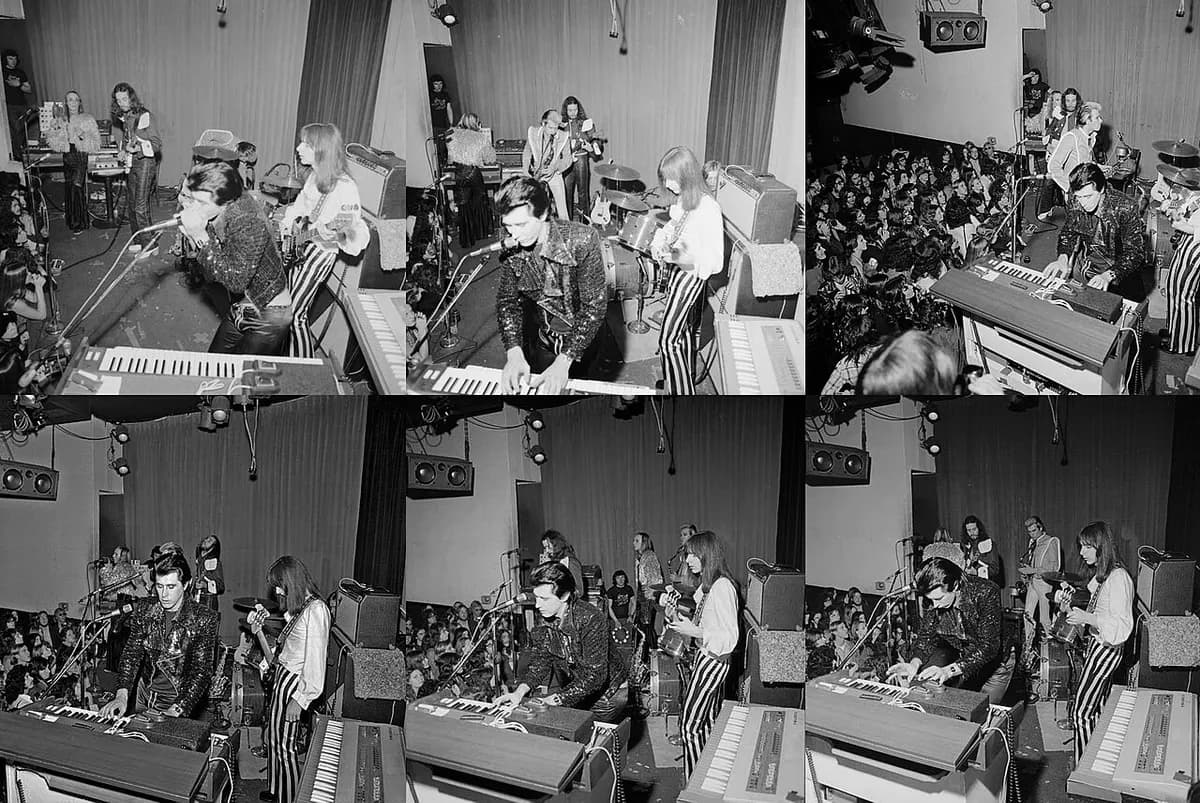
- Saxophone and piano carried over from 1950s rock and roll, used for short hooks; Andy Mackay's saxophone and oboe were part of Roxy Music's sound from the first album.
- String arrangements on Bowie and Roxy Music records, written for real players.
- Early synthesisers: on Roxy Music's first two albums Brian Eno, who did not play a conventional instrument, ran an EMS VCS3 and a Revox tape recorder to process the band's sound; Eddie Jobson replaced him in mid-1973.
- Vocal stacking, with choruses doubled and tripled and sometimes the whole studio singing.
- Producers and writers as authors: Tony Visconti with T. Rex, Nicky Chinn and Mike Chapman with Sweet, Mud and Suzi Quatro.
Related Styles & Descendants
The family around it:
- Glitter rock: an early name for the same style, later used for its more extreme, costume-heavy end.
- Art glam: the conceptual wing of Bowie, Roxy Music and Sparks.
- Proto-punk: the New York Dolls and Iggy Pop, glam's rougher American branch and the direct route into punk.
- Glam metal: the 1980s Los Angeles style that borrowed the look and joined it to hard rock technique.
- Gothic rock: kept glam's theatricality and pointed it at gloom.
- Britpop: Suede in particular rebuilt glam's androgyny and Bowie-derived melody for the 1990s.
- Synth Pop: the New Romantic movement applied glam's persona-driven approach to synthesisers.
Notable Artists & Albums
Where to start:
- David Bowie: The Rise and Fall of Ziggy Stardust and the Spiders from Mars (1972), Aladdin Sane (1973).
- T. Rex: Electric Warrior (1971), The Slider (1972).
- Roxy Music: For Your Pleasure (1973).
- Slade: Slayed? (1972).
- Sweet: Desolation Boulevard (1974).
- Lou Reed: Transformer (1972).
- New York Dolls: New York Dolls (1973).
- Mott the Hoople: All the Young Dudes (1972).
- Alice Cooper: Billion Dollar Babies (1973).
- Suzi Quatro: Quatro (1974).
Three albums for the arc: Electric Warrior for the sound, Ziggy Stardust for the idea, New York Dolls for what glam turned into once it crossed the Atlantic.
How AI Detects Glam Rock
Glam is a period style, and the period is much of what a classifier hears. Records from 1971 to 1975 share a recording signature: analogue tape saturation, limited stereo width, drums recorded in a live room with heavy compression, and a mid-forward mix in which the vocal and the snare occupy the same space.
Genre AI's production taxonomy has no glam label. The closest home is the coarse Rock category, and the answer you see will be one of its subgenres, most likely RocknRoll (the label behind our rock and roll page), Hard Rock (hard rock) or Soft / Pop Rock. Saxophone, piano and twelve-bar shapes probably push the reading towards RocknRoll; louder guitar singles towards Hard Rock. Pop has no subgenres in the taxonomy, so it is rarely the answer while a rock reading is available. Try one in the Genre AI music genre detector.
For glam rock, Genre AI is likely to answer with a subgenre of its coarse Rock label: RocknRoll (Rock and Roll) when the saxophone and boogie riffs dominate, Hard Rock or Soft / Pop Rock otherwise, with the other Rock subgenres as alternatives. Stripped of the costume, a T. Rex single is a boogie with handclaps, so that is a fair verdict on the sound. Pop is unlikely to appear even though the choruses are built like pop choruses, because the model prefers a category with subgenres when one is close, and Rock almost always is. Bowie and Roxy Music may behave differently from the singles bands: string arrangements could pull a track towards Progressive / Psychedelic Rock, and a synthesiser-led Roxy track could, less often, land in Electronic Dance as Synth Pop.