Bebop is the style that turned jazz from dance music into concert music. Developed in New York in the early 1940s by younger musicians who wanted more room than dance-band swing allowed, it replaced big bands with small combos, moderate tempos with breakneck ones, and simple arrangements with dense harmony and virtuoso improvisation.
This guide covers what bebop is, the after-hours sessions where it was built, its harmonic innovations, the rhythmic revolution in the drum kit, and the musicians who defined it. Curious how a classifier hears fast acoustic jazz? Play a few seconds into our free AI music genre detector.
What Is Bebop?
Bebop is small-group jazz built around improvisation over complex chord progressions at high speed. The standard format is a quintet (trumpet, saxophone, piano, bass, drums) playing the "head", the written melody, in unison, then taking extended solos over the same chord changes, then restating the head. Wikipedia calls it "musician's music": not meant for dancing, so the bands were free to play faster and listeners were expected to follow the soloists through the harmony.
Melodically it is angular and fast, built from long streams of eighth notes that outline chord extensions (ninths, elevenths, thirteenths) and use chromatic approach notes and altered tones that swing melodies avoided. Harmonically it adds substitutions, especially the tritone substitution, and reharmonises standards until the original is barely audible. Fast tempos are the norm: Parker's "Ko-Ko" (1945) runs at about 300 BPM. At the Harlem jam sessions where the style grew up, that difficulty was used on purpose to keep weaker players off the bandstand.
History & Origins
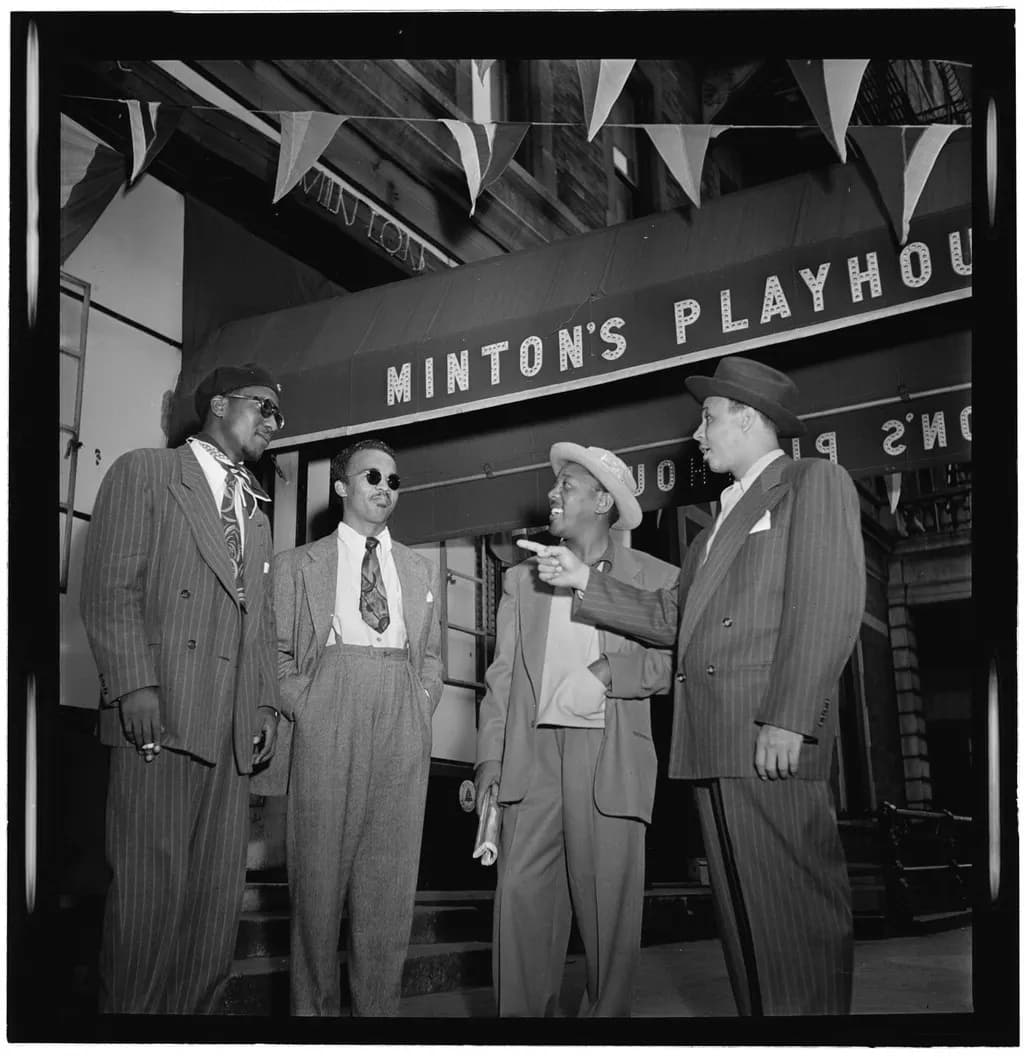
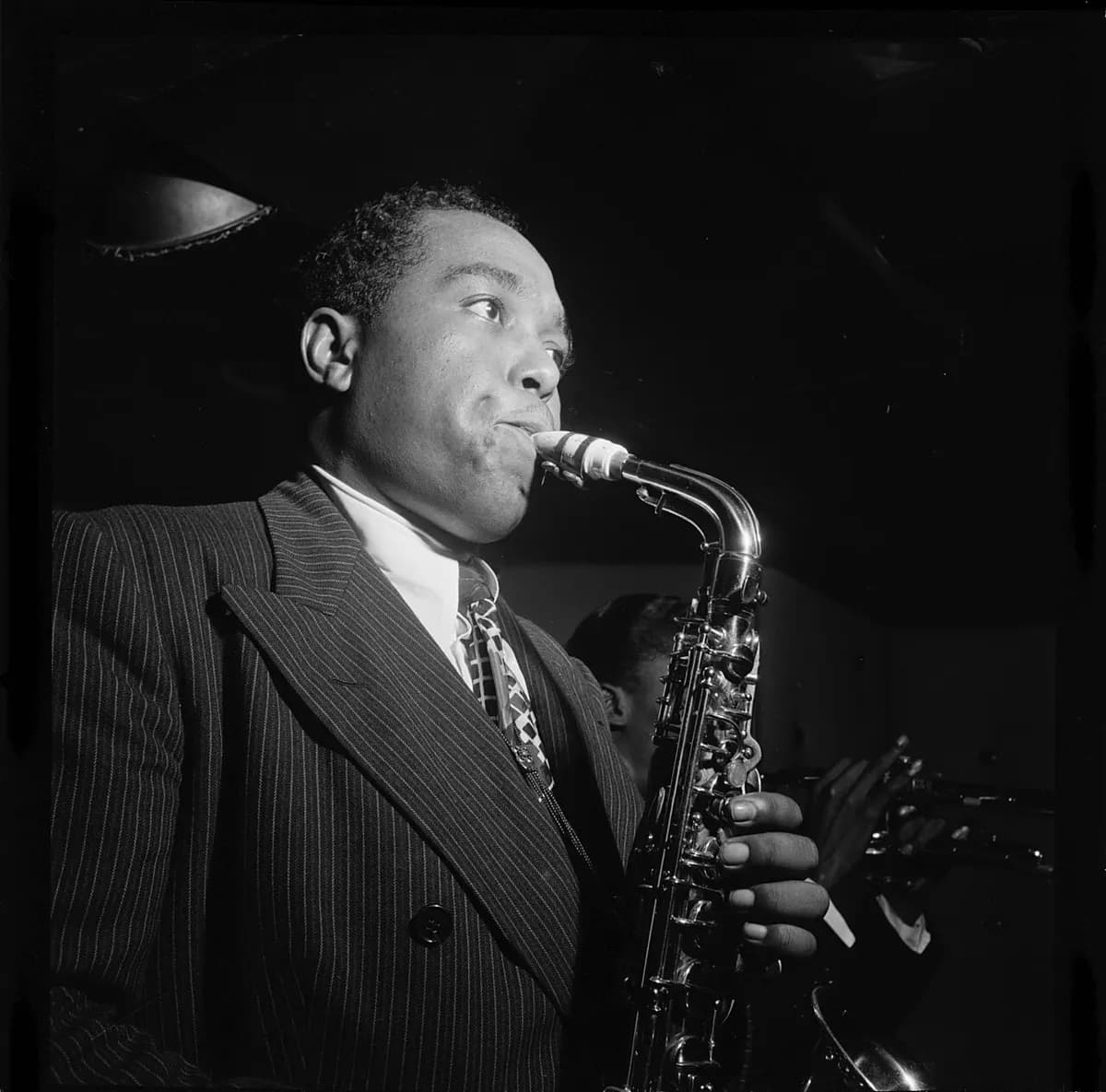
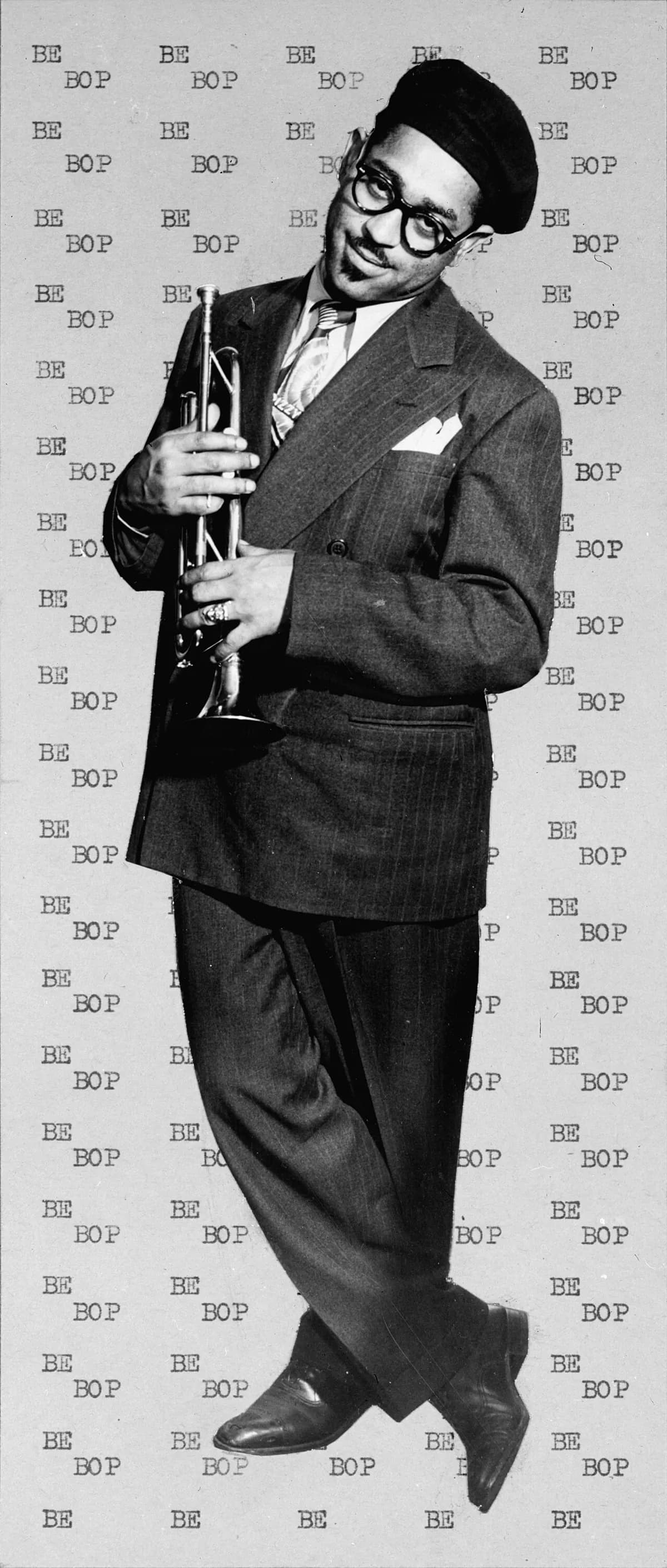
Bebop was worked out after hours. During the early 1940s, musicians finishing their paid big-band jobs gathered at two Harlem clubs, Minton's Playhouse and Monroe's Uptown House, for jam sessions where the regulars reharmonised standards and played fast tempos to discourage lesser players from sitting in. Thelonious Monk and drummer Kenny Clarke were in the house band at Minton's, Max Roach at Monroe's, and Charlie Parker, Dizzy Gillespie and guitarist Charlie Christian were among those who sat in. Some Minton's sessions from 1941 were recorded informally.
The style's early development is poorly documented for a specific reason: the American Federation of Musicians' strike of 1942–1944 barred its members from recording for the major labels during exactly the years bebop was forming. The first formal bebop recording was made for a small label: "Woody'n You", cut on February 16, 1944, by a Coleman Hawkins group with Gillespie and Max Roach. In 1945 Gillespie recorded "Salt Peanuts" and "Groovin' High", and that November Parker cut "Ko-Ko" for Savoy, so the public heard a largely developed language all at once. Gillespie got the first major-label bebop date in February 1946, when RCA's Bluebird recorded "A Night in Tunisia" and "Anthropology".
Reaction split sharply: to a public used to the dance bands of Benny Goodman and Glenn Miller, the music sounded jarring. By 1946, though, a broad group of New York players had taken it up, among them Fats Navarro, J. J. Johnson, Sonny Stitt and Milt Jackson. Within a decade it had produced its own descendants: hard bop (Art Blakey, Horace Silver, Clifford Brown) brought back blues and gospel feeling, cool jazz (Miles Davis, Gerry Mulligan) lowered the temperature, and modal jazz moved past chord-change improvisation entirely.
Key Characteristics & Sound
What identifies bebop by ear:
- Tempo: often 200–320 BPM, though ballads at 60–80 BPM are part of the repertoire.
- Ensemble: small combo, typically three to six players; no written section work.
- Melody: long, angular eighth-note lines with chromatic approaches and wide intervals.
- Harmony: extended and altered chords, rapid ii–V–I movement, tritone substitutions.
- Form: head–solos–head, usually over 32-bar standards or 12-bar blues.
- Rhythm section: walking bass in quarter notes, ride cymbal carrying the pulse, comping piano.
- Drums: "dropping bombs", irregular bass drum accents that punctuate the music while the ride cymbal keeps time.
The break from swing is visible parameter by parameter:
| Trait | Swing (1935–45) | Bebop (1945–55) |
|---|---|---|
| Ensemble size | 12–25 musicians | 3–6 musicians |
| Tempo | 120–200 BPM | 200–320 BPM |
| Purpose | Dancing | Listening |
| Timekeeping | Bass drum and hi-hat | Ride cymbal |
| Written vs improvised | Mostly arranged | Mostly improvised |
| Harmony | Triads and sevenths | Extensions, alterations, substitutions |
| Audience | Mass, commercial | Small, specialist |
Contrafacts & Rhythm Changes
One of bebop's most characteristic devices is the contrafact: a new melody written over the chord progression of an existing song. Because copyright protected melodies but not chord sequences, musicians could record original compositions over familiar changes without paying royalties. The practice was older than bebop, but bebop made it central.
Two progressions dominate. The changes to Gershwin's "I Got Rhythm", known simply as rhythm changes, underpin Parker's "Anthropology," Gillespie's "Salt Peanuts," and dozens more. The changes to "How High the Moon" produced Parker's "Ornithology." Wikipedia calls rhythm changes "one of the most common vehicles for improvisation", and jazz students still learn to solo over them and over the 12-bar blues at fast tempos.
Instruments & Roles
Bebop kept the instruments of swing and reassigned nearly every role:
- Alto and tenor saxophone: the lead voice, capable of the speed the style demands.
- Trumpet: equal partner in the front line, playing the head in unison with the sax.
- Piano: stopped playing stride patterns and started "comping", sparse and syncopated chords behind the soloist.
- Double bass: the only reliable timekeeper, walking quarter notes throughout.
- Drums: the ride cymbal took over timekeeping, freeing the snare and bass drum for accents and interaction.
- Recording: mostly live in the studio on small labels such as Savoy, Dial and Guild, with little or no editing.
The bass keeps time, the drums comment, the piano punctuates and the horns solo. Most acoustic jazz groups still divide the work this way.
Descendants & Related Styles
Bebop is the root of modern jazz:
- Hard bop: bluesier, gospel-inflected, more grounded (Art Blakey's Jazz Messengers, Horace Silver).
- Cool jazz: softer tone, slower tempos, arranged textures (Miles Davis's Birth of the Cool, Gerry Mulligan).
- Modal jazz: improvisation over scales, with few chord changes (Kind of Blue).
- Post-bop: the 1960s synthesis of bebop vocabulary with modal and free approaches.
- Free jazz: the rejection of fixed harmony altogether (Ornette Coleman, late Coltrane).
- Latin jazz: bebop harmony over Afro-Cuban rhythm, born from Gillespie's collaborations.
- Jazz fusion: the electric response two decades later.
Notable Musicians & Recordings
The core of the repertoire:
- Charlie Parker: "Ko-Ko," "Ornithology," "Confirmation," "Now's the Time."
- Dizzy Gillespie: "Salt Peanuts," "A Night in Tunisia," "Groovin' High."
- Thelonious Monk: "Round Midnight," "Straight, No Chaser."
- Bud Powell: "Un Poco Loco," "Tempus Fugit."
- Max Roach & Clifford Brown: Study in Brown (1955).
- Dexter Gordon: an early bebop tenor player; "Cheese Cake" from Go! (1962) shows his later hard-bop sound.
- Sonny Stitt, J.J. Johnson, Fats Navarro: part of the New York bebop movement by 1946.
- The Quintet: Jazz at Massey Hall (1953), Parker, Gillespie, Powell, Mingus, and Roach on one stage.
Start with "Ko-Ko" for the speed, "A Night in Tunisia" for the Latin rhythm in its theme, and "Round Midnight" for Monk's harmony.
How AI Detects Bebop
Bebop gives a classifier a clear acoustic profile: acoustic instruments, a very high onset rate from fast eighth-note lines, a continuous ride cymbal in the high frequencies, walking bass in steady quarter notes and swung eighth notes. Tempo estimates are less reliable. Automated tools often report "Ko-Ko" at about 150 BPM, half the roughly 300 BPM that transcribers count, because they lock onto every other beat.
The harder distinction is within jazz itself. Bebop, hard bop and post-bop share instrumentation and differ mainly in tempo, harmonic density and feel. Genre AI has a Bebop label but none for hard bop or post-bop, so all three are likely to land under Jazz, with Bebop or one of its siblings as the subgenre. Test your own recordings in the Genre AI music genre detector and read how AI music genre detection works for why sibling styles collapse together.
Bebop is one of the few styles in this guide with its own label in Genre AI: it is a subgenre of the coarse Jazz category, next to Big Band / Swing, Contemporary Jazz, Easy Listening, Fusion, Latin Jazz and Smooth Jazz. The answer always names one of those subgenres, so you will not get plain "Jazz" on its own. Fast small-combo recordings with a prominent ride cymbal, walking bass and dense horn lines are the most likely to come back as Bebop. A slower tempo and a fuller, arranged sound may move the result to Big Band / Swing (see swing); congas and clave may pull it to Latin Jazz, and electric instruments to Fusion (see jazz fusion). One quirk: the label prompts list "hard bop" under Rock's Hard Rock subgenre, not under Jazz, so the model's text side does not treat hard bop as a Bebop relative.