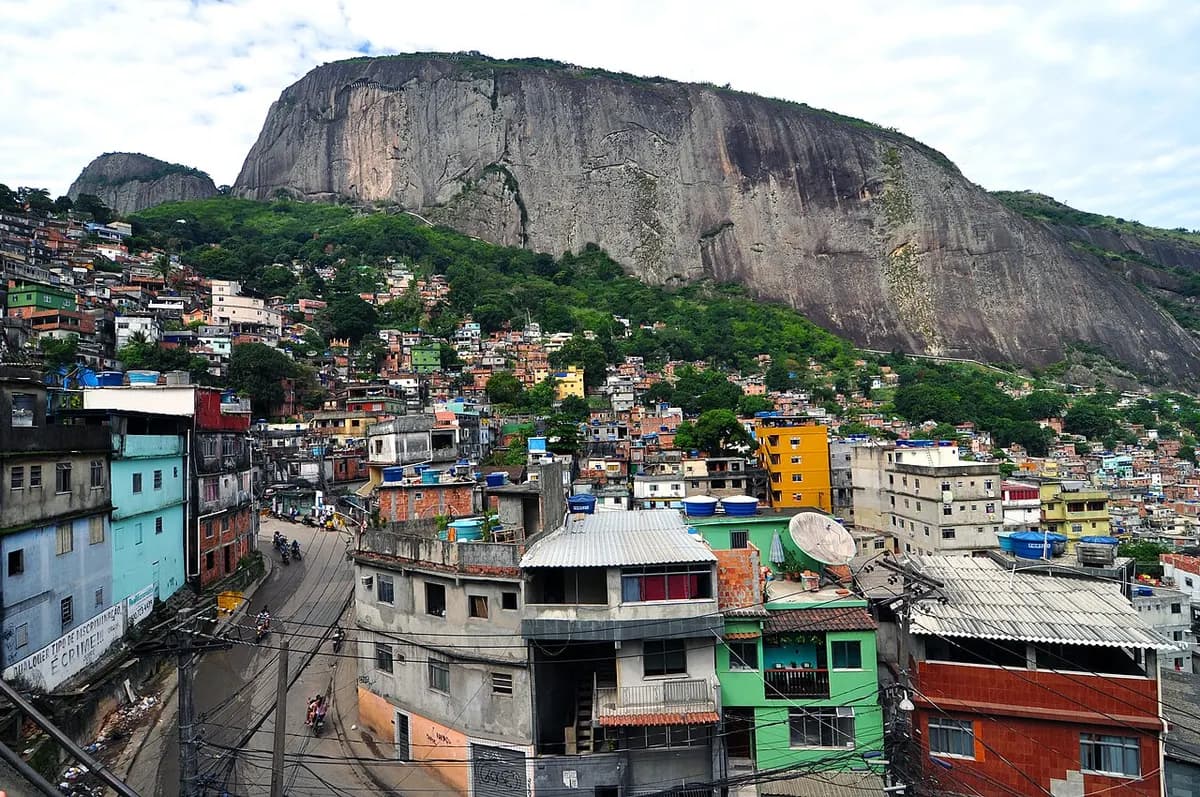
Brazilian funk (in Brazil funk carioca or simply funk, abroad often baile funk) is an electronic dance and rap genre born at the bailes, the dance parties of Rio de Janeiro's favelas, in the late 1980s. It began as Portuguese-language rapping over imported Miami bass records. In the late 1990s it found its own beat, the tamborzão, a drum pattern drawn from Afro-Brazilian percussion, and it has since split into regional and tempo-based styles, from São Paulo's funk ostentação to Recife's brega funk and Rio's 150 BPM sound. MCs chant, rap and half-sing over loud, repetitive, bass-heavy beats made for large sound systems.
Despite the name, it has almost nothing in common with American funk: no live band, no slap bass, no horn section. This hub goes deeper into its history, styles, production and artists; for a shorter primer, read our blog post What Is Brazilian Funk?. To hear how a baile track reads to a machine, drop a clip into our free AI music genre detector.
What Is Brazilian Funk?
Brazilian funk is party music made with drum machines, samplers and laptops, not with a band. A typical track has a loud, syncopated percussion loop, a short repeating vocal hook, one or more MCs delivering chanted or rapped lines in Brazilian Portuguese, and very little else. Melody is secondary; the groove, the shouted refrain and the crowd's response carry the track. Lyrics range from party and dance instructions to romance, explicit sex (funk putaria), bragging about money and brands, and descriptions of favela life.
The name is a historical accident. In the 1970s Rio's Black youth danced to American soul and funk records at huge parties in the city's north zone, and the parties, and later everything played at them, kept the name "funk" after the music had changed completely. By the end of the 1980s the records at the bailes were Miami bass, the fast, booming Florida offshoot of electro and hip-hop, and local MCs started rapping over them in Portuguese.
Today "funk" in Brazil is a wide umbrella. It is one of the most popular genres in the country, regularly shares the top of the domestic streaming charts with sertanejo, and has spawned styles that sound quite different from one another. They are tied together by a shared lineage (the baile, the MC and the drum-machine groove), not by one tempo or rhythm.
History & Origins
The roots lie in the Black Rio scene of the 1970s, when sound-system crews known as equipes, among them Soul Grand Prix and Furacão 2000, threw enormous dances playing James Brown, soul and disco to audiences in Rio's suburbs. Through the 1980s the music on those systems followed American trends into electro and then Miami bass, and records by acts such as 2 Live Crew became staples. A drum track from Battery Brain's 1988 single "8 Volt Mix", known in Brazil simply as the Volt Mix, was reused under so many early raps that it served as a shared backing beat for the whole scene.
The shift to a Brazilian genre came at the end of the decade. DJ Marlboro's album Funk Brasil (1989), with Portuguese-language tracks over Miami bass-style beats, is usually named as the record that turned an imported sound into a local one. Through the 1990s the bailes became the main weekend culture of the favelas, drawing thousands of dancers a night. Two very different currents emerged: the romantic, radio-friendly funk melody of duos such as Claudinho & Buchecha, and proibidão ("very forbidden"), raw tracks praising or describing the drug factions that controlled many communities, sold unofficially and frequently targeted by police and courts.
Around the turn of the 2000s producers replaced the borrowed Miami bass loop with the tamborzão, a heavier, rolling beat built from samples of Afro-Brazilian drums and the rhythms of candomblé and maculelê; it is commonly credited to DJ Luciano Oliveira, around 1998. It gave the genre the sound most people now recognise. The early 2000s brought national hits from Bonde do Tigrão, outspoken female MCs such as Tati Quebra Barraco and Deize Tigrona, and attention abroad: DJs including Diplo played baile funk in foreign clubs, M.I.A.'s "Bucky Done Gun" (2005) was built on the style, and the documentary Favela on Blast (2008), made by Leandro HBL with Diplo, showed the bailes to audiences outside Brazil.
From the late 2000s the scene spread beyond Rio. In São Paulo, funk ostentação ("show-off funk") rapped about cars, brands and money in slick videos, and MC Guimê became its best-known face. KondZilla, the YouTube channel of director Konrad Dantas, built its audience on funk videos and in February 2018 became the most-subscribed channel in Brazil. Anitta, who started out in Rio's funk scene, broke into the mainstream with "Show das Poderosas" (2013) and went on to an international pop career; Ludmilla, MC Kevinho ("Olha a Explosão", 2016) and MC Fioti followed. Fioti's "Bum Bum Tam Tam" (2017) is built around a flute line from J.S. Bach's Partita for solo flute. Later in the decade Rio producers sped the tamborzão up to around 150 BPM, creating the frantic funk 150 sound, while São Paulo developed the minimal, distorted mandelão and Recife's brega funk crossed into the national charts.
In the 2020s Brazilian funk travelled further online. Distorted São Paulo "montagem" and automotivo tracks fed directly into Brazilian phonk, a viral offshoot of phonk heard across short-video platforms, and funk producers and MCs began collaborating regularly with reggaeton, Afrobeats and pop stars abroad.
Key Characteristics & Sound
What marks a Brazilian funk track:
- Tempo: classic tamborzão funk sits around 125–135 BPM; funk 150 runs at about 150 BPM; São Paulo styles vary and often feel half-time over a fast pulse.
- Rhythm: the tamborzão, a syncopated loop of booming low drum, sharp tom and clap or snare hits, in place of a straight four-on-the-floor kick. Earlier tracks use the Miami bass and Volt Mix patterns.
- Bass: enormous 808-style sub-bass hits, often doubled with the kick and pushed to the point of distortion.
- Vocals: MCs who chant, rap and sing in Brazilian Portuguese, frequently in call-and-response with the crowd; short, repeated hooks; vocal chops and shouted samples used as percussion.
- Harmony: minimal. A single synth stab, a looped sample or a one-note bass is often all there is, and many tracks have almost no chord changes.
- Production: loud, raw, heavily compressed and deliberately unpolished; samples from anywhere, including classical music, TV and other funk tracks ("montagem" collages).
The main styles under the umbrella:
| Style | Where | Approx. tempo | What defines it |
|---|---|---|---|
| Early funk carioca (Volt Mix era) | Rio de Janeiro, late 1980s–1990s | ≈125–130 BPM | Portuguese raps over Miami bass loops |
| Funk melody | Rio, 1990s–2000s | ≈125–130 BPM | Sung, romantic, radio-friendly |
| Proibidão | Rio, 1990s– | ≈125–135 BPM | Lyrics about drug factions; circulated unofficially |
| Tamborzão funk | Rio, late 1990s– | ≈130 BPM | Afro-Brazilian drum samples, heavy groove |
| Funk ostentação | São Paulo, late 2000s–2010s | ≈125–130 BPM | Lyrics about money, cars and brands; glossy videos |
| Funk 150 BPM | Rio, late 2010s– | ≈150 BPM | Accelerated tamborzão, frantic energy |
| Mandelão / automotivo | São Paulo, 2010s–2020s | Varies, often ≈130 BPM | Minimal, distorted, repetitive; feeds Brazilian phonk |
| Brega funk | Recife, 2010s– | Slower, swinging groove | Fuses brega romantic pop with funk beats |
Production & Instruments
Brazilian funk has always been do-it-yourself music. The first productions used drum machines and cheap samplers to loop Miami bass records; from the 2000s onward almost everything has been made in software such as FL Studio, often on modest home computers, and passed straight to sound systems, to CDs sold at street markets and later to YouTube and streaming. Because anyone with a computer can make a track, new styles appear quickly.
The essential ingredients are a strong percussion loop, a booming sub-bass, a vocal hook and an MC. Producers sample heavily: TV themes, pop songs, classical pieces and other funk records are chopped into short phrases and repeated. Vocals are processed to be loud and upfront, sometimes clipped, with few effects for their own sake. On a baile sound system that bare arrangement works in the track's favour, because every element is built to be felt in the body at high volume.
Key Artists & Records
- DJ Marlboro: producer and DJ whose Funk Brasil albums (from 1989) defined the early Portuguese-language sound.
- Claudinho & Buchecha: the duo that took funk melody to national radio in the 1990s.
- MC Marcinho: leading voice of romantic funk melody.
- Bonde do Tigrão: early-2000s party-funk hitmakers.
- Tati Quebra Barraco and Deize Tigrona: outspoken female MCs who challenged the scene's gender politics.
- MC Guimê: the face of São Paulo's funk ostentação.
- Anitta: from the Rio funk scene to international pop; "Show das Poderosas" (2013).
- Ludmilla: Rio MC who became a major pop and funk star.
- MC Kevinho: "Olha a Explosão" (2016).
- MC Fioti: "Bum Bum Tam Tam" (2017), built on a Bach flute sample.
- Pedro Sampaio: DJ-producer behind many 2020s funk crossover hits.
Brazilian Funk vs American Funk, Miami Bass and Reggaeton
Most confusion around the genre comes from three comparisons: the name, the origin and the closest modern relative.
| Trait | Brazilian funk | American funk | Miami bass | Reggaeton |
|---|---|---|---|---|
| Origin | Rio de Janeiro, late 1980s | USA, mid-1960s | Miami, mid-1980s | Puerto Rico and Panama, 1990s |
| Made with | Drum machines, samplers, laptops | Live band: bass, guitar, drums, horns | Roland TR-808, samplers | Drum machines, dembow riddim |
| Tempo | ≈125–135 BPM; 150 BPM style | ≈95–120 BPM | ≈125–135 BPM | ≈88–100 BPM |
| Rhythm | Tamborzão: syncopated Afro-Brazilian drum loop | Syncopated groove on "the one" | Booming 808 kick, fast hi-hats | Dembow: kick plus syncopated snare |
| Vocals | Portuguese MCs, chants and hooks | Sung, with call-and-response | Rapped party chants | Spanish rap and singing |
Culture, Controversy and Legacy
Brazilian funk has always carried social weight beyond the music. The bailes are among the largest regular gatherings of young people in Brazil, and for decades the genre has been both a source of income and pride for favela communities and a target of moral panic, police raids and attempts at legal restriction. Arguments about explicit lyrics, about proibidão's links to criminal factions and about the policing of bailes recur throughout its history. Funk has also become an export: its rhythms turn up in international pop, its producers work with reggaeton and Afrobeats stars, and the Brazilian phonk wave introduced its distorted São Paulo strand to listeners who had never heard the word "baile".
Within Brazil, it sits alongside very different traditions (the songwriting of MPB, the percussion of samba and the country-pop of sertanejo), and in the big cities it is often the music young listeners identify with most strongly.
For an audio classifier such as Genre AI, Brazilian funk is a name trap. The live taxonomy has no funk carioca label, and its Funk / Soul family describes American band funk, a sound with almost nothing in common with a baile track. Judged on the audio, the model should respond to what is actually there: syncopated drum-machine percussion, huge sub-bass and chanted vocals in a Romance language. That profile sits closest to Latin (reggaeton shares much of the percussion and vocal style) or Rap Hip-Hop, while 150 BPM and distorted mandelão tracks can drift toward Electronic Dance labels such as Breakbeat / Drum & Bass or Electro, where the Miami bass ancestry shows. A Funk result on a baile track is therefore a misreading, and it says nothing about a shared musical lineage.