Deathcore is the collision of death metal and metalcore: blast beats, tremolo-picked riffs and guttural growls from one side, the slowed-down, syncopated breakdown from the other. It took shape in North America in the first half of the 2000s, exploded through MySpace around 2006–2009 with bands such as Suicide Silence, Whitechapel and Job for a Cowboy, and returned in the 2020s at a larger scale with Lorna Shore and Slaughter to Prevail.
This guide covers where it came from, what a deathcore song is built of, how it differs from the two parents, its main branches, and the records worth hearing. If you are not sure whether a track is deathcore, death metal or metalcore, drop a clip into our free AI music genre detector and look at the alternatives it lists.
What Is Deathcore?
Deathcore takes the sonic extremity of death metal (down-tuned guitars, blast-beat drumming, low growled vocals) and arranges it the way hardcore and metalcore bands arrange songs: around the breakdown. A breakdown is the moment the tempo drops to half-time or slower, the guitars switch to staccato, palm-muted chugs on the lowest string, and the drums lock to them with the kick and a crash or china cymbal. In deathcore the breakdown is often the point of the song, with the rest of it built to lead there.
The result has a recognisable shape: fast, blasting passages that sound like death metal, followed by sudden drops into crushing, syncopated grooves that are the genre's signature. The vocals range across the whole harsh spectrum in a single song: guttural lows, mid-range screams, high shrieks and, in the genre's early years especially, "pig squeals" and other inhaled noises.
Melody is usually secondary. Where metalcore leans on clean sung choruses, classic deathcore avoids clean vocals almost entirely; the modern symphonic wing adds orchestral and choral layers, still without sung hooks.
History & Origins
The ingredients were in place by the late 1990s. American death metal, especially the brutal, groove-heavy style of bands such as Suffocation, Dying Fetus and Cannibal Corpse, supplied the riffs, the blast beats and the vocal register. The metalcore and beatdown hardcore scenes supplied the breakdown. A handful of bands combined the two early, and Despised Icon from Montreal, whose debut Consumed by Your Poison appeared in 2002, are usually cited among the first to sound recognisably like the later genre.
The scene coalesced in the United States in the mid-2000s, particularly in Southern California and Arizona. Suicide Silence, formed in Riverside, California in 2002, released The Cleansing in 2007 and No Time to Bleed in 2009, and frontman Mitch Lucker became the genre's defining voice and image. Job for a Cowboy, from Glendale, Arizona, spread its Doom EP (2005) almost entirely through MySpace, then moved towards straight death metal on Genesis (2007). Whitechapel, from Knoxville, Tennessee and named after the London district of the Jack the Ripper murders, released The Somatic Defilement in 2007 and This Is Exile in 2008 with a three-guitar line-up. Carnifex in San Diego, Chelsea Grin in Salt Lake City, Emmure, All Shall Perish, Bring Me the Horizon on its debut Count Your Blessings (2006), and Born of Osiris and Veil of Maya around Chicago filled out a fast-growing circuit.
That growth ran on MySpace, all-ages venues and labels such as Sumerian Records, Metal Blade and Century Media. It also produced a backlash: older death metal fans dismissed the style as breakdown-driven and image-led, and "deathcore" was frequently used as an insult. Several founding bands, most visibly Job for a Cowboy and Bring Me the Horizon, moved away from the label within a few years.
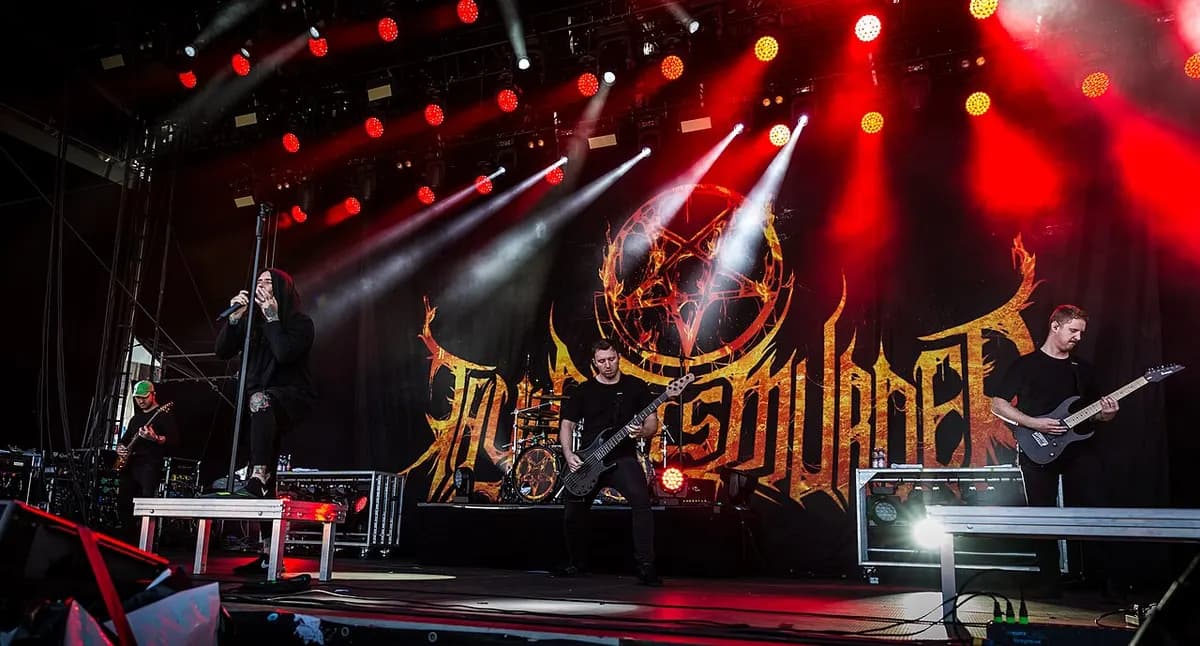
On 1 November 2012 Mitch Lucker died of injuries from a motorcycle crash in Huntington Beach the night before; he was 28. By then deathcore had also become international: Thy Art Is Murder from Blacktown in Sydney released Hate (2012), and Slaughter to Prevail, formed in Yekaterinburg in 2014 and fronted by Alex Terrible, built a large online following through the late 2010s.
The 2020s revival was led by Lorna Shore from New Jersey. With vocalist Will Ramos, the single "To the Hellfire" (June 2021) and the EP ...And I Return to Nothingness (2021) spread widely online and pulled in listeners who had never followed extreme metal; the album Pain Remains (2022) followed. Their blackened, symphonic version of deathcore, with orchestral layers, blast beats and a vocalist who switches between many harsh techniques, is the version of the genre that "To the Hellfire" carried to a wider audience, alongside bands such as Shadow of Intent and Fit for an Autopsy.
Key Characteristics & Sound
What identifies a deathcore track:
- Tempo: blast sections at roughly 180–240 BPM, breakdowns in half-time or slower, so the felt tempo can fall to the equivalent of 60–90 BPM in a single bar.
- Breakdowns: the structural centre; often several per song, each heavier or slower than the last, with the final one saved for the end.
- Blast beats and double kick: taken from death metal, played with very tight, triggered kick drums.
- Tuning: drop A, G or lower on seven-string guitars, with some bands going lower still on eight-strings.
- Riffs: mix of tremolo-picked death metal lines, chromatic dissonance and single-string chug patterns; pinch harmonics and "bree"-style squeals are common accents.
- Vocals: guttural lows alternating with high screams; pig squeals and gutturals in the early wave; increasingly theatrical range in the modern wave.
- Production: very loud, compressed and precise, with edited drums, sample-reinforced kicks and a dense low end.
- Atmosphere layers: in the modern wave, synth pads, choirs and orchestral parts sit beneath the guitars.
How it compares with its parents:
| Trait | Deathcore | Death Metal | Metalcore |
|---|---|---|---|
| Emerged | Early–mid 2000s | Mid-1980s | Early 1990s |
| Typical BPM | 180–240 blasts, half-time breakdowns | 160–240 | 130–190 |
| Song centre | The breakdown | Riff sequence | Chorus + breakdown |
| Vocals | Lows, highs, squeals | Guttural growl | Screams + clean chorus |
| Clean vocals | Rare | Almost never | Standard |
| Tuning | Drop A–G or lower | D–B standard | Drop C–drop A |
| Reference | Whitechapel, Lorna Shore | Morbid Angel, Death | Killswitch Engage |
Instruments & Production
Deathcore is a modern-studio genre, and its records sound the way they do because of a handful of choices:
- Seven- and eight-string guitars in very low tunings, with high-gain amps or modellers and tight noise gates so breakdown chugs stop dead.
- Triggered and replaced drums. Kick drums in particular are reinforced with samples so every hit in a blast or a breakdown reads with the same attack; snares are often layered too.
- Bass doubling the guitars and often supplemented on breakdowns with low sub drops: a sine-wave "boom" borrowed from electronic music.
- Vocal layering: lows and highs stacked or alternated line by line, sometimes by two vocalists, sometimes by one performer tracking both.
- Orchestration and synths in the symphonic and blackened wing: strings, brass, choirs and pads, mostly from sample libraries.
- Heavy bus compression and limiting, which produces the genre's wall-like loudness.
The producer name most associated with the early scene is Joey Sturgis, whose clean, quantised and sample-heavy approach shaped many metalcore and deathcore records of the late 2000s and early 2010s.
Subgenres & Branches
The main directions:
- Classic / MySpace-era deathcore: the 2006–2010 sound of Suicide Silence, Whitechapel, Carnifex, Chelsea Grin.
- Blackened deathcore: tremolo melodies and atmosphere from black metal, as in Lorna Shore, Carnifex on its later records, Make Them Suffer in its early period.
- Symphonic deathcore: orchestra and choir as core instruments, as in Shadow of Intent and Lorna Shore.
- Downtempo deathcore: the breakdown stretched into whole songs at crawling speed, as in Black Tongue and Traitors.
- Technical / progressive deathcore: odd metres and djent-style syncopation in Born of Osiris, Veil of Maya, After the Burial, Rings of Saturn at the extreme technical end.
- Slam-influenced deathcore: borrowing the lurching grooves of slamming brutal death metal.
For how these sit in the wider metal tree, see our guide to metal subgenres.
Key Bands & Records
A short listening path:
- Despised Icon: Consumed by Your Poison (2002), The Ills of Modern Man (2007).
- Job for a Cowboy: Doom EP (2005), the MySpace landmark.
- Suicide Silence: The Cleansing (2007), No Time to Bleed (2009).
- Whitechapel: This Is Exile (2008); The Valley (2019) for their later, more melodic side.
- Carnifex: Dead in My Arms (2007).
- Bring Me the Horizon: Count Your Blessings (2006), before their move to metalcore and rock.
- Chelsea Grin: Desolation of Eden (2010).
- Thy Art Is Murder: Hate (2012).
- Lorna Shore: ...And I Return to Nothingness EP (2021) with "To the Hellfire"; Pain Remains (2022).
- Slaughter to Prevail: Kostolom (2021).
Deathcore vs Death Metal vs Metalcore
The boundaries are blurred by design, but each comparison has a practical test:
- Against death metal: both blast and growl. Death metal organises a song as a chain of riffs and rarely stops for a half-time chug section; deathcore builds towards breakdowns and treats them as the payoff. Deathcore is also tuned lower and produced more tightly.
- Against metalcore: both have breakdowns. Metalcore pairs them with harmonised melodic riffing and a clean sung chorus; deathcore replaces the chorus with blast beats, guttural vocals and dissonance.
- Against grindcore: grindcore is short, raw and chaotic, with songs often under a minute; deathcore songs are longer, polished and structured around grooves.
A quick rule of thumb: if the heaviest moment of the song is a slow, syncopated chug under a guttural vocal and there is no sung chorus anywhere, you are almost certainly listening to deathcore.
Genre AI's taxonomy has no separate deathcore label, though the word itself is one of the text prompts of the Death Metal label. A deathcore track is likely to resolve to Metal at the top level, and the fine-grained choice is then between its two parents. The model averages several 18-second windows taken from the body of the track, skipping the first and last 12 seconds, so the balance of blast passages and breakdowns in that stretch matters. A blast-beat passage with tremolo riffing and a guttural vocal has the cues of Death Metal; a breakdown, half-time and chugging, with a crash on every accent, is closer to Metalcore. Because the alternatives are sibling Metal labels, the runner-up between those two is often the most informative part of the result. Symphonic deathcore is the harder case: long orchestral passages may tip the answer to Classical if that family ranks above Metal, while Soundtrack, a coarse label without subgenres, is unlikely to come up.