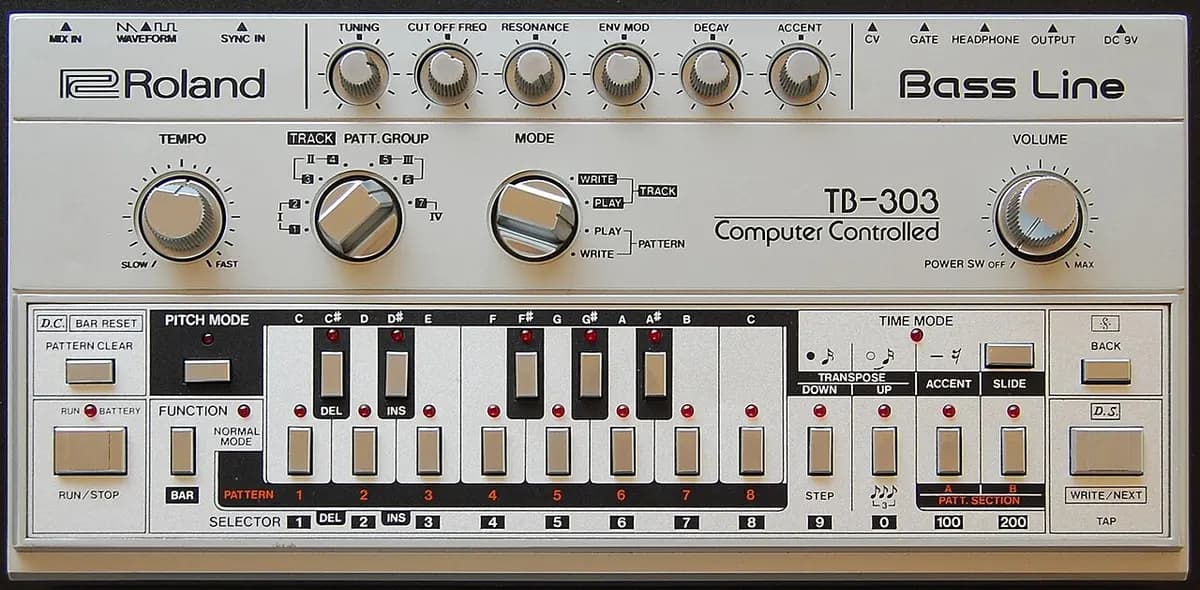
Acid house is the strand of house music built around one instrument: the Roland TB-303, a commercially failed bass machine that Chicago producers rewired into the squelching, morphing lead sound the genre is named after. Its first records were released in Chicago in 1986–87, and two years later it was the soundtrack of Britain's Second Summer of Love.
This guide covers what acid house is, how the 303 was rediscovered, the 118–130 BPM records that defined it, the British rave explosion and the moral panic that followed, and the acid variants that grew out of techno and trance. Curious how a model hears a 303 line? Play a few seconds into our free AI music genre detector.
What Is Acid House?
Acid house is Chicago house with a Roland TB-303 as the lead voice. Underneath sits standard house architecture: a four-on-the-floor kick at 118–130 BPM, TR-707 or TR-909 hi-hats and claps, and a repetitive, hypnotic arrangement. On top, a 303 pattern runs continuously while the producer moves its cutoff, resonance, envelope, and accent controls in real time, turning a fixed sequence into a constantly mutating sound.
That performance element is the genre's core idea. The notes rarely change; the timbre changes constantly. A typical acid track is one riff reshaped for six minutes or more, and the tension comes from the filter sweep. Harmony and arrangement barely move. Tracks are usually instrumental, with vocals limited to short chants or samples.
The TB-303: A Failure That Made a Genre
Roland released the TB-303 Bass Line in 1981 as a small silver box meant to stand in for a bass player, for example when a guitarist rehearsed alone. It was awkward to program, sounded nothing like a bass guitar, and sold poorly. Roland discontinued it in 1984 after about 10,000 units, and second-hand examples turned up in Chicago pawn shops for very little money.
The rediscovery is usually credited to Phuture (DJ Pierre, Earl "Spanky" Smith Jr. and Herbert "Herb J" Jackson), who obtained one, could not work out how it was meant to be used, and began twisting the controls while a sequence played. The result was "Acid Tracks," a twelve-minute exercise in filter modulation. Ron Hardy was playing an early version at the Music Box in 1985; Trax released it in 1987, with Marshall Jefferson credited as producer. The 303's resonant low-pass filter, accent, and slide functions, designed to imitate a bassist's articulation, turned out to be the perfect controls for building tension on a dancefloor.
Originals now sell for thousands, and the sound has been rebuilt in many clones and plugins. Roland made its own successors: the TB-3 in 2014 and the compact TB-03 in 2017.
History & Origins
Acid house was made in Chicago in 1985–1988, within the same scene and often by the same people as house itself. Alongside Phuture's "Acid Tracks," the founding records include Sleezy D's "I've Lost Control" (produced with Marshall Jefferson), Adonis's "No Way Back," Armando's "Land of Confusion," and Bam Bam's "Where's Your Child?"; several of them came out on Trax.
Britain is where it became a mass movement. After a 1987 trip to Ibiza, the DJs Danny Rampling, Paul Oakenfold and Nicky Holloway started London nights such as Shoom and The Trip, playing Chicago imports alongside Balearic records. Acid house, MDMA and the smiley face logo came together in the Second Summer of Love of 1988 and 1989, which brought large illegal warehouse and field raves and a long-running tabloid panic.
The political consequence was durable: after a decade of confrontation over unlicensed raves, the UK's Criminal Justice and Public Order Act 1994 gave police powers to shut down gatherings playing music "wholly or predominantly characterised by the emission of a succession of repetitive beats". It is a rare case of a law defining a kind of music.
Musically the 303 moved on. Acid techno grew in London and continental Europe, acid trance followed in the 1990s, and the sound now turns up in styles from hard techno to electronica; acid lines have been common again in club music since the mid-2010s.
Key Characteristics & Sound
What identifies an acid house record:
- The 303: a continuously modulated resonant filter sweep (the "squelch") as the lead element.
- Tempo: 118–130 BPM, sitting squarely in house territory.
- Drums: four-on-the-floor kick with TR-707/909 hats and claps; dry and unfussy.
- Arrangement: minimal and repetitive; changes come from knob movement, not new sections.
- Harmony: often a single key or mode; the 303 line supplies both bass and melody.
- Vocals: usually absent, or a short repeated chant or sample.
- Length: long; the original "Acid Tracks" runs about twelve minutes.
The 303 travelled far beyond house, and the variants are distinguished mostly by tempo and drum treatment:
| Style | Typical BPM | Drums | Character |
|---|---|---|---|
| Acid house | 118–130 | TR-707/909, dry | Hypnotic, playful, raw |
| Acid techno | 130–145 | Hard, distorted | Relentless, London/Euro squat scene |
| Acid trance | 135–145 | Punchy, big reverb | Melodic builds around the 303 |
| Hard acid / hardcore | 150–180 | Distorted kicks | Aggressive, rave-derived |
| Modern acid revival | 120–135 | Clean, sub-heavy | Retro-facing club material |
Notable Artists & Tracks
The essential records:
- Phuture: "Acid Tracks" (1987), the record that named the style.
- Sleezy D: "I've Lost Control" (1986).
- Adonis: "No Way Back" (1986).
- Armando: "Land of Confusion," "100% of Dis Now."
- Bam Bam: "Where's Your Child?"
- A Guy Called Gerald: "Voodoo Ray" (1988), from Manchester.
- 808 State: "Pacific State" (1989).
- Fast Eddie: "Acid Thunder."
- Hardfloor: "Acperience 1" (1992), from Germany.
- Josh Wink: "Higher State of Consciousness" (1995).
- Plastikman: Sheet One (1993), acid pushed toward minimal techno.
Start with "Acid Tracks," "Voodoo Ray," and "Acperience 1" to hear Chicago, Manchester and Germany in turn.
Related Styles
Acid is as much a technique as a genre, and it turns up in several:
- Chicago house: the parent style, same city and often the same producers.
- Acid techno: faster and harder, associated with London's 1990s squat party scene.
- Acid trance: 303 lines inside big melodic trance structures.
- Balearic and Madchester: the British crossover into indie and pop (Happy Mondays, and Primal Scream's Screamadelica).
- Braindance / IDM: Aphex Twin and Luke Vibert's more abstract 303 work.
- Hard techno and hardcore, where acid lines sit over distorted kicks.
How AI Detects Acid House
Acid house gives a classifier an unusually clear timbral cue. The 303's resonant filter produces a strong, continuously moving spectral peak, a resonance that slides up and down across the harmonic series while the note pattern stays fixed. That behaviour is unusual: most instruments change pitch and keep timbre, and the 303 does the opposite.
The genre boundary is fuzzier than the sound: a 303 over a faster, distorted kick is techno, over trance builds it is trance, and the model has to weigh drums and tempo alongside the acid line. Test your own records in the Genre AI music genre detector and read how AI music genre detection works for the mechanics.
Testing this style in Genre AI ourselves, Acid House reads most confidently at 120–128 BPM when a moving resonant filter line sits over dry four-on-the-floor drums. The 303's sweep is one of the easier textures for a model to latch onto, but the label it lands on depends on everything around it: harden and speed the drums and the same acid line returns Techno or Hard Techno; add big melodic breakdowns and it goes to Trance; keep the drums soft and swung and it settles on House. Acid is a technique before it is a genre, and the classifier reflects that.