
J-pop is the mainstream popular music of Japan. The label was invented by a Tokyo radio station in 1988, and today it covers idol groups, anime themes, Vocaloid producers and stadium rock bands alike. Japan is the world's second-largest music market, and for most of its history J-pop was made almost entirely for listeners at home.
Below: where J-pop came from, why it sounds harmonically busier than Western pop, how idol culture and anime shaped it, and how it differs from K-pop. To see what a classifier makes of a track, run a few seconds through our free AI music genre detector.
What Is J-Pop?
J-pop is less a single style than the Japanese equivalent of the word "pop": commercially released popular music sung mostly in Japanese, from rock bands and R&B singers to electronic producers and idol groups. Tempos usually sit between 110 and 180 BPM. Arrangements are dense and brightly mixed, with the vocal high and forward.
The clearest difference from Anglo-American pop is how much happens harmonically and structurally. J-pop routinely uses seventh chords, secondary dominants and modulations that Western chart pop avoids. The best-known example is the Royal Road progression (IVM7–V7–iii7–vi), common enough that Japanese listeners know it by name. Songs also pack in more sections. A typical track goes intro, A-melo, B-melo, a big chorus (sabi), an interlude and often a modulated final chorus, all inside four minutes.
English phrases turn up in the lyrics mostly for their sound. Singers aim for clarity and a high register; the grain and rasp Western pop likes are uncommon.
History & Origins
Before J-pop there was kayōkyoku (歌謡曲), the postwar Japanese popular song, and its sentimental cousin enka. The 1960s Group Sounds boom brought guitar bands after the Beatles' 1966 Tokyo shows; the 1970s brought singer-songwriters (New Music) and, at the end of the decade, two exports that would matter enormously abroad.
The first was Yellow Magic Orchestra (1978–1983), whose synthesizer records were sampled by early American hip-hop and electro producers and influenced techno. The second was city pop by Tatsuro Yamashita, Mariya Takeuchi, Anri and others: glossy, jazz- and funk-inflected music made for a booming urban economy. City pop was largely forgotten until YouTube's recommendation algorithm turned "Plastic Love" into a global phenomenon around 2017.
The name arrived in 1988, when Tokyo station J-Wave needed a term for domestic pop that sounded modern next to the Western records it played. "J-pop" stuck, and the 1990s became its commercial peak. Producer Tetsuya Komuro built a chart empire (trf, globe, Namie Amuro), and rock acts B'z, Mr. Children and Southern All Stars sold in huge numbers. In 1999 Utada Hikaru's First Love became the best-selling album in Japanese history, at over seven million copies.
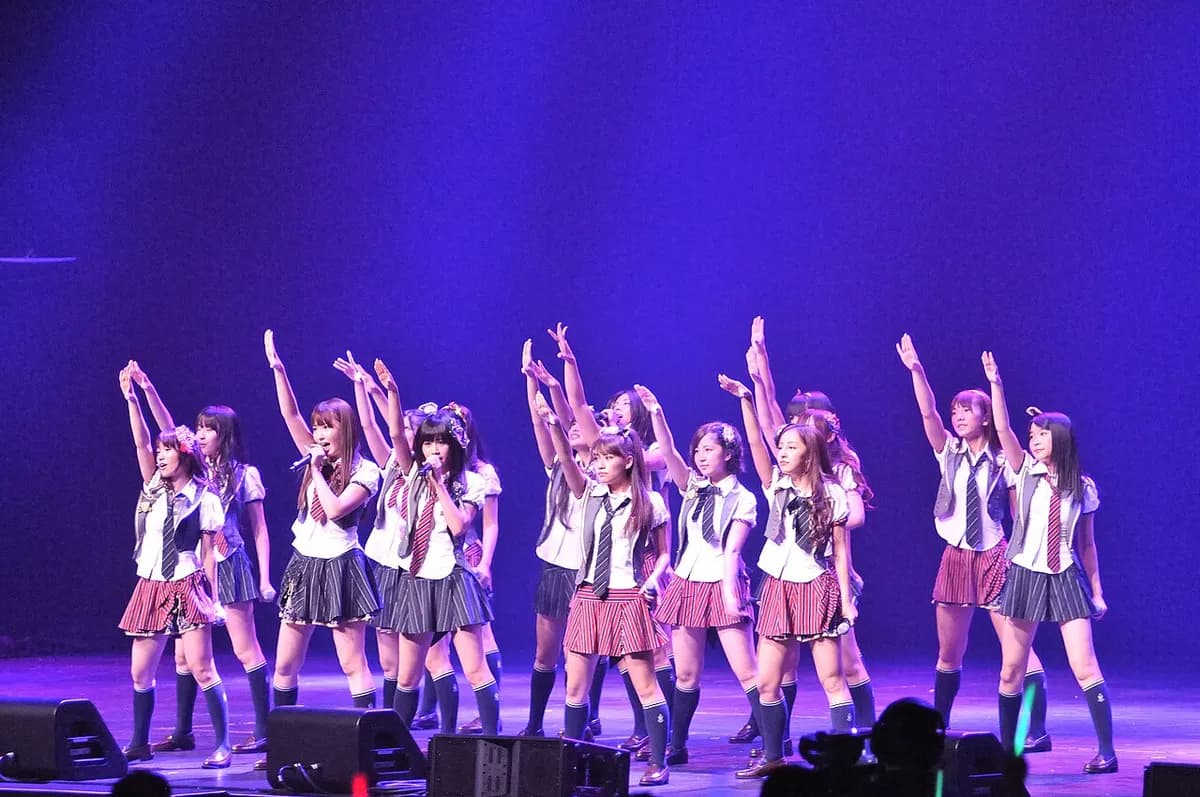
The 2000s and 2010s belonged to idol groups: AKB48 and its regional franchises, Hello! Project, and the male groups of the Johnny's agency. Their business model sold CD singles bundled with event tickets and voting rights, which kept physical sales alive in Japan long after they collapsed elsewhere. Meanwhile Yasutaka Nakata's productions for Perfume and Kyary Pamyu Pamyu pushed a heavily processed technopop. Vocaloid software, above all Hatsune Miku (released in 2007), created a parallel scene of amateur producers whose songs became mainstream hits.
Many of today's chart artists came out of that internet scene. Kenshi Yonezu was a Vocaloid producer before he wrote "Lemon" and Chainsaw Man's "KICK BACK"; YOASOBI adapt published short stories into songs; Ado, Fujii Kaze, Official HIGE DANdism and King Gnu round out the list. Anime tie-ins and TikTok have now given J-pop the international audience its 1990s peak never had.

Key Characteristics & Sound
Recurring musical traits across the genre:
- Tempos of 110–180 BPM, with anime themes and rock-leaning material clustering at the top of that range.
- Seventh chords, secondary dominants, borrowed chords and the Royal Road progression (IVM7–V7–iii7–vi).
- A key change into the final chorus, which is close to a convention.
- Many short sections (intro, A-melo, B-melo, sabi, interlude, final sabi).
- High, clean vocals with precise diction, heavily stacked and doubled.
- Bright, loud, treble-forward mixes with a wide arrangement and busy fills.
- Lyrics in Japanese, with English phrases used as ornament.
How it lines up against K-pop and Western pop:
| Trait | J-Pop | K-Pop | Western Pop |
|---|---|---|---|
| Primary market | Domestic Japan | Global by design | Global |
| Harmony | Dense, jazz-derived | Western pop, EDM-based | Simple, loop-based |
| Sections per song | Many, fast-changing | Many, block-structured | Few, repetitive |
| Tempo | 110–180 BPM | 100–140 BPM | 90–130 BPM |
| Visual focus | Varies; song-led | Choreography-central | Artist image |
| Physical sales | Still significant | Album-collectible driven | Minimal |
| Main export channel | Anime, games | Music video, social | Streaming, radio |
Instruments & Production
J-pop production is maximalist by international standards:
- Live drums, bass and guitars layered over programmed parts, with both kept in the mix.
- Piano and strings, used unironically and often, especially in ballads and anime themes.
- A lead vocal doubled and harmonised extensively; group tracks may carry dozens of voices.
- Vocal processing, from Perfume's fully vocoded sound to the Vocaloid software voices that spawned their own scene.
- Counter-melodies, fills and instrument changes between sections, so silence is rare.
- Mastering, historically very loud and treble-forward, tuned for CD and small speakers.
The split between composer, arranger and lyricist, inherited from kayōkyoku, is still normal, and many hits are written by professional songwriters for a performer. The newer solo artists (Yonezu, Fujii Kaze, Ayase of YOASOBI) write, arrange and produce their own records.

Subgenres & Related Styles
Distinct scenes that live under the J-pop umbrella:
- City pop, the 1970s–80s urban, funk- and jazz-influenced style rediscovered globally in the 2010s.
- Technopop in YMO's lineage, continued by Perfume and Yasutaka Nakata.
- Idol pop, group-based, performance- and fandom-driven (AKB48, Nogizaka46, Hello! Project).
- Anison, meaning anime theme songs, a big commercial category of its own.
- Vocaloid or boku-ka songs built on synthesised voices, distributed on Niconico and YouTube.
- J-rock and visual kei, the band-format J-pop and its theatrical branch (X Japan, One OK Rock, Babymetal).
- Shibuya-kei, the 1990s cosmopolitan, sample-literate scene (Pizzicato Five, Cornelius).
- Enka, the older sentimental ballad tradition J-pop grew away from.
Notable Artists & Tracks
Five decades in ten names:
- Yellow Magic Orchestra: "Firecracker," "Rydeen" (1978–79).
- Mariya Takeuchi: "Plastic Love" (1984).
- Tatsuro Yamashita: "Ride on Time."
- Namie Amuro: "Can You Celebrate?" (1997).
- Utada Hikaru: "First Love" (1999), "Automatic."
- Perfume: "Polyrhythm" (2007).
- Hatsune Miku / ryo: "Melt" (2007).
- Kenshi Yonezu: "Lemon" (2018), "KICK BACK" (2022).
- YOASOBI: "Yoru ni Kakeru" (2019), "Idol" (2023).
- Fujii Kaze: "Shinunoga E-Wa" (2020).
Three tracks that show the range: "Plastic Love" for the city pop era, "First Love" for the 1990s peak, "Idol" for what J-pop sounds like once the internet does the distributing.
How AI Detects J-Pop
J-pop is defined by market, and that is the main problem for a classifier. A J-pop ballad, a J-rock single and an idol dance track share a language and an industry but not a sound, so a model trained on audio will usually route each to its musical neighbour: pop, rock, or dance.
Some cues do carry. Frequent seventh chords and a late modulation are rare in Western chart pop, and so are the bright treble-forward mastering, the high clean vocal and the quick section changes. Models with a regional label often lump J-pop together with other East Asian pop under one broad tag, and our own taxonomy returns a coarse Asian label for much of it instead of a specific genre. Try a track in the Genre AI music genre detector and see how AI music genre detection works for why regional categories behave differently from stylistic ones.
In our own tests J-Pop turned out to be a label the audio barely reflects. Idol and dance-leaning tracks come back as Pop or Dance; band material returns Rock; Perfume-style production returns Electronic. Where the model does react to something specifically Japanese, it is usually very bright mastering paired with a high, clean, heavily stacked vocal. It tends to file that pairing under the coarse Asian category, which is also why K-Pop frequently appears in the alternatives for a J-pop track. Language is not audible to a genre classifier; production style is.