Hard rock is rock played loud and riff-first: overdriven electric guitars, a heavy backbeat, and songs built around a repeated guitar figure instead of a strummed chord sequence. It grew out of the British blues boom of the late 1960s, filled arenas through the 1970s and 1980s, and is still the sound many people picture when they hear the words "rock band."
This guide covers what separates hard rock from heavy metal and from ordinary rock, how the style developed, its tempo and production habits, and the records worth starting with. Want to know what a specific track is? Run a few seconds through our free AI music genre detector.
What Is Hard Rock?
Hard rock is guitar-led rock music, usually at 110–140 BPM, in which distortion is part of the writing. The guitar carries a riff, a short repeated figure that is the song's main hook, while bass and drums lock into a heavy backbeat on beats two and four. Vocals sit high and forceful, and most songs leave room for a guitar solo.
The definition is easiest to pin down by comparison. Next to mainstream rock, hard rock is louder, more distorted, and organised around riffs instead of chord progressions. Next to heavy metal, it stays closer to blues phrasing, often keeps a swung or shuffled feel, and writes verse-chorus songs about everyday subjects; metal moves to modal and chromatic material, plays tighter and often faster, and takes on darker themes. The boundary is fuzzy. Led Zeppelin, Deep Purple and Black Sabbath are claimed by both camps, and the argument has never been settled.
History & Origins
The style begins with British bands playing American blues louder and harder. The Kinks' "You Really Got Me" (1964), whose distorted guitar sound came from Dave Davies slicing his amplifier's speaker cone, is one of the earliest records built on power chords. The Who, Cream and the Jimi Hendrix Experience pushed volume, feedback and improvisation further between 1966 and 1968.
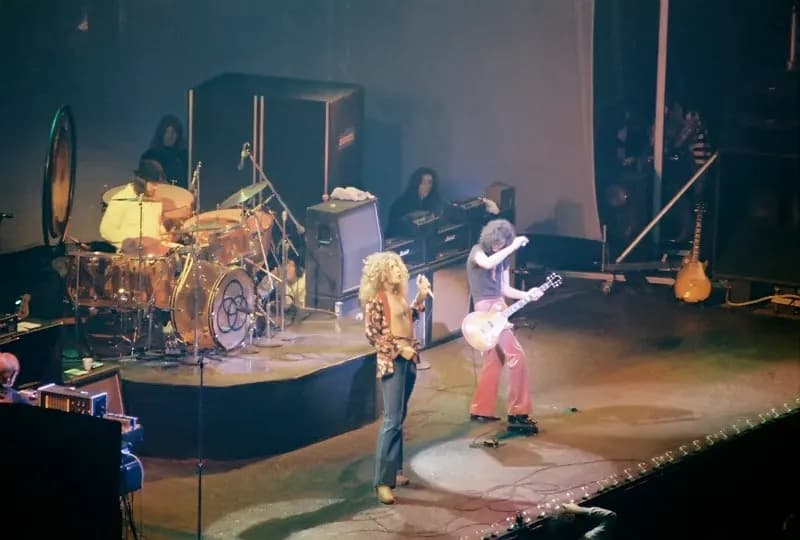
By 1969 the genre had its full shape. Led Zeppelin's first two albums, both released that year, set the template: blues structures, a huge drum sound, a singer working at the top of his range, and riffs that carry whole songs. Deep Purple added Hammond organ and classical-influenced solos on In Rock (1970); Black Sabbath slowed everything down and darkened it, laying the foundations of metal in the process.
The 1970s were the commercial peak. AC/DC cut the style back to rhythm and swing, Aerosmith gave it an American blues-and-R&B accent, Queen and Thin Lizzy added vocal harmony and twin-guitar melody, and Kiss turned it into stage spectacle. Arena rock bands such as Boston, Foreigner and Journey made the sound radio-friendly. In 1978 Van Halen's debut, with the solo piece "Eruption," made two-handed tapping a standard guitar technique.
The 1980s split the field. On one side was the polished, image-driven Sunset Strip scene (Mötley Crüe, Poison) and its pop-metal cousins Bon Jovi and Def Leppard; on the other were rougher records that pushed against it, above all Guns N' Roses' Appetite for Destruction (1987), later certified 18× platinum in the US. Then grunge broke through in 1991 and hard rock spent most of the decade out of fashion.
It never went away. The early-2000s garage-rock revival (The White Stripes, The Hives) and the desert rock of Queens of the Stone Age won critics back, Foo Fighters kept it on radio, and the 2010s produced open revivalists in Greta Van Fleet and Rival Sons. Today it is mostly a classic form, heard constantly in films, adverts and stadiums.
Key Characteristics & Sound
What makes a record read as hard rock:
- Tempo: mostly 110–140 BPM, slow enough to swing and fast enough to drive.
- Riffs: the main building block; people usually remember the guitar figure before the chorus melody.
- Distortion: valve amplifiers pushed into natural saturation, looser than the tight high-gain tone of metal.
- Harmony: power chords (root and fifth) over blues and minor pentatonic scales.
- Rhythm: heavy backbeat, frequent shuffle and swing feel, 4/4 almost throughout.
- Vocals: high, strained and projecting, as with Robert Plant, Ian Gillan, Brian Johnson or Axl Rose.
- Structure: verse-chorus with a dedicated solo section, typically 3–6 minutes.
The neighbours it is most often confused with:
| Trait | Hard Rock | Heavy Metal | Blues Rock | Grunge |
|---|---|---|---|---|
| Tempo | 110–140 BPM | 120–200 BPM | 80–130 BPM | 90–130 BPM |
| Scale material | Blues / minor pentatonic | Modal, chromatic | Blues | Minor, modal |
| Guitar tone | Overdriven valve amp | Tight high gain | Light crunch | Fuzz, muddy |
| Feel | Swung, groove-led | Straight, precise | Loose, shuffled | Loose, dragging |
| Vocals | High and forceful | Powerful or harsh | Blues phrasing | Raw, unpolished |
| Subject matter | Sex, freedom, the road | Darkness, myth, conflict | Love and loss | Alienation, apathy |
Instruments & Production
The gear is nearly as standardised as the songwriting:
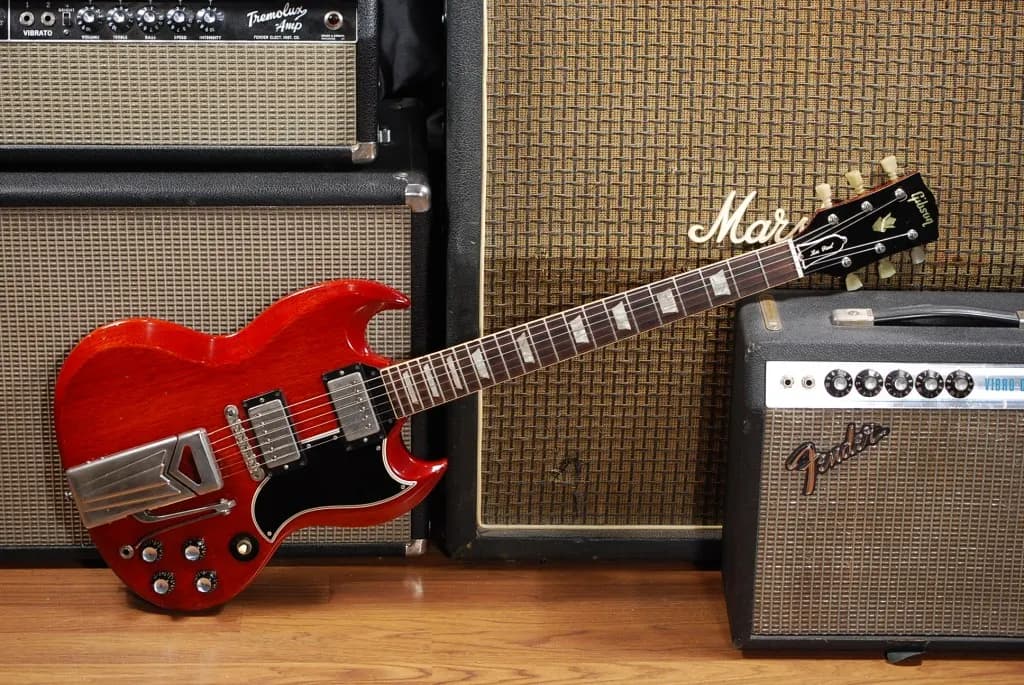
- Guitars: Gibson Les Paul and SG for thickness, Fender Stratocaster and Telecaster for bite.
- Amplifiers: Marshall stacks turned up until the distortion comes from the valves themselves.
- Drums: big kit, big room, tuned low. John Bonham's drums on "When the Levee Breaks" (Led Zeppelin IV) were recorded in the stairwell of Headley Grange and have been sampled many times since.
- Bass: Fender Precision or Rickenbacker, doubling the riff more often than playing counterpoint.
- Hammond organ: a defining colour in Deep Purple, Uriah Heep and Argent.
- Recording: the band tracked live in a room with ambient mics, so the space around the drums becomes part of the sound.
- Effects: wah, phaser and tape delay, used sparingly, since the amp does most of the work.
Production changed with the decade. Seventies records are roomy and dynamic; eighties records are compressed, gated and layered with harmony guitars and reverb; post-2000 revival records often go back to the earlier approach, some of them tracked to tape.
Subgenres & Related Styles
Hard rock is a broad category with well-defined branches:
- Blues rock: the direct ancestor, closer to its source material (Cream, Free, early Zeppelin).
- Arena rock: melodic, chorus-first, built for stadiums (Boston, Foreigner, Journey).
- Glam metal / hair metal: the 1980s image-led branch (Mötley Crüe, Poison, Def Leppard).
- Southern rock: country and boogie inflected (Lynyrd Skynyrd, ZZ Top).
- Stoner and desert rock: downtuned, hypnotic, Sabbath-derived (Kyuss, Queens of the Stone Age).
- Garage rock revival: stripped back to two or three players (The White Stripes, The Hives).
- Nu metal: the late-1990s crossover that swapped blues riffs for downtuned groove and hip-hop rhythm.
- Punk: the reaction against hard rock's excess that later fed back into it.
Notable Artists & Tracks
The core catalogue, roughly chronological:
- Led Zeppelin: "Whole Lotta Love," "Black Dog," "Kashmir."
- Deep Purple: "Highway Star," "Smoke on the Water."
- Black Sabbath: "Paranoid," "War Pigs."
- AC/DC: "Back in Black," "Highway to Hell."
- Aerosmith: "Walk This Way," "Sweet Emotion."
- Queen: "Tie Your Mother Down," "Stone Cold Crazy."
- Van Halen: "Runnin' with the Devil," "Eruption."
- Guns N' Roses: "Welcome to the Jungle," "Sweet Child o' Mine."
- Queens of the Stone Age: "No One Knows," "Go with the Flow."
- Foo Fighters: "Everlong," "Monkey Wrench."
Three tracks to hear the whole arc: "Whole Lotta Love" (1969) for the early form, "Back in Black" (1980) for the stripped-down peak, and "No One Knows" (2002) for a modern version.
How AI Detects Hard Rock
Hard rock is easy to hear and awkward to classify. A model picks up the obvious markers without trouble: broadband guitar distortion, a loud backbeat with a prominent snare, mid-tempo 4/4, and forceful vocals over a dense mid-range. What it cannot do reliably is draw the line between hard rock and metal, because that line is partly historical and cultural.
Expect neighbouring labels such as rock, metal, blues and alternative to appear in the alternatives list with real confidence. That spread is useful: it tells you the track sits in the disputed zone. Try it in the Genre AI music genre detector, and see how AI music genre detection works for why boundary genres behave this way.
Testing this style in Genre AI ourselves, Hard Rock almost always returns Rock as the top label, and the useful detail is one level down. Seventies records with swung drums and a Hammond keep Blues high in the alternatives; eighties records with gated reverb and harmonised leads pull Metal up; downtune the guitar and slow to 90 BPM and it goes to Metal outright; strip the distortion and the reading falls back to plain Rock. In other words, the model hears the amount of gain and the tightness of the rhythm section, which is most of what separates hard rock from its neighbours.