
Post-hardcore is what hardcore punk turned into once its own musicians tired of the format. It kept the volume, the independence and the shout, and added dynamics, dissonant chords, longer and less predictable song structures and, eventually, singing. In the 1980s and 1990s it was an underground tradition run from small labels such as Dischord; in the early 2000s bands working under the same name sold records on major labels and played on MTV.
This guide covers the origins, what defines the sound, how it differs from emo and metalcore, and which records matter. To hear how a track reads to a classifier, run a few seconds through our free AI music genre detector.
What Is Post-Hardcore?
Post-hardcore is hardcore that has stopped obeying hardcore's rules. Songs get longer and stop being uniformly fast. Quiet passages appear and are used to build tension. Guitars trade barre chords for dissonant intervals, harmonics and delay, and the rhythm section is given room to carry the song alone. AllMusic's summary of the early bands is that their singers were as likely to deliver a line in a whispered croon as in a yell.
The vocal is where most listeners recognise the later style. In the 1980s and 1990s the contrast was a shout collapsing into a mutter; in the 2000s it hardened into a formula of screamed verse and sung chorus, used by many of the bands that broke through commercially in those years.
The two eras share a method more than a sound: songs are built around how tension is raised and released, not around a repeating verse and chorus. That is why one label covers bands as different as Fugazi, Refused, Glassjaw and La Dispute.
History & Origins
The first bands later given the name were active in the early 1980s. Hüsker Dü in Minneapolis, the Minutemen in San Pedro, and Naked Raygun and the Effigies in Chicago all took hardcore's speed and DIY economy and pulled it towards post-punk, noise and pop melody.
Washington DC supplied the second wave. In 1985, a period the scene called Revolution Summer, bands including Rites of Spring and Embrace turned away from the violence and macho posturing that hardcore shows had acquired, and slowed down enough to let songs breathe. The same moment is usually credited with founding emo.
Fugazi grew out of that scene. Ian MacKaye, formerly of Minor Threat and Embrace, formed the band in 1986 with bassist Joe Lally; Brendan Canty of Rites of Spring took over the drums in January 1987, and Canty's bandmate Guy Picciotto joined as second guitarist and vocalist. The band became the genre's model in two ways. Musically it offered dub-influenced bass and two guitars playing against each other. Practically it ran on low-priced shows, no merchandise stall and albums released at low prices on Dischord, the label MacKaye co-founded. Repeater (1990), recorded with Don Zientara at Inner Ear Studios, and The Argument (2001) bracket its output.
Other cities pushed in other directions. In Chicago, Big Black made the style abrasive and mechanical, and The Jesus Lizard, formed in Austin by former members of Scratch Acid, later moved there. In San Diego, Drive Like Jehu wrote long, multi-section songs with interlocking guitar lines. In New York, Quicksand, fronted by Walter Schreifels of Youth of Today and Gorilla Biscuits, made it heavy and groove-based. In Sweden, Refused's The Shape of Punk to Come (1998) added electronics, jazz and manifesto-writing; the band split the same year, and the album's reputation grew after the fact.
The commercial turn came from El Paso, Texas. At the Drive-In's Relationship of Command (2000), produced by Ross Robinson, took the band onto MTV, and its break-up in 2001 produced The Mars Volta. Robinson, known for his nu metal records with Korn and Slipknot, also produced Glassjaw's debut that year. In the following years Thursday, Thrice, Glassjaw, Alexisonfire, Underoath, Saosin and The Used reached a mainstream audience, many of them on the screamed-verse, sung-chorus template.
Since the 2010s the field has split again: a heavy, technical wing that borders metalcore, and a literary, dynamics-driven one (La Dispute, Touché Amoré, Pianos Become the Teeth) that is often filed under the same "post-hardcore" and "screamo" labels their predecessors argued about.
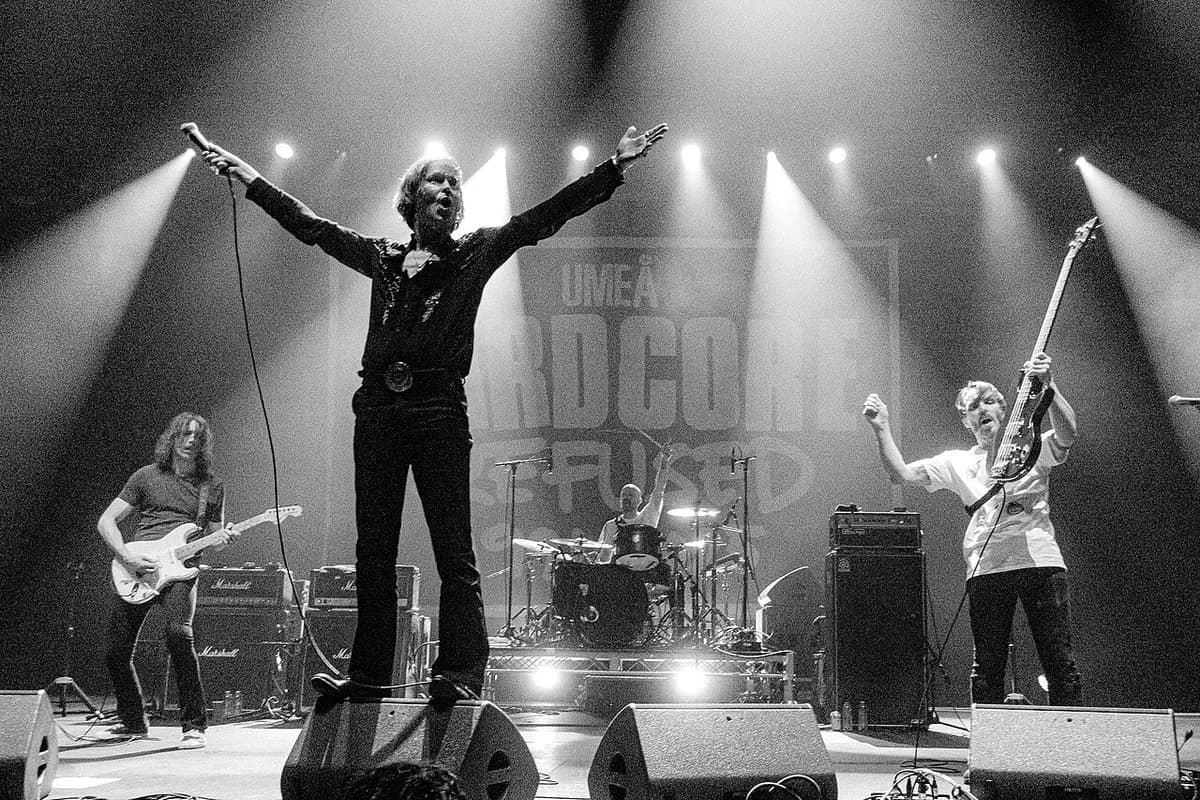
Key Characteristics & Sound
What identifies a post-hardcore track:
- Dynamics as structure: quiet, tense verses set against full-volume sections.
- Dissonant guitar: minor seconds, tritones, harmonics and unresolved chords in place of plain power chords.
- Two guitars in counterpoint, each playing its own part instead of doubling one riff.
- Bass carrying melody, often high in the mix and dub-influenced, an inheritance from post-punk.
- Vocals alternating between screamed and sung, frequently split between two vocalists.
- Tempo: broad, typically 120–180 BPM, with deliberate stops, half-time drops and metre changes.
- Song length: 3–7 minutes, organised around build and release.
- Lyrics: political, literary or confessional.
Where it sits among the styles it is most confused with:
| Trait | Post-Hardcore | Hardcore Punk | Emo | Metalcore |
|---|---|---|---|---|
| Song length | 3–7 min | 0:45–2:00 | 3–4 min | 3–4:30 |
| Vocals | Screamed and sung | Shouted | Sung, emotive | Screamed and sung |
| Guitar | Dissonant, textural | Barre chords | Arpeggiated, melodic | Palm-muted riffs |
| Structure | Build and release | Fast then breakdown | Verse–chorus | Riff–chorus–breakdown |
| Bass role | Melodic, prominent | Root notes | Supporting | Doubling guitar |
| Reference album | Repeater (1990) | Damaged (1981) | Diary (1994) | Jane Doe (2001) |
Instruments & Production
The gear is ordinary rock equipment used against type:
- Mid-gain guitars with delay and chorus: enough distortion for weight, enough clarity for a dissonant interval to be heard as an interval.
- Bass with a bright, aggressive tone, often played with a pick and given melodic lines.
- Drums recorded live and loud, with rim work and dynamics that survive the mix.
- Two vocal sounds on many records: a distorted or heavily compressed one for screams, a cleaner one for sung parts.
- Engineers who belonged to the scene: Steve Albini, who also led Big Black and Shellac; Don Zientara at Inner Ear Studios in Arlington, Virginia, who recorded Fugazi and much of Dischord; and later Ross Robinson, producer of Relationship of Command and Glassjaw's debut.
- Audible rawness: room sound and imperfect takes were often left in, even on major-label records.
Subgenres & Related Styles
The family around it:
- Screamo: usually classed as a branch of emo; faster, more chaotic and more emotionally extreme. San Diego's Heroin and Antioch Arrow started it in the early 1990s; pg.99, Orchid and City of Caterpillar carried it into the 2000s.
- Noise rock: the abrasive neighbour that shares the dissonance and drops the melody.
- Mathcore: odd metres and metal weight on a hardcore frame; The Dillinger Escape Plan, Converge.
- Post-metal: the slow, heavy descendant; Isis, Neurosis.
- Emo: the sibling from the same DC summer, melodic where post-hardcore is dissonant.
- Metalcore: the heavier cousin, driven by riffs and breakdowns.
- Math Rock: the mostly instrumental relative that took the rhythmic ideas and dropped the shouting.
Notable Artists & Albums
Where to start:
- Fugazi: Repeater (1990), The Argument (2001).
- Refused: The Shape of Punk to Come (1998).
- At the Drive-In: Relationship of Command (2000).
- Drive Like Jehu: Yank Crime (1994).
- Quicksand: Slip (1993).
- Glassjaw: Everything You Ever Wanted to Know About Silence (2000).
- Thursday: Full Collapse (2001).
- Thrice: The Artist in the Ambulance (2003), the band's first major-label album.
- La Dispute: Wildlife (2011).
- Touché Amoré: Stage Four (2016).
For a short route through the history: Repeater for the principle, The Shape of Punk to Come for the ambition, Full Collapse for the version that reached a mass audience.
How AI Detects Post-Hardcore
Post-hardcore is difficult for the same reason it is interesting: its defining feature is contrast, and a classifier averaging a few short windows may hear mostly one side of it. A quiet verse of clean guitar and bass sounds like indie rock or alternative; the chorus twenty seconds later, a scream over full-band distortion, sounds like metalcore or punk.
Genre AI has no post-hardcore label of its own. The phrase "post hardcore" is one of the text prompts of the Hard Rock label in the Rock family, alongside "hardcore punk" and "melodic hardcore", so Rock › Hard Rock is the likely answer, with Punk or Indie / Alternative as possible alternatives. The heaviest screamed material may instead put the Metal family on top, where the closest label is Metalcore. Test it in the Genre AI music genre detector: uploading a verse and a chorus separately makes the point better than any description.
Genre AI's production taxonomy has no post-hardcore class. The words "post hardcore" belong to the text prompts of Hard Rock, a fine label under Rock, so a typical track is likely to come back as Rock › Hard Rock, with sibling Rock labels such as Punk or Indie / Alternative shown as alternatives when they score close. A quiet, clean section may lean towards Indie Rock territory, that is, Indie / Alternative. When distorted screaming and palm-muted riffs dominate, the Metal family can outscore Rock, and then the answer is likely Metalcore; in that case the alternatives come only from other Metal labels, never from Rock. The result depends on which family wins first, so the same song can be filed differently depending on which part you upload.