EBM (electronic body music) is the dancefloor branch of the industrial family: a relentless, sequenced synthesizer bassline, a hard drum-machine beat, and shouted or barked vocals, made in Belgium and West Germany in the early 1980s and built to make bodies move. Front 242, DAF and Nitzer Ebb are its reference acts.
This guide covers where the term came from, how the sound was built, the scenes and offshoots it spawned, the key records, and how EBM differs from industrial and synth-pop. To see how a classifier reads a sequenced bassline, play a few seconds into our free AI music genre detector.
What Is EBM?
EBM is minimal, physical electronic music. Its core is a single repeating synthesizer bass pattern, usually a stream of 16th notes from a monophonic analogue synth driven by a sequencer, locked to a straight, punchy drum-machine beat. Over that, a vocalist delivers short slogans and commands instead of melodic verses. Chords are scarce, melodies are short, and arrangements grow by adding and removing layers, with no verse-chorus development.
The aesthetic is deliberately hard. Synth-pop used the same machines to make songs; EBM used them to make rhythm. The lyrics favour discipline, work, the body, power and politics, often delivered in a militaristic tone. Bands presented this as provocation and commentary, not endorsement, and critics and fans have argued about where that line sits from the start: the fascist imagery of DAF's "Der Mussolini" caused controversy as soon as it came out.
It is also a bridge. EBM took the mechanical sound of the original industrial avant-garde and turned it into club music, and in doing so it fed directly into techno, new beat and much of the dark electronic scene that followed.
History & Origins
The phrase "electronic body music" goes back to Ralf Hütter of Kraftwerk, who used it in a November 1977 interview with the British paper Sounds and again in 1978 to describe the more physical direction of The Man-Machine. It became a genre name in 1984, when Belgium's Front 242 used it to describe the sound of their second album, No Comment; as Daniel B. of the band later put it, the term had been around for a few years before they co-opted it.
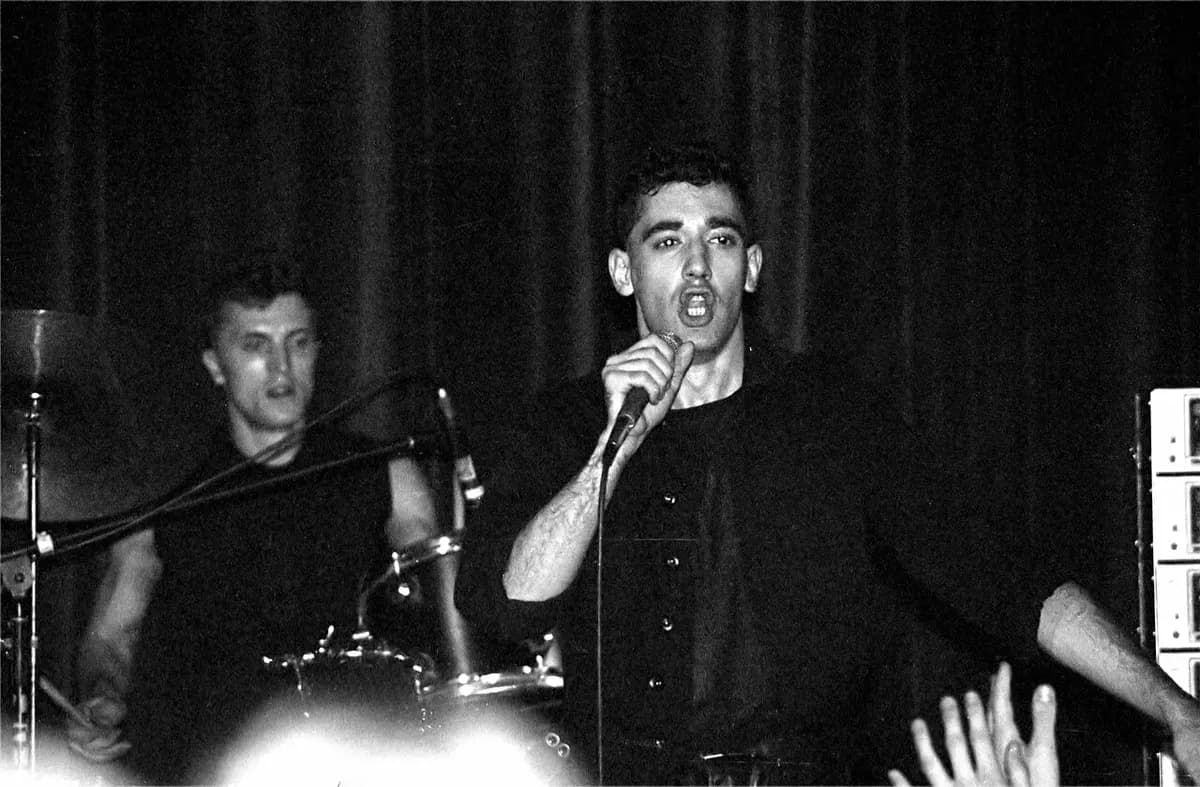
The musical template was assembled between about 1980 and 1984. In Düsseldorf, DAF (Deutsch Amerikanische Freundschaft) reduced their line-up to a duo, Gabi Delgado on vocals and Robert Görl on synthesizer and drums, and made records such as "Der Mussolini" (1981) out of little more than a sequenced bassline, live drums and chanted German lyrics. DAF themselves called it "Körpermusik", body music. Liaisons Dangereuses' "Los Niños del Parque" (1981) and Die Krupps' "Wahre Arbeit, wahrer Lohn", from their 1981 debut EP, pushed the same idea. In Belgium, Front 242 refined it into a cleaner, more percussive form on No Comment (1984), and later on "Headhunter" (1988), the genre's most widely known track.
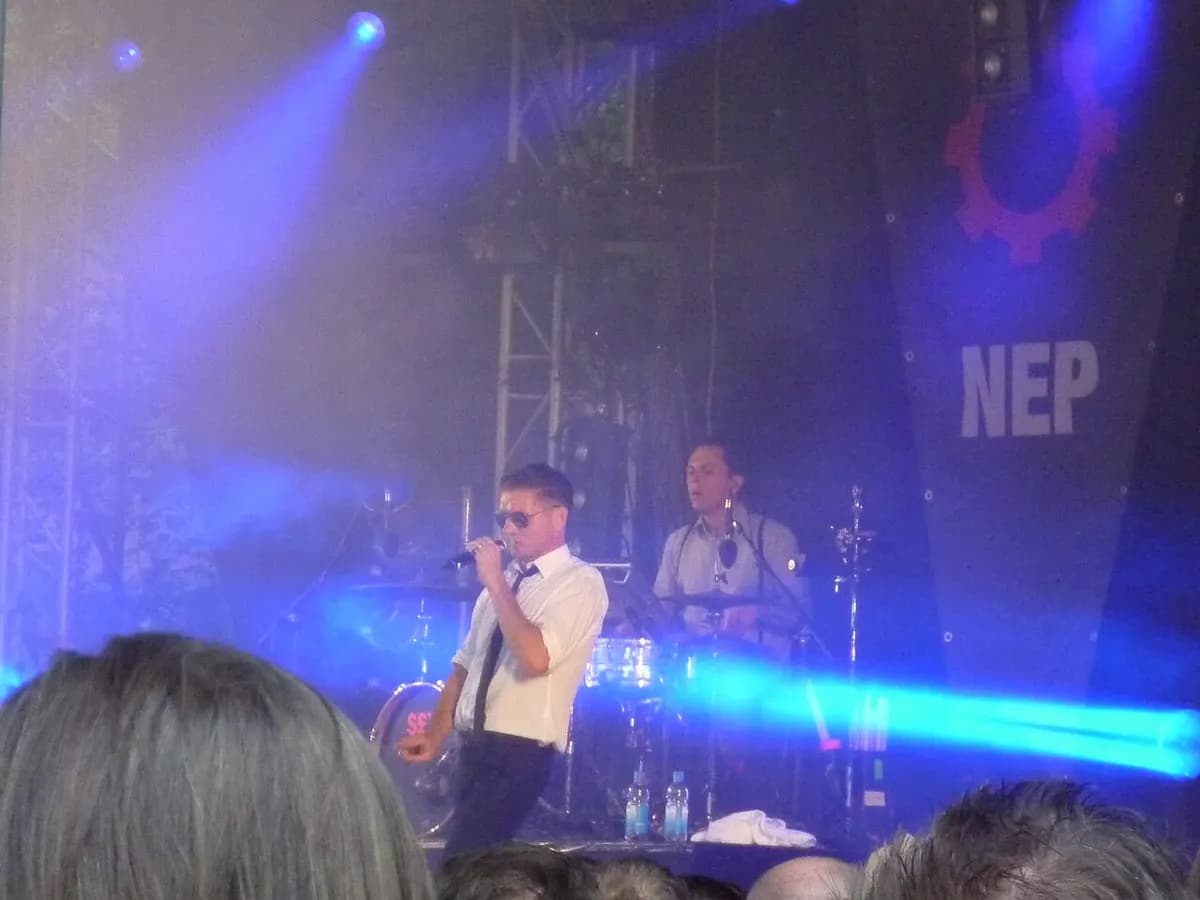
In Britain, Nitzer Ebb, formed by school friends in Essex in 1982, took the DAF model and made it harsher and more athletic. "Join in the Chant" (1987) became a club staple and their first US chart single, reaching No. 9 on Billboard's dance chart. Belgian labels, notably Play It Again Sam, and acts such as The Neon Judgement and A Split-Second made Belgium the genre's centre of gravity.
In 1987 Belgian DJs began playing EBM records slowed down, and a short-lived but influential club sound called new beat grew out of it. The usual story has a DJ playing A Split-Second's 45 rpm single "Flesh" at 33 rpm with the pitch raised by 8%; accounts disagree on whether it was Dikke Ronny or Marc Grouls, and in which Antwerp-area club. Through the 1990s, EBM's descendants multiplied: harsher electro-industrial from Canada (Skinny Puppy, Front Line Assembly), then aggrotech and the more melodic futurepop of VNV Nation and Covenant. From the late 2000s an "old-school EBM" revival, especially in Sweden with acts like Spetsnaz and Pouppée Fabrikk, returned to the minimal 1980s template, and a strand of the techno scene began absorbing EBM basslines and vocals directly.
Key Characteristics & Sound
What identifies EBM:
- Tempo: roughly 115–135 BPM, a dance tempo close to house and techno.
- The bassline: a sequenced, repeating 16th-note (or 8th-note) pattern on a monophonic analogue synth, the genre's defining element.
- Drums: straight, hard, machine-precise; snares and claps on two and four, often heavily gated.
- Vocals: shouted, barked or chanted; short repeated phrases in place of sung melodies, in English or German.
- Harmony: minimal, often a single key centre for the whole track, with few or no chord changes.
- Sound design: metallic percussion, samples of machinery or speech, short synth stabs.
- Structure: layer-based and repetitive, built for DJ mixing and dancing.
- Imagery: uniforms, discipline and physicality, a stark visual identity that matched the sound.
EBM against its two nearest relatives:
| Trait | EBM | Industrial (original) | Synth-Pop |
|---|---|---|---|
| Era of origin | c. 1980–1984 | 1976 onward | c. 1978–1985 |
| Main centres | Belgium, West Germany | UK (Throbbing Gristle), Germany | UK, Germany |
| Goal | Dance, physical impact | Confrontation, experiment | Songs, melody, chart pop |
| Typical tempo | 115–135 BPM | Often no steady tempo | 100–130 BPM |
| Bass | Sequenced, relentless 16ths | Noise, drones, tape loops | Melodic synth bass |
| Vocals | Shouted commands | Processed, spoken, screamed | Sung, hook-driven |
| Reference record | "Headhunter" (1988) | 20 Jazz Funk Greats (1979) | "Don't You Want Me" (1981) |
Instruments & Production
EBM was built from the early-1980s electronic studio:
- Monophonic analogue synthesizers: the source of the bass; their filters are swept to give the repeating pattern movement.
- Step sequencers: hardware sequencers, and later MIDI, that hold the bass pattern with machine accuracy.
- Drum machines and sampled drums: punchy, dry kicks and big snares. DAF also used a live drummer playing to the sequencer.
- Samplers: from the mid-1980s, for metallic hits, speech and orchestral stabs.
- Distortion and effects on vocals: megaphone-like filtering, delay and doubled shouts.
The production logic is subtraction. The bass occupies the low and mid range continuously, so everything else must be short and percussive to stay out of its way. That is why EBM sounds so spare even when it is loud, and why its basslines transfer so easily into techno, which is built on the same principle.
Offshoots & Related Styles
- Electro-industrial: denser, noisier and more sample-heavy. Skinny Puppy, Front Line Assembly.
- New beat: late-1980s Belgian club music born partly from EBM records played at slower speeds.
- Aggrotech: a 1990s and 2000s descendant with distorted vocals and harsher synths.
- Futurepop: melodic, trance-influenced EBM of the late 1990s. VNV Nation, Covenant.
- Old-school EBM revival: a return to the minimal 1980s template, strong in Sweden and Germany.
- EBM-techno crossover: modern club producers using EBM basslines and vocals at techno tempos, a strand that overlaps with hard techno's industrial wing.
- Industrial rock: the guitar-based North American branch of the same family, which shares the machine rhythm but not the dancefloor focus.
EBM also shares clubs and audiences with gothic rock and post-punk, and the three often turn up together on the same dark-scene playlists.
Notable Artists & Records
A starting list:
- DAF: "Der Mussolini" (1981), from Alles ist gut.
- Liaisons Dangereuses: "Los Niños del Parque" (1981).
- Die Krupps: "Wahre Arbeit, wahrer Lohn" (1981), later remade with Nitzer Ebb as "The Machineries of Joy" (1989).
- Front 242: "Headhunter" (1988) and its B-side "Welcome to Paradise".
- Nitzer Ebb: "Join in the Chant" (1987), "Let Your Body Learn".
- The Neon Judgement and A Split-Second: Belgian scene mainstays.
- Skinny Puppy: the electro-industrial turn.
- Front Line Assembly: Canadian electro-industrial.
- VNV Nation and Covenant: futurepop.
- Spetsnaz: Swedish old-school revival.
For the arc in three records: "Der Mussolini" for the invention, "Headhunter" for the definitive form, and "Join in the Chant" for the harder British version that the techno world later rediscovered.
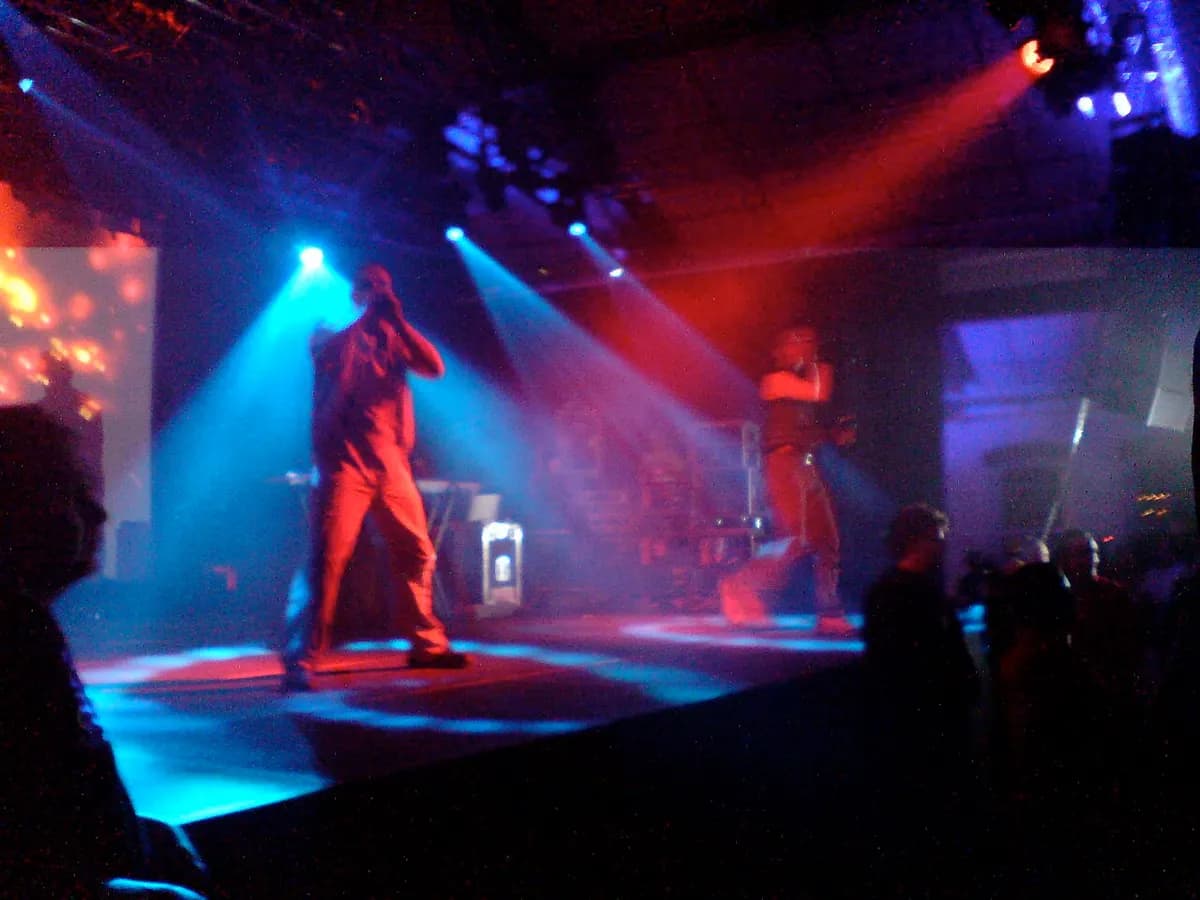
EBM vs Industrial vs Synth-Pop
Against industrial: the original industrial music of Throbbing Gristle and Cabaret Voltaire was experimental and often had no steady beat at all; it was made to confront, not to dance to. EBM kept industrial's harsh textures and attitude but added a fixed tempo, a sequenced bassline and a four-square drum pattern. "Industrial" is now often used as an umbrella that includes EBM, so the cleanest rule is functional: if it is built to dance to, with a sequenced bass at the centre, it is EBM.
Against synth-pop: the two use the same machines and emerged in the same years, but they point in opposite directions. Synth-pop writes songs, with verses, choruses, melodic hooks and sung vocals designed for radio. EBM writes rhythm: one bass pattern, minimal harmony, shouted phrases designed for the floor. Depeche Mode's harder late-1980s records sit near the border, which is part of why the two audiences overlapped.
Against techno: EBM was one of techno's European ingredients, and the two share tempo and machine logic. The difference is the voice and the bass: EBM keeps a frontman and a melodic bass sequence, while techno generally drops vocals and puts the kick at the centre.
Genre AI's production taxonomy has no EBM label, and no separate industrial label either. A track with a dominant sequenced bass, straight drum machines and shouted vocals is most likely to be placed in the Electronic Dance family (the electronic umbrella), where the fine answer will probably be Electro or Techno. If the vocal turns melodic and a chorus appears, the answer is likely to move to Synth Pop, another Electronic Dance subgenre; strip the vocal and raise the tempo and it may settle on Techno or Minimal. Alternatives, when shown, come from the same Electronic Dance list. Guitar-heavy industrial tracks are a different case and may be pulled into Metal or Rock. The 16th-note sequenced bass is a strong, regular pattern a model can latch onto, but synth-pop and techno share it, so the vocal style is likely to do most of the work of telling the three apart.